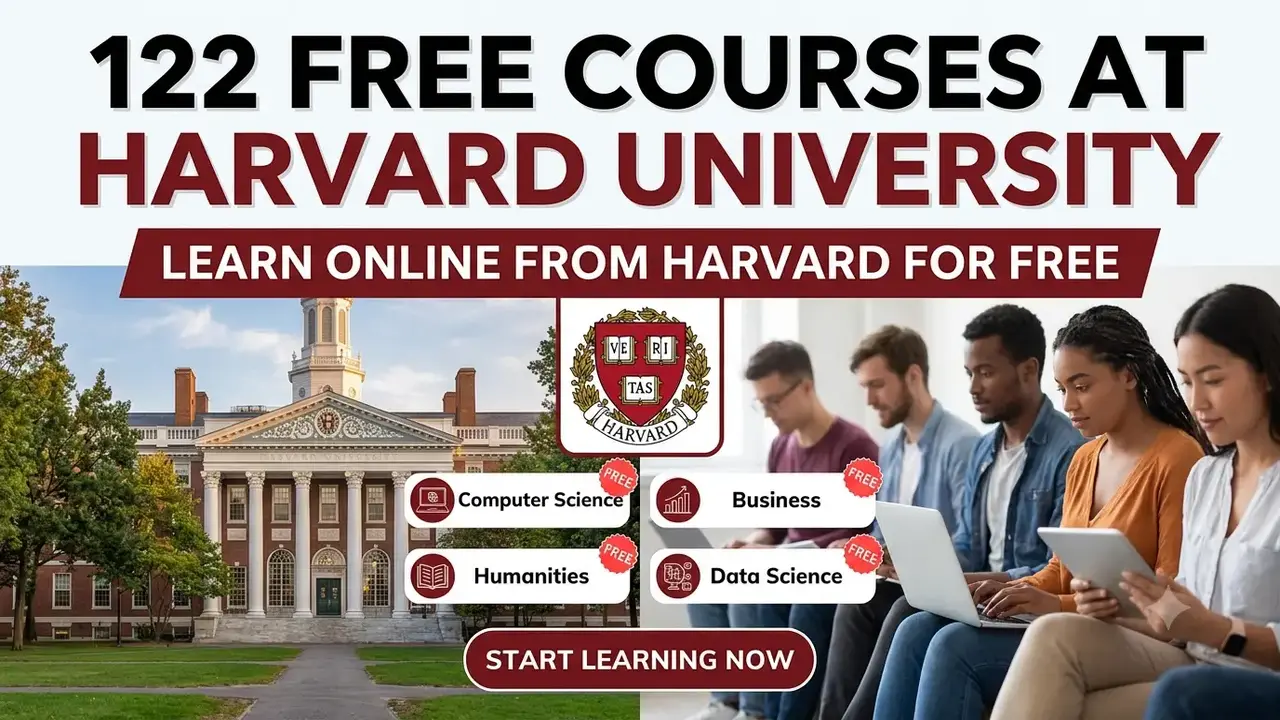
122 Free Courses at Harvard University: Learn Online from Harvard for Free
Harvard University is offering access to 122 free courses through its official Professional and Lifelong Learning catalog. These courses cover high-demand subjects such as computer science, artificial intelligence, data science, business, public health, humanities, programming, mathematics, social sciences and education.
Whether you are a university student, working professional, researcher, entrepreneur or lifelong learner, the free courses at Harvard University provide an opportunity to develop valuable skills while learning from one of the world’s most respected academic institutions.
Most courses can be accessed online, allowing international learners to study from home and progress at their own pace. Enrollment is completed through Harvard’s official course catalog, although some courses are delivered through learning platforms such as edX.
Official course catalog: Explore 122 free courses at Harvard University
Course availability and the number of free offerings may change as Harvard adds, updates or removes programs. Always review the individual course page for current dates, fees, certificate options and enrollment instructions.
Check: Erasmus Mundus Scholarship 2026 in Europe | Fully Funded
About Harvard University
Founded in 1636, Harvard University is the oldest higher-education institution in the United States. Located in Cambridge, Massachusetts, Harvard is internationally recognized for excellence in research, teaching and innovation.
The university includes several renowned schools and academic units, including:
- Harvard Business School
- Harvard Medical School
- Harvard T.H. Chan School of Public Health
- Harvard Law School
- Harvard Graduate School of Education
- Harvard Kennedy School
- Harvard John A. Paulson School of Engineering and Applied Sciences
- Harvard Faculty of Arts and Sciences
Harvard’s online learning initiatives make selected courses and educational resources accessible to learners beyond its physical campus. The free catalog allows people worldwide to study topics taught or developed by Harvard faculty without enrolling in a traditional degree program.
Are Harvard’s Free Courses Really Free?
Many courses in Harvard’s catalog can be studied at no cost through a free or audit track. This commonly provides access to course videos, readings and selected learning activities.
However, “free” does not always mean that every feature is included. Depending on the course and delivery platform, learners may need to pay for:
- A verified certificate
- Graded assignments or examinations
- Extended access to course materials
- Identity verification
- Additional learning resources
- Professional or academic credit
Some courses may provide all learning materials free while charging only for an optional certificate. Other courses may use different participation arrangements. Applicants should check the Price, Platform, Duration and Certificate sections on the individual course page before enrolling.
Harvard’s free online courses generally do not provide automatic admission to the university, Harvard student status or academic credit toward a Harvard degree.
Main Subjects Available
The 122 free Harvard courses span a broad selection of academic and professional disciplines. The exact list changes, but learners can commonly find opportunities in the following areas.
Computer Science and Programming
Harvard is widely known for its CS50 course series. These programs introduce learners to computer science, programming and software development through lectures, exercises and practical projects.
Topics may include:
- Introduction to computer science
- Python programming
- Web development
- Artificial intelligence
- Cybersecurity
- Game development
- Computer science for business professionals
- Database concepts and SQL
- Mobile application development
These courses may be valuable for complete beginners, university students and professionals moving into technology careers.
Artificial Intelligence and Machine Learning
Artificial intelligence is transforming healthcare, finance, education, engineering and business. Harvard’s free learning catalog may include courses that introduce AI concepts and their practical implementation.
Learners can explore areas such as:
- Machine learning algorithms
- Neural networks
- Natural language processing
- Search and optimization
- Classification
- Reinforcement learning
- Responsible use of AI
- AI applications with Python
Some advanced courses require previous programming experience, particularly in Python. Check the prerequisites before enrolling.
Data Science and Statistics
Harvard’s data science courses can help learners build skills in statistical reasoning, visualization and data-driven decision-making.
Common topics include:
- R programming
- Data visualization
- Probability
- Statistical inference
- Linear regression
- Machine learning
- Data-wrangling tools
- Research productivity
- Data science capstone projects
These courses can benefit aspiring data analysts, researchers, health professionals, business specialists and students preparing for advanced study.
Business and Management
Free Harvard courses may also cover business strategy, leadership, entrepreneurship and organizational decision-making.
Depending on current availability, learners may find courses related to:
- Entrepreneurship
- Leadership
- Business analytics
- Financial decision-making
- Contract law
- Strategy
- Innovation
- Negotiation
- Technology management
These courses do not replace an MBA or another formal business qualification, but they can provide valuable introductory or professional-development knowledge.
Health, Medicine and Public Health
Harvard University’s medical and public-health schools contribute to educational initiatives covering important global health issues.
Available subjects may include:
- Epidemiology
- Global health
- Climate change and health
- Nutrition
- Health policy
- Disease prevention
- Clinical research
- Human anatomy
- Mental health
- Health-data analysis
Healthcare courses can have specific intended audiences. Some are designed for the general public, while others may require a background in medicine, biology or public health.
Completing an online course does not grant a medical license or professional authorization.
Humanities and Social Sciences
Harvard’s free catalog is not limited to science and technology. Learners can also study history, literature, religion, politics, ethics and culture.
Subjects may include:
- Moral and political philosophy
- World literature
- Religious studies
- Ancient history
- American government
- Shakespeare
- Digital humanities
- China and global history
- Architectural history
- Cultural studies
These courses provide an accessible way to explore major ideas, historical developments and social questions through university-level teaching.
Mathematics
Free mathematics courses can support students preparing for university study or professionals who need stronger quantitative skills.
Topics may cover:
- Calculus
- Probability
- Algebra
- Mathematical modelling
- Statistics
- Quantitative methods
- Applied mathematics
Prerequisites differ considerably. Introductory courses may accept beginners, while advanced programs can require previous university-level mathematics.
Education and Teaching
Teachers, education leaders and parents may find free courses focused on learning, schools and child development.
Possible themes include:
- Family engagement in education
- Higher-education teaching
- Learning design
- Educational leadership
- Early childhood development
- Assessment
- Online instruction
These courses can support professional development, but participants should confirm whether a course is recognized for continuing-education requirements in their country or profession.
Popular Harvard Courses to Look For
The exact 122-course selection can change, but several Harvard programs are widely recognized by online learners. Search the official catalog to check whether the following courses are currently accepting enrollments.
CS50’s Introduction to Computer Science
CS50 is one of Harvard’s best-known courses. It introduces the intellectual foundations of computer science and teaches learners how to solve problems using programming.
The course may cover C, Python, SQL, HTML, CSS and JavaScript. It is designed for learners with or without previous programming experience, although the problem sets can be demanding.
CS50’s Introduction to Programming with Python
This course focuses specifically on Python, one of the most widely used programming languages in data science, artificial intelligence, web development and automation.
Learners may study functions, variables, conditionals, loops, exceptions, libraries, regular expressions, object-oriented programming and file handling.
CS50’s Web Programming with Python and JavaScript
This program is intended for students who want to move beyond introductory programming and develop database-driven web applications. It commonly covers Python, JavaScript, Django, SQL and modern web-development practices.
Previous programming experience may be required.
CS50’s Introduction to Artificial Intelligence with Python
This course explores fundamental concepts and algorithms used in modern artificial intelligence. Topics may include graph search, knowledge representation, optimization, machine learning and natural language processing.
Applicants should check the prerequisites because the program is generally more suitable for learners who already understand Python.
Data Science: R Basics
This introductory course teaches the foundations of R, a programming language frequently used in statistics, public health, biology and academic research.
It can be a useful starting point for learners planning to complete additional courses in Harvard’s data science series.
Justice
Harvard’s Justice course examines philosophical and ethical questions involving rights, equality, morality and public life. It is based on the influential teaching of political philosopher Michael Sandel and is accessible to learners from many academic backgrounds.
Availability may vary, so confirm its current status through the official catalog.
Who Can Enroll?
Harvard’s free online courses are generally open to learners worldwide. Most do not require applicants to be admitted to Harvard University.
Potential participants include:
- High school and university students
- Recent graduates
- Working professionals
- Teachers and researchers
- Entrepreneurs
- Career changers
- Retired learners
- International students
- Anyone interested in lifelong learning
Age restrictions, prerequisites and geographic limitations may apply to individual courses. Learners should read the complete course description before registering.
How to Enroll in Harvard’s Free Courses
The enrollment process is straightforward.
Step 1: Open the Official Harvard Catalog
Visit the official page:
Harvard University Free Course Catalog
The free-price filter should already be applied.
Step 2: Browse or Filter the Courses
Use the available filters to narrow the results according to:
- Subject area
- Difficulty level
- Duration
- Start date
- School
- Learning format
- Price
You can also search by course name or keyword.
Step 3: Open the Course Page
Select a course to review its full information, including:
- Course description
- Instructor or teaching team
- Subject area
- Difficulty level
- Duration
- Time commitment
- Start and end dates
- Delivery platform
- Certificate information
- Prerequisites
Do not rely only on the word “Free.” Confirm what the free learning option includes.
Step 4: Select “Enroll” or “Learn More”
The course page will direct you to the appropriate registration platform. Some programs are hosted directly through a Harvard unit, while many online courses are delivered through edX.
Step 5: Create an Account
Register using your name and email address. If the course is available through edX, you may need to create an edX account.
Step 6: Choose the Free Access Option
Where offered, select the audit, free or course access track rather than the verified-certificate track.
Read the options carefully. The paid track may be selected by default on some registration pages.
Step 7: Start Learning
After enrolling, review the syllabus and create a realistic study plan. Note any deadlines for assignments, examinations or free-access periods.
Can You Get a Free Harvard Certificate?
Not necessarily. In many cases, the course content is free, but the verified certificate requires payment.
A verified certificate can be useful for demonstrating course completion on a CV, LinkedIn profile or professional portfolio. However, it is not equivalent to a Harvard degree, university transcript or professional license.
Some learning platforms may offer financial assistance for eligible participants. Availability, eligibility requirements and funding levels are determined by the course provider. Check the course registration page for current information.
If you do not purchase a certificate, you can still mention the training appropriately on your CV—for example, under a “Professional Development” or “Online Learning” section—but you should not claim a qualification that was not awarded.
Benefits of Taking a Free Harvard Course
Learn from a Globally Recognized University
Participants can access university-level content developed by Harvard faculty and academic units without relocating to the United States.
Study from Anywhere
Online delivery enables learners to participate from almost any country with a stable internet connection.
Explore a Subject Before Paying for a Degree
A free course can help you determine whether fields such as programming, public health, data science or philosophy match your interests and career goals.
Build Practical Skills
Courses in Python, R, statistics, AI and web development can provide practical skills that learners can demonstrate through projects and portfolios.
Improve Your Academic Preparation
University-level courses can help prospective students strengthen their knowledge before applying for bachelor’s, master’s or doctoral study.
Learn at Your Own Pace
Many courses are self-paced or provide flexible schedules. Nevertheless, participants should verify whether their selected course has fixed deadlines.
Important Points to Remember
Before enrolling, keep the following points in mind:
- Free course access may not include a certificate.
- Course availability and the total number of offerings can change.
- Some courses have fixed enrollment or access periods.
- Advanced courses may have academic or technical prerequisites.
- Completing a course does not make you a Harvard student or alumnus.
- Free courses generally do not provide Harvard degree credit.
- Always register through Harvard’s official website or the platform linked from it.
- Never pay an unofficial agent to enroll you in a free Harvard course.
Frequently Asked Questions
Are all 122 Harvard courses completely free?
The catalog lists courses with a free participation option. However, some features—particularly verified certificates and graded assessments—may require payment. Review each course page for exact terms.
Can international students enroll?
Most free online courses are available internationally. Individual restrictions may apply, depending on the course or platform.
Do I need an IELTS or TOEFL score?
Most open online courses do not require an English-language test. Learners need sufficient English proficiency to understand lectures, readings and assessments.
Are there admission requirements?
Many introductory courses have no formal admission process. Advanced courses may recommend or require previous knowledge in programming, mathematics, science or another subject.
Will I receive academic credit?
Usually not. Open online courses generally do not provide academic credit toward a Harvard degree unless the individual course page explicitly states otherwise.
Can a certificate help with employment?
A certificate can demonstrate initiative and subject knowledge, but its value depends on the employer and role. Practical projects, relevant experience and formal qualifications remain important.
Start Learning with Harvard University
The 122 free courses at Harvard University make high-quality learning more accessible to students and professionals around the world. With subjects ranging from artificial intelligence and computer science to health, business and the humanities, the catalog offers options for nearly every type of learner.
Browse the official course descriptions, compare the time commitments and prerequisites, and select a program aligned with your academic or professional goals.
Official Enrollment Link
Explore and enroll in free Harvard University courses
Course numbers, prices, enrollment dates and certificate arrangements can change. Harvard University’s individual course pages are the authoritative source for current information.