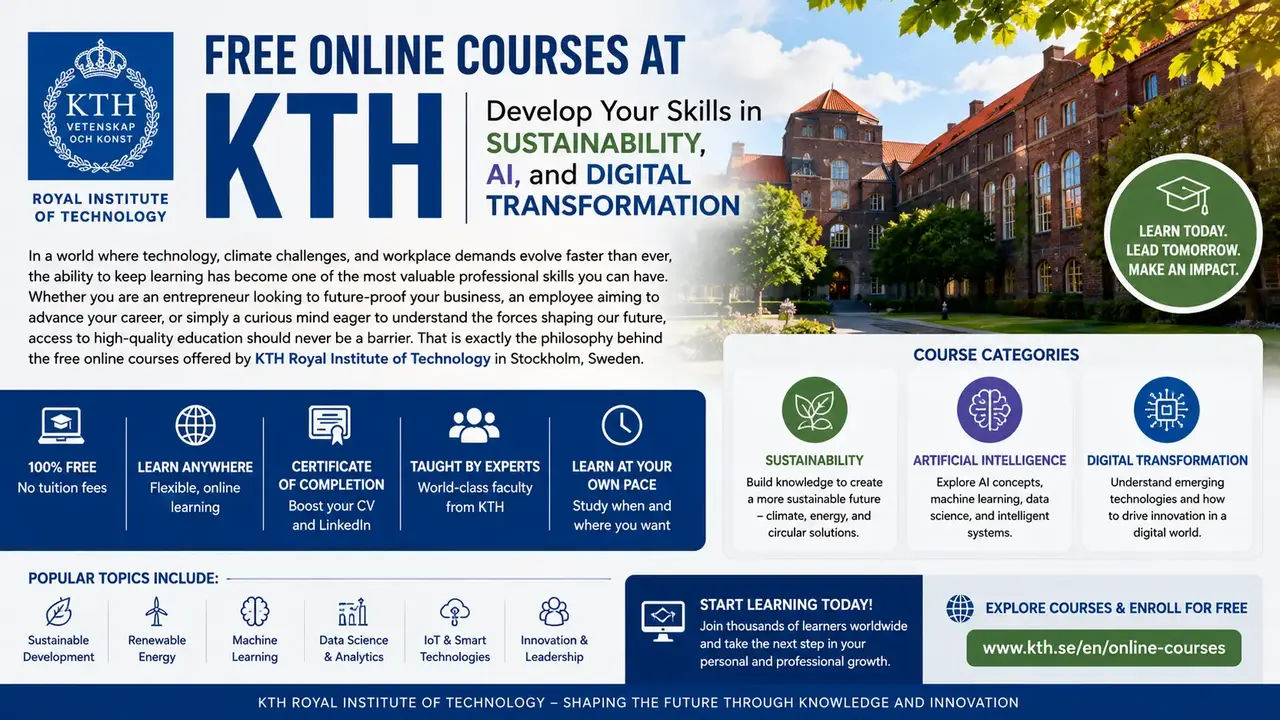
Free Online Courses at KTH
In a world that is changing faster than ever, the most valuable currency isn’t just money—it’s knowledge. The twin engines of the 21st-century economy—sustainability and digital transformation—are reshaping every industry. Meanwhile, Artificial Intelligence (AI) and Machine Learning are no longer just buzzwords in Silicon Valley; they are tools being deployed in warehouses, hospitals, energy grids, and retail stores across the globe.
For professionals, entrepreneurs, and lifelong learners, the question is no longer if they need to upskill, but how. The answer, however, often comes with barriers: high tuition fees, rigid schedules, and intimidating prerequisites.
KTH Royal Institute of Technology – Sweden’s leading technical university – is tearing down those barriers. They offer a suite of Massive Open Online Courses (MOOCs) that are completely free, self-paced, and designed for anyone with a curious mind. Whether you are a business leader looking to integrate climate risk assessment into your strategy, a logistics manager curious about electromobility, or a developer wanting to look “under the hood” of Machine Learning, KTH has a course for you.
This article explores the profound value of these courses, detailing how you can leverage them to drive business growth, enhance your career, and contribute to a more sustainable future.
Check: Scholarships in New Zealand Without IELTS 2026 | Fully Funded
The KTH Advantage: Why Free Doesn’t Mean Cheap
When you hear “free online course,” you might imagine a low-quality, pre-recorded lecture from the early 2000s. KTH flips that script. As one of Europe’s most prestigious technical universities, KTH brings academic rigor and real-world research to every MOOC.
1. World-Class Instruction, Zero Cost
These courses are not watered-down introductions. They are developed by leading researchers and professors who are actively shaping the fields of energy systems, work environment engineering, and AI. You are getting the same intellectual framework that is taught to Master’s students on campus, but distilled into accessible, focused modules.
2. Flexibility for the Modern Professional
One of the greatest barriers to professional development is time. KTH’s MOOCs are designed to be completed in just a few hours—not weeks. You can watch a module during your lunch break, pause a lecture to take notes, and resume on your commute home. There are no deadlines, no fixed start dates, and no pressure. You start when you want and finish at your own pace.
3. No Prerequisites Required
Imposter syndrome often stops us from learning. Many people think, “I don’t have a background in engineering, so I can’t learn about batteries or climate adaptation.” KTH has designed these courses to be accessible. You don’t need a degree or prior knowledge. They are built for beginners who are eager to understand complex systems.
4. Tangible Business Application
This is not just theoretical learning. Each course is designed to help you make decisions. If you are a manager, the risk assessment courses (RAMP) give you a tool to protect your workforce. If you are a strategist, the Sustainability courses help you understand frameworks like the UN Sustainable Development Goals (SDGs). If you are a product lead, “Learning Electromobility” helps you understand the market shift toward electric vehicles.
Deep Dive into the Course Catalog
Below is the complete list of free KTH online courses, with direct links. You can enroll immediately at no cost.
The Sustainability & Climate Track
| Course Name | Official Link | Duration (approx.) |
|---|---|---|
| Introduction to Systems Thinking for Sustainable Transition | Enroll on edX | 2 hours |
| Introduction to Sustainable Development | Enroll on edX | 4 hours |
| Enforcing Sustainable Development | Enroll on edX | 4 hours |
| Managing Climate Risks: The Basics of Climate Adaptation | Enroll on edX | 2 hours |
Why take these?
Sustainability is a competitive necessity. “Systems Thinking” teaches you to see your company as an interconnected system, finding leverage points for real change. “Climate Risks” is essential for real estate, insurance, and supply chain professionals.
The Electromobility & Energy Track
| Course Name | Official Link | Duration (approx.) |
|---|---|---|
| Learning Electromobility | Enroll on edX | 4 hours |
| Introduction to Batteries in the Power Grid | Enroll on edX | 2 hours |
Why take these?
If you manage a fleet, work in utilities, or are planning a transition to electric vehicles, these courses give you the technical and economic foundations you need to make smart investments.
The Occupational Health & Safety Track (RAMP Series)
| Course Name | Official Link | Duration (approx.) |
|---|---|---|
| Assessment of Work-Related Injury Risks using RAMP I | Enroll on edX | 4 hours |
| Risk Management of Work-Related Injuries using RAMP II | Enroll on edX | 4 hours |
| Proficiency in using RAMP for Risk Management of Work-Related Injuries | Enroll on edX | 6 hours |
Why take these?
These three courses form a certified pathway in ergonomics. They are recognized by industry and can help you reduce workplace injuries, lower insurance costs, and improve employee wellbeing.
The AI & Digital Transformation Track
| Course Name | Official Link | Duration (approx.) |
|---|---|---|
| Under the Hood of Machine Learning | Enroll on edX | 4 hours |
Why take this?
This course demystifies AI. It is designed for non-technical managers, product owners, and business analysts. You will learn the vocabulary to speak to data scientists and the critical thinking to separate hype from real value.
How to Leverage These Courses for Business Development
Taking a course is one thing; using it to develop your business is another. Here is a strategic approach:
1. Build a “Sustainability Competency” on Your Team
Assign a specific employee to take the “Systems Thinking” and “Climate Risks” courses. Have them present a 15-minute summary to the leadership team. This creates an internal champion who can spot climate-related opportunities and threats that others miss.
2. Use the RAMP Series for Internal Training
Instead of hiring expensive external consultants for ergonomics, have your safety officer take the full RAMP series. They can then lead internal workshops. This saves money and builds internal expertise that stays with the company.
3. Validate Your Tech Strategy
If your company is considering investing in electric fleet vehicles or battery storage, have the relevant decision-maker take the “Electromobility” and “Batteries in the Grid” courses first. The $0 cost of the course is a low-risk way to validate a multi-million dollar investment decision.
4. Bridge the Gap Between Business and Tech
AI projects often fail due to poor communication between the business side and the engineering side. Have your product managers take “Under the Hood of Machine Learning.” They will learn to ask better questions of your data team, leading to more successful project outcomes.
Why You Should Enroll Today
The window of opportunity for upskilling is closing, not opening. The cost of ignorance is high. If you fail to understand sustainability, you will be caught off guard by new regulations. If you ignore AI, your competitors will outperform you. If you neglect occupational safety, you will lose your best talent to injury and burnout.
KTH offers a lifeline. These courses are a low-stakes, high-reward way to keep your finger on the pulse of global change. You are not just learning; you are investing in your cognitive adaptability.
So, take the plunge. Visit the KTH MOOC portal to browse all courses:
👉 KTH Online Courses – Official Portal
Pick one course that scares you a little (or one that promises the most immediate value for your job). Sign up today. Your future self—and your business—will thank you.
Frequently Asked Questions (FAQs)
1. Are these courses really completely free, with no hidden fees?
Yes. KTH’s MOOCs are 100% free. You do not need a credit card. Simply register with an email address on the KTH MOOC page or directly on edX. If you want a verified certificate (e.g., for LinkedIn), edX charges a small fee (typically $50–$99), but the learning content itself remains free.
2. How long does it take to finish a course?
Most courses take between 2 and 6 hours total. They are self-paced, so you can finish in one afternoon or spread the work over a month. The RAMP III proficiency course may take slightly longer due to the practical application component.
3. Do I get a certificate or university credit?
You will not receive formal higher education credits (ECTS) from these courses. However, edX offers a verified certificate for a fee. The RAMP courses also issue a KTH competency badge. These are recognized by employers and can be added to your CV and LinkedIn profile.
4. Do I need a technical background to take “Under the Hood of Machine Learning”?
No. The course is designed for a general audience. It explains concepts visually and avoids heavy math or coding. It is perfect for project managers, marketers, and business analysts who want to understand AI enough to make better decisions.
5. Which course should I take if I am a small business owner?
We recommend starting with “Introduction to Systems Thinking for Sustainable Transition” (link). It teaches you to see the big picture and identify leverage points in your business. Follow this with “Managing Climate Risks” (link) to future-proof your supply chain. For operational health, consider the RAMP I course (link).
6. Can I use these courses to prepare for a Master’s degree at KTH?
While these MOOCs do not count as admission credits, they are excellent preparation. If you are considering a Master’s in Sustainable Energy Engineering or AI, taking these introductory courses will give you a solid foundational understanding of terminology and core concepts. This will make your transition into formal academic study much smoother. For more information on KTH Master’s programs, visit the KTH Master’s admissions page.
Start learning today at the official KTH MOOC portal: https://www.kth.se/en/studies/mooc/online-courses-from-kth-1.989581