Fully Funded Scholarships at the National University of Singapore (NUS) for 2026: The Complete International Student Guide
Singapore has firmly established itself as a global epicenter for higher education, and at the heart of this reputation stands the National University of Singapore (NUS).
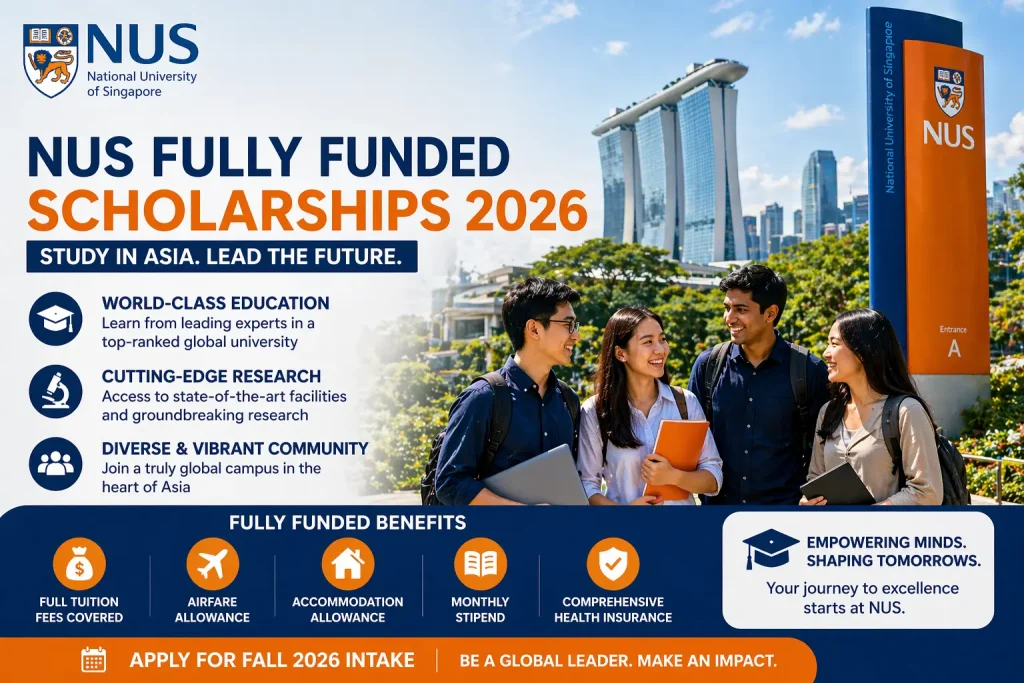
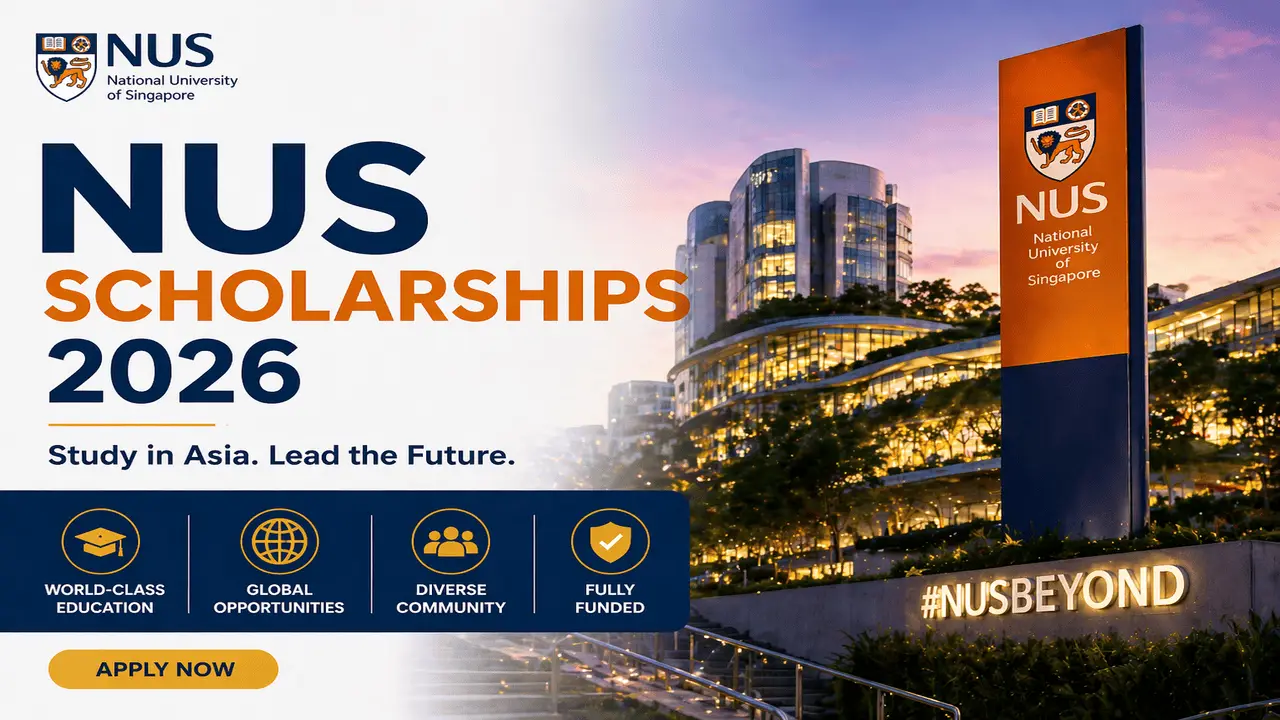
Consistently ranked among the world’s top universities, NUS attracts brilliant minds from every corner of the globe who seek rigorous academics, cutting-edge research facilities, and a multicultural campus environment that mirrors the dynamism of Asia’s most innovative city-state. For many aspiring students, however, the cost of studying at such a prestigious institution can appear prohibitive. Recognizing this barrier, NUS has developed one of the most comprehensive financial support ecosystems in the world, and the fully funded scholarships for the 2026 intake represent a transformative opportunity for international students to pursue their academic ambitions without the burden of overwhelming debt.
Whether you are a recent high school graduate aiming for a Bachelor’s degree, a young professional seeking advanced training through a Master’s program, or a researcher ready to push the boundaries of knowledge in a PhD, NUS offers pathways that combine academic excellence with substantial financial backing. These scholarships are not merely tuition waivers; they are holistic support packages designed to cover the full spectrum of living and learning expenses in Singapore. From full tuition coverage and monthly stipends to accommodation support and international travel allowances, NUS is committed to nurturing talent regardless of nationality or financial background. Yet this generosity comes with high expectations. The selection process is intensely competitive, seeking individuals who demonstrate not only outstanding academic records but also exceptional leadership potential, community engagement, and the English proficiency necessary to thrive in a rigorous intellectual environment.
This guide provides a detailed exploration of everything you need to know about securing a fully funded scholarship at NUS for the 2026 academic year. We will examine the available degree programs, break down the distinct categories of scholarships, outline the extensive benefits, clarify eligibility requirements, and walk you through the application process step by step. By the end, you will have a clear roadmap for transforming your aspiration of studying at NUS into a fully funded reality.
Check: DAAD Scholarship 2026 in Germany
Check: Harvard University Free Online Courses 2026 with Certificates
Academic Programs Covered by NUS Scholarships for 2026
NUS operates a comprehensive research-intensive university model, and its scholarships for 2026 span the full academic spectrum, ensuring that talented students at every stage of their educational journey can find support.
Bachelor’s Degrees
At the undergraduate level, NUS offers a diverse portfolio of programs across faculties including Arts and Social Sciences, Business, Computing, Dentistry, Design and Engineering, Law, Medicine, Science, and Music. International students can apply for scholarships covering four-year honors programs, with certain professional degrees such as Law, Medicine, and Dentistry following extended curricula. The university’s flexible degree framework allows students to combine majors, pursue minors, and engage in interdisciplinary coursework that prepares them for global careers. Scholarship holders at this level are expected to maintain exemplary academic standing while actively contributing to campus life.
Master’s Degrees
For graduate students, NUS provides both coursework-based and research-based Master’s programs. Coursework Master’s degrees—such as the Master of Science, Master of Engineering, or Master of Business Administration—typically span one to two years and are designed for students seeking advanced professional competencies. Research Master’s programs, including the Master of Philosophy (MPhil) in various disciplines, emphasize independent investigation under faculty supervision and serve as a pathway to doctoral study. Fully funded scholarships for Master’s students are particularly competitive, often targeting candidates whose research interests align with NUS’s strategic priorities in fields like artificial intelligence, biomedical science, sustainable development, and advanced materials.
PhD Degrees
The Doctor of Philosophy (PhD) represents the pinnacle of NUS’s academic offerings. PhD candidates engage in original research that contributes new knowledge to their fields, working alongside world-renowned faculty in state-of-the-art laboratories and research centers. NUS PhD scholarships are designed to provide multi-year support, typically covering the entire duration of the degree, which ranges from three to four years. These awards are geared toward students who have already demonstrated research aptitude, often through prior publications, thesis work, or significant project experience. The university’s graduate schools, including the NUS Graduate School for Integrative Sciences and Engineering and faculty-specific doctoral programs, offer structured training that combines disciplinary depth with interdisciplinary breadth.
Types of Fully Funded Scholarships Available at NUS in 2026
NUS administers a portfolio of scholarships that cater to different student profiles, academic levels, and regions. Understanding the distinctions between these awards is essential for identifying the right opportunity for your circumstances.
Undergraduate Scholarships
NUS offers several flagship undergraduate scholarships specifically designed for international students entering their first year of study. The NUS Global Merit Scholarship and the NUS Undergraduate Scholarship are among the most prestigious, targeting students who have achieved stellar academic results in their pre-university examinations—such as A-Levels, the International Baccalaureate, or equivalent national qualifications. These scholarships are typically bonded only by the expectation of academic excellence and active participation in the NUS community, rather than post-graduation employment obligations. Recipients are often selected not merely for their grades but for their potential to become future leaders and ambassadors for the university.
Graduate Scholarships
For students pursuing Master’s and PhD degrees, NUS provides a range of graduate scholarships administered either centrally by the NUS Graduate School or by individual faculties and research institutes. The NUS Research Scholarship is the cornerstone award for research-based graduate programs, providing comprehensive funding that enables students to focus entirely on their studies and research without financial distraction. Faculty-specific scholarships may also be available, often funded by industry partnerships or endowed gifts, and may target particular disciplines such as business analytics, public policy, or engineering. These graduate awards recognize that advanced study requires sustained intellectual investment, and they are structured to provide multi-year stability.
Merit-Based Scholarships
Merit-based awards at NUS transcend simple academic metrics. While a strong academic record is non-negotiable, these scholarships explicitly seek students who have distinguished themselves through leadership in student government, athletic achievement, artistic excellence, entrepreneurial ventures, or significant community service. The selection committees look for evidence of impact—students who have not only excelled personally but have also elevated their schools, communities, or organizations. For the 2026 intake, merit-based scholarships will continue to prioritize candidates who demonstrate the potential to contribute meaningfully to the NUS campus and, eventually, to society at large.
Research Scholarships
Distinct from general graduate funding, research scholarships are tightly coupled with specific research projects, laboratories, or supervisory teams. These awards are most common at the PhD level but are also available for research-intensive Master’s programs. Applicants typically need to identify a potential supervisor, articulate a coherent research proposal, and demonstrate alignment with the university’s research strengths. NUS is a major hub for scientific innovation in Asia, and research scholarship holders often find themselves working on projects with significant real-world applications—from urban sustainability solutions to breakthroughs in precision medicine. These scholarships frequently include additional funding for conference travel, fieldwork, and research materials.
Southeast Asian Student Scholarships
Reflecting Singapore’s role as a regional leader and its deep historical ties to neighboring countries, NUS offers dedicated scholarship streams for students from Southeast Asia. The ASEAN Undergraduate Scholarship is one such program, aimed at citizens of ASEAN member states who demonstrate both academic talent and the potential to foster regional cooperation. At the graduate level, the NUS Graduate Scholarship for ASEAN Nationals supports Master’s and PhD students from the region. These scholarships recognize the unique contributions that Southeast Asian perspectives bring to NUS’s diverse learning environment and are part of a broader institutional commitment to cultivating regional leadership and cross-cultural understanding.
Comprehensive Benefits: What NUS Fully Funded Scholarships Cover
One of the defining features of NUS scholarships for 2026 is their comprehensiveness. Unlike partial tuition waivers that leave students scrambling to cover living costs, these fully funded packages are designed to eliminate financial barriers entirely, allowing recipients to devote their full attention to academic and personal growth.
Full Tuition Fees
The cornerstone of every NUS fully funded scholarship is the complete coverage of tuition fees for the normal duration of the program. For undergraduates, this means four years of tuition are fully paid. For Master’s students, the coverage extends through the standard program length, while PhD scholars typically receive support for three to four years, with possible extensions depending on research progress. This coverage applies to the standard tuition rates for international students, which are significantly higher than subsidized rates for Singapore citizens, making the scholarship invaluable for non-resident applicants.
Monthly Stipend
Beyond tuition, NUS scholarship recipients receive a generous monthly living allowance. For undergraduate scholars, this stipend helps cover daily expenses such as food, transportation, and personal necessities. Graduate scholarship holders—particularly those in research programs—receive more substantial stipends commensurate with the demands of full-time research and the cost of living in Singapore. PhD scholars typically receive the highest stipend levels, which are competitive with graduate funding at top universities in North America and Europe. These stipends are disbursed regularly throughout the year and are intended to provide financial stability without the need for external employment.
Accommodation Support
Housing in Singapore can be expensive, and NUS scholarships address this reality through dedicated accommodation support. Many scholarships guarantee or prioritize on-campus housing in NUS’s residential colleges or student residences, often at subsidized rates or with housing allowances built into the award. Living on campus places students at the heart of university life, providing easy access to libraries, laboratories, and extracurricular facilities. For scholars, this support removes one of the most significant logistical and financial challenges of studying abroad.
Travel Allowance
International students traveling to Singapore for their studies often face substantial airfare costs. NUS fully funded scholarships typically include a travel allowance or one-time airfare grant to cover the cost of relocating to Singapore at the beginning of the program. Some awards also provide a return airfare allowance upon successful completion of the degree. Additionally, certain research scholarships include conference travel funds, enabling graduate students to present their work at international academic gatherings—a critical component of scholarly development and professional networking.
Additional Perks
Depending on the specific scholarship, recipients may also receive benefits such as one-time settling-in allowances, computer or book allowances, funding for overseas exchange programs, and access to exclusive mentorship and leadership development initiatives. These supplementary benefits underscore NUS’s commitment to the holistic development of its scholars.
Eligibility Criteria: Are You Qualified?
Securing a fully funded scholarship at NUS requires meeting a stringent set of criteria that reflect the university’s commitment to excellence. While specific requirements vary by scholarship type and faculty, several core eligibility standards apply across the board for the 2026 intake.
International Student Status
These scholarships are explicitly designed for non-Singaporean citizens, though some awards—particularly those for Southeast Asian students—have specific nationality requirements. Applicants must hold citizenship from outside Singapore and, in most cases, must not be permanent residents of Singapore at the time of application. Dual citizens should carefully review the specific terms of each scholarship to ensure eligibility.
Strong Academic Records
Academic excellence is the foundation of NUS scholarship eligibility. Undergraduate applicants should present outstanding pre-university examination results, typically ranking in the top percentile of their graduating class. For graduate applicants, this translates into a strong Bachelor’s degree (usually with First Class Honors or its equivalent) and, for PhD candidates, a demonstrated track record of research capability. NUS evaluates academic records in the context of the applicant’s national education system, but the universal expectation is one of sustained, high-level achievement.
Leadership Qualities and Holistic Achievement
NUS operates on the principle that tomorrow’s leaders must possess more than intellectual ability. The university actively seeks students who have held leadership positions in student organizations, excelled in competitive environments, initiated community projects, or demonstrated entrepreneurial spirit. The application process provides multiple opportunities—through essays, recommendation letters, and interviews—for candidates to showcase how they have influenced their communities and how they plan to contribute to the NUS ecosystem.
English Proficiency
As the medium of instruction at NUS is English, all international applicants must demonstrate proficiency through standardized tests such as the IELTS or TOEFL. Minimum score requirements vary by program, with competitive scholarship candidates typically scoring well above the minimum thresholds. Some applicants may be exempted based on the language of instruction in their prior education, but scholarship applicants are generally expected to demonstrate exceptional communication skills, as these are essential for academic success and leadership.
Program-Specific Requirements
Certain faculties impose additional criteria. Medical and dental programs may require aptitude tests or interviews. Engineering and computing programs may value mathematics and science competition records. Business programs may prefer candidates with demonstrated quantitative skills or professional experience. Research scholarships require alignment with available supervisors and research areas. Applicants must carefully review the specific requirements for their intended program and scholarship combination.
The Application Process: A Step-by-Step Roadmap
Navigating the NUS scholarship application process requires careful planning, attention to detail, and strategic timing. While the exact timeline for 2026 admissions will be published on the official NUS portals, the following steps represent the standard pathway for international scholarship applicants.
Step 1: Search for Suitable NUS Scholarships
Begin by thoroughly researching the scholarship landscape at NUS. Visit the official NUS financial aid and admissions websites to identify which scholarships align with your intended degree level, nationality, and field of study. Create a shortlist of scholarships for which you are broadly eligible, paying close attention to whether the award is applied for automatically upon admission or requires a separate application. Some undergraduate scholarships consider all applicants, while others require explicit nomination or a supplementary form.
Step 2: Check Specific Eligibility Requirements
Once you have identified potential scholarships, conduct a granular review of their eligibility criteria. Confirm that your academic qualifications, nationality, age, and intended program match the scholarship’s parameters. Note any special requirements, such as specific pre-university subjects, work experience minimums, or research proposals. This step is crucial because applying for scholarships for which you are ineligible wastes time and resources while potentially delaying your admission process.
Step 3: Prepare Required Documents
Scholarship applications demand a comprehensive dossier of supporting materials. Gather your academic transcripts, standardized test scores, English proficiency results, passport copies, and curriculum vitae well in advance. Most importantly, invest significant time in your personal statement or scholarship essay. This document should articulate not only your academic achievements but also your personal narrative, career aspirations, and specific reasons for choosing NUS. For research scholarships, prepare a detailed research proposal that engages with current scholarship in your field and identifies potential supervisors at NUS. Secure recommendation letters from referees who know you well and can speak to both your intellectual abilities and your character.
Step 4: Apply Online Through the NUS Portal
NUS utilizes centralized online application systems for both admission and scholarship consideration. For undergraduate applicants, this typically means submitting an application through the NUS Office of Admissions portal. Graduate applicants usually apply through the NUS Graduate Admission System or faculty-specific portals. Ensure that you indicate your interest in scholarship consideration where prompted, and complete all sections of the application accurately. Pay close attention to word limits for essays and the formatting requirements for uploaded documents.
Step 5: Submit Required Documents and Track Your Application
After submitting the online application, upload all required supporting documents before the stated deadlines. Some materials, such as official transcripts or test scores, may need to be sent directly by issuing institutions. Monitor your application portal regularly for updates, requests for additional information, or interview invitations. Missing a document request can result in disqualification, so maintain organized records and respond promptly to all communications from NUS.
Step 6: Interviews and Selection
Shortlisted candidates are typically invited for interviews, which may be conducted virtually or in person depending on the applicant’s location. Scholarship interviews at NUS are rigorous; expect questions about your academic interests, leadership experiences, ethical reasoning, and understanding of global issues. Prepare by researching current events related to your field, reviewing your application materials thoroughly, and practicing articulate responses that convey both confidence and humility.
Step 7: Acceptance and Visa Processing
If selected, you will receive a scholarship offer letter detailing the terms, conditions, and acceptance procedures. Upon acceptance, NUS will guide you through the student pass application process with Singapore’s Immigration and Checkpoints Authority. Begin arranging your travel and accommodation once your student pass is approved, and participate in any pre-departure orientations offered by the university.
Official Application Link
All prospective international students seeking fully funded scholarships at NUS for the 2026 intake should begin their journey at the official university portals. For comprehensive information on available scholarships, eligibility criteria, and application procedures, visit:
Official NUS Scholarships and Financial Aid Portal:
https://nus.edu.sg/oam/financial-aid/scholarships
For undergraduate admissions and scholarship applications:
https://nus.edu.sg/admissions
For graduate admissions and research scholarship applications:
https://gs.nus.edu.sg
These official links provide the most accurate, up-to-date information regarding application windows, document requirements, and contact details for admissions officers.
Required Documents Checklist
To ensure your application is complete, prepare the following materials:
- Certified academic transcripts and degree certificates from all prior institutions
- Standardized test scores (SAT, ACT, GRE, GMAT) if required by your program
- English proficiency test results (IELTS, TOEFL, or equivalent)
- Valid passport identification page
- Curriculum vitae or resume detailing academic and extracurricular achievements
- Two to three letters of recommendation from teachers, professors, or employers
- Personal statement or scholarship essay responding to specific prompts
- Research proposal (for research-based Master’s and PhD applicants)
- Portfolio or work samples (for design, architecture, or arts programs)
- Proof of leadership roles, awards, and community service involvement
Strategies for a Competitive Application
Given the intense competition for NUS fully funded scholarships, strategic preparation can significantly enhance your prospects.
Start Early
The most successful applicants begin preparing at least twelve months in advance. This timeline allows you to retake standardized tests if necessary, cultivate relationships with potential referees, and craft essays that undergo multiple revisions.
Articulate Your “Why NUS” Narrative
Generic applications rarely succeed. Your essays should demonstrate specific knowledge of NUS’s programs, faculty, research centers, and campus culture. Explain precisely how NUS fits into your long-term academic and career trajectory.
Quantify Your Leadership Impact
When describing leadership experiences, move beyond titles. Use specific metrics and outcomes: the number of people you led, funds you raised, events you organized, or communities you impacted. Concrete evidence of impact resonates more powerfully than vague assertions.
Secure Glowing, Specific Recommendations
Choose referees who can provide detailed anecdotes about your abilities rather than those who merely offer generic praise. Provide your recommenders with your CV and a summary of your scholarship goals to help them write targeted, compelling letters.
Prepare Meticulously for Interviews
Practice behavioral and situational questions. Be ready to discuss not only your strengths but also how you have overcome failures. Demonstrate cultural awareness and an openness to engaging with Singapore’s diverse society.
Frequently Asked Questions (FAQs)
1. Can I apply for multiple NUS scholarships simultaneously?
Yes, in most cases, international students can be considered for multiple scholarships, though the specific rules depend on the level of study and the scholarship types. For undergraduate admissions, applying to NUS automatically considers you for several merit-based scholarships if you indicate your interest, and you do not need to submit separate applications for each. However, certain named scholarships may require additional essays or nominations. At the graduate level, applicants can typically apply for the NUS Research Scholarship alongside faculty-specific awards, but recipients are usually allowed to hold only one major scholarship at a time. If you are offered multiple awards, the university will guide you on which one provides the most comprehensive benefits. Always read the terms and conditions of each scholarship carefully to ensure compliance with stacking or exclusivity rules.
2. What is the typical deadline for 2026 scholarship applications?
Application deadlines for the 2026 intake vary by degree level and faculty. For undergraduate programs, international applications typically open between October and December 2025, with deadlines falling between February and March 2026 for the August intake. Some programs may also offer a January intake with deadlines around July to September of the preceding year. Graduate program deadlines are more varied; research program applications often operate on a rolling basis or have multiple rounds, while coursework Master’s programs usually adhere to fixed deadlines several months before the semester begins. Because deadlines are subject to change and differ across faculties, you should consult the official NUS admissions portal directly and create a personalized calendar of deadlines for your specific programs of interest.
3. Do I need to submit a separate admission application and scholarship application?
For most undergraduate applicants, the scholarship application is integrated into the general admissions application. When you apply for admission to NUS, you will be prompted to indicate your interest in scholarship consideration, and the same application materials will be used for both processes. However, some specialized scholarships may require supplementary forms or additional essays. For graduate research programs, the situation is more nuanced. You typically apply for admission to your chosen program and simultaneously indicate your interest in the NUS Research Scholarship or other awards. Some faculty-specific scholarships may require a separate application submitted directly to the department. Always verify the process for your specific program to ensure you have completed all necessary steps for scholarship consideration.
4. Is there an age limit for applying to NUS fully funded scholarships?
NUS scholarships generally do not enforce strict age limits for international applicants. Instead, the focus remains on academic merit, leadership potential, and research fit. However, certain government-funded scholarships or bonded awards may have age restrictions or prefer candidates at specific career stages. For undergraduate scholarships, the implicit expectation is that applicants are recent high school graduates or gap-year students, typically in their late teens or early twenties. Graduate scholarship applicants may range from early twenties to mid-thirties or beyond, particularly for professional Master’s or mid-career research programs. If you have concerns about your age relative to typical cohort profiles, you are encouraged to contact the NUS admissions office or the specific faculty to discuss your circumstances.
5. What happens if my English proficiency scores are slightly below the published requirement?
English proficiency requirements at NUS are generally strict, especially for scholarship applicants who are expected to demonstrate exemplary communication skills. If your scores fall slightly below the minimum threshold—such as an IELTS score marginally under the required band—your application may still be reviewed holistically if other components are exceptionally strong, but this is rare and not guaranteed. Some applicants may be required to enroll in additional English language support or bridging courses if conditionally admitted. The best course of action is to retake the English proficiency test to achieve the required scores before submitting your application. For scholarship consideration specifically, meeting the minimum is advisable, but competitive candidates typically present scores well above the baseline to distinguish themselves in a crowded applicant pool.
The Bottom Line
NUS is offering comprehensive financial support for international students in 2026, covering major study expenses, but applicants must meet high academic and program-specific standards.
The opportunity to study at the National University of Singapore under a fully funded scholarship is one of the most valuable propositions in global higher education today. For the 2026 intake, NUS continues its tradition of investing in exceptional human capital by removing financial obstacles and providing a supportive ecosystem where scholars can flourish. The benefits—spanning full tuition, monthly stipends, accommodation support, and travel allowances—are designed to ensure that the only thing students need to worry about is their intellectual growth and community impact. Yet this investment is matched by equally high expectations. The university seeks not just brilliant students, but future leaders, innovators, and global citizens who will leverage their NUS education to make meaningful contributions to the world. If you possess the academic credentials, the leadership experience, and the drive to excel in one of Asia’s most dynamic learning environments, the path to a fully funded future at NUS is open. Begin your preparation today, engage deeply with the application process, and take the decisive step toward joining a community that shapes the leaders of tomorrow.