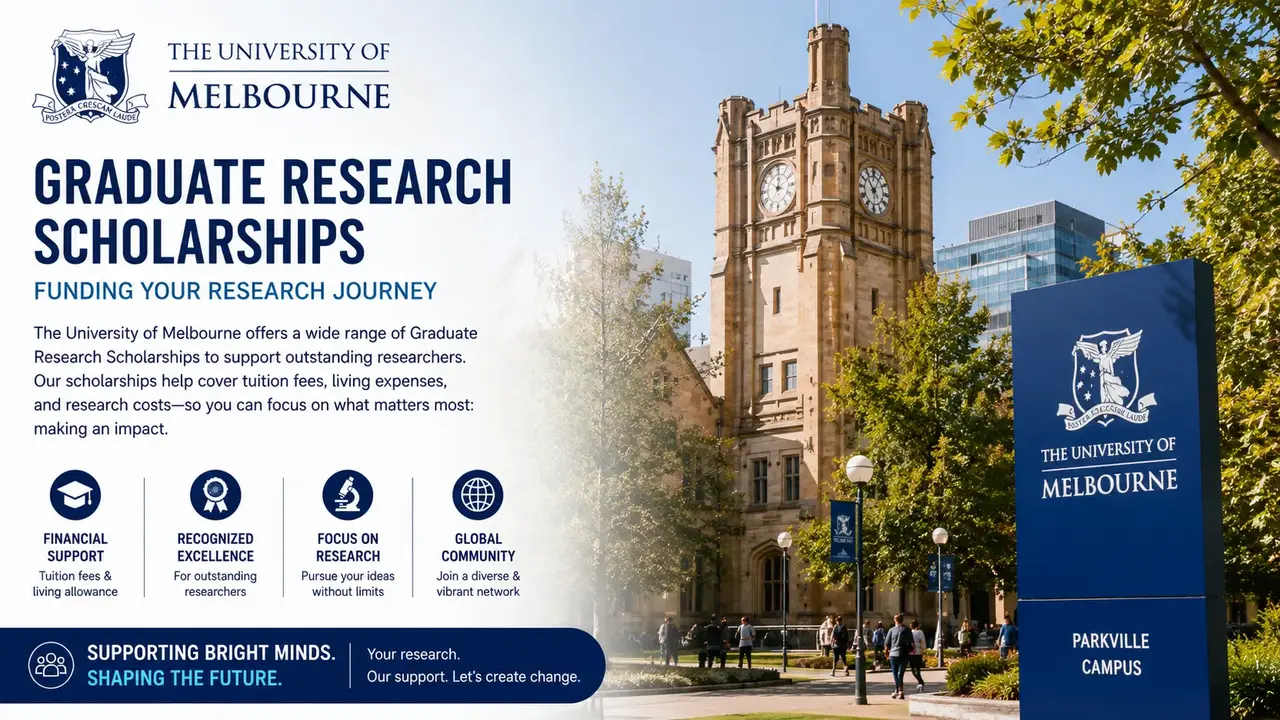
Research Scholarships at the University of Melbourne
The University of Melbourne stands as one of the premier research institutions in the Southern Hemisphere, consistently ranked among the top universities globally. For prospective doctoral and master’s by research candidates, securing admission is only half the battle; securing funding is equally critical. The financial demands of higher degree by research (HDR) programs can be significant, encompassing tuition fees, living expenses, and research costs. To support outstanding scholars, the University of Melbourne offers a robust suite of Graduate Research Scholarships. These scholarships are designed to alleviate financial burdens, allowing researchers to focus entirely on their intellectual contributions.
The primary scholarships available are the Melbourne Research Scholarship (MRS) and the Research Training Program (RTP) Scholarship. While the RTP is funded by the Australian Commonwealth Government, the MRS is funded directly by the university. Both operate under a unified set of Graduate Research Scholarships Terms and Conditions, ensuring consistency in benefits and obligations regardless of the funding source. This article provides an exhaustive guide to these scholarships, detailing the financial benefits, leave entitlements, duration rules, and application processes. By understanding the intricacies of these terms, prospective students can navigate their research journey with confidence and security.
Check: PhD Scholarships at the University of Southern Denmark: Complete Guide for International Students
Check: PhD Positions at Chalmers University of Technology, Sweden
Understanding the Scholarship Types
The University of Melbourne offers various graduate research scholarships, but the MRS and RTP are the most prominent. The terms and conditions apply to both, creating a standardized framework for support. The Melbourne Research Scholarship (MRS) is the university’s flagship award, designed to attract high-caliber domestic and international students. It typically covers tuition fees and provides a living allowance. The Research Training Program (RTP) Scholarship is an Australian Government initiative that supports domestic and international students undertaking research higher degrees.
While the funding sources differ, the operational rules regarding leave, duration, and conduct are harmonized. This means that whether you are on an MRS or an RTP, your entitlements to recreational leave, parental leave, and fee offsets are generally consistent. This standardization simplifies the administrative experience for scholars, ensuring that all graduate researchers are treated equitably. The University reserves the right to make minor amendments to these terms without prior notice, so it is essential for scholars to stay updated with the latest policy documents available on the university’s website.
Financial Benefits and Support
The core value of these scholarships lies in their comprehensive financial support package. The benefits are designed to cover the essential costs of living and studying in Melbourne, one of the world’s most livable cities.
1. Stipend (Living Allowance)
The stipend is the primary source of income for scholarship holders. It is paid fortnightly from the commencement date of the scholarship. The full-time stipend rate is specified in the individual scholarship offer and is subject to annual indexing by the University to account for inflation and cost of living adjustments. For students enrolled in part-time study, the stipend rate is adjusted to fifty percent of the full-time rate. This ensures that researchers who need to balance their studies with other commitments still receive proportional support. The stipend is tax-exempt for international students in many cases, though domestic students should consult with the Australian Taxation Office regarding their specific liability.
2. Fee Sponsorship (Offset)
Tuition fees for research degrees can be substantial, particularly for international students. The scholarship includes a fee sponsorship or offset that applies to either Australian Fee Places or Overseas Fee Places. This benefit covers the cost of tuition in part or in full for the duration of the scholarship. For most full scholarship holders, this means tuition is fully covered, removing a significant barrier to entry. This offset is applied directly to the student account, so scholars do not need to manage these payments themselves.
3. Overseas Student Health Cover (OSHC) Allowance
International students requiring a Student Visa to study in Australia must have health insurance. The scholarship provides an OSHC allowance that covers single membership. If the student requests the University to arrange OSHC with the preferred provider, the allowance is applied automatically. Alternatively, if the student arranges their own membership, the University provides a reimbursement upon provision of a receipt, up to the scheduled value used by the University’s preferred provider. This ensures that international scholars have access to healthcare without out-of-pocket expenses.
4. Relocation Allowance
Recognizing the costs associated with moving for study, the University offers a relocation allowance. Eligibility requires that the student was living outside the State of Victoria at the time of applying, has not studied at a Victorian institution within the prior 12 months, and has relocated to Melbourne to commence the course. The value is $2,000 for those relocating from another Australian State or Territory, and $3,000 for those relocating from outside Australia. Students in approved Joint PhD programs are also entitled to a $3,000 allowance. This payment is typically made with the first stipend payment after studies commence, helping to settle initial housing and setup costs.
Duration and Enrolment Conditions
Understanding the timeline of the scholarship is crucial for planning the research project. The duration rules are strict and vary based on the level of the degree.
Maximum Duration
For students enrolled in a Master’s degree, the maximum duration of both the stipend and fee sponsorship is 2 years of full-time study equivalent. For students enrolled in a Doctoral degree (PhD), the maximum duration of the stipend is 3.5 years, while the fee sponsorship can extend to 4 years of full-time equivalent. This slight difference allows PhD candidates to focus on writing up their thesis in the final period without the pressure of the stipend ending exactly when the fees do.
Full-Time vs. Part-Time Study
The scholarship is calculated based on a full-time equivalent (FTE) measure. If a scholar enrols part-time, the actual calendar duration of entitlements is doubled proportionally. For example, a 2-year Master’s scholarship would last 4 calendar years if studied part-time. However, the stipend rate is halved during this time. Scholars can change their study rate with approval. If moving from full-time to part-time, the stipend adjusts immediately, and the scholarship end date is extended to reflect the remaining duration. Conversely, moving to full-time accelerates the end date. It is important to note that the duration of the scholarship is reduced by any periods of study undertaken previously towards the same course.
Commencement Rules
Scholars must commence the scholarship in the offer year specified. If permission is granted to defer to the following academic year, the scholarship can be deferred. However, if the course is not commenced in the offer year or the following year (if permitted), the scholarship is withdrawn. If a student has already commenced the course prior to the offer year, the scholarship commences on either 1 January of the offer year or the day the offer is accepted, whichever is later. This ensures that funding aligns with the academic cycle.
Leave Entitlements and Wellbeing
The University of Melbourne places a strong emphasis on the wellbeing of its researchers. The terms and conditions outline generous leave entitlements, acknowledging that research is a demanding endeavor that requires balance.
Recreational and Personal Leave
Scholars are entitled to 20 working days of paid recreational leave per year (full-time equivalent) and 10 working days of paid personal leave per year. These leaves accrue over the duration of the scholarship and roll over to subsequent years, providing flexibility. However, unused leave is forfeited at the end date of the scholarship, and the scholarship duration is not extended by these leave periods. This policy encourages scholars to take time off to rest and recharge without penalizing their research timeline.
Paid Additional Personal Leave
If the standard personal leave is exhausted, scholars are entitled to 60 working days of paid additional personal leave for periods of illness or family caring responsibilities. This requires supporting documents, such as a medical certificate. This safety net ensures that unexpected health issues do not derail a research career financially.
Maternity and Parental Leave
The University offers supportive policies for scholars starting or expanding their families. If a scholar has completed 12 months of study, they are entitled to 100 working days of paid maternity leave for each child they give birth to and are the primary carer of. This leave can start six weeks prior to the expected birth date and must be taken as continuous leave within 52 weeks of the birth. Similarly, 100 working days of paid parental leave is available for partners adopting a child under 16 or for the birth of a child by a partner, provided the scholar is the primary carer. Evidence of birth or adoption is required. These entitlements are significant, allowing researchers to maintain their income during critical family moments.
Partner and Family Violence Leave
Recognizing diverse family structures, the scholarship includes 5 days of paid partner leave for each child where the partner is the main carer. Additionally, a crucial provision is the Paid Family Violence Leave. Scholars are entitled to 10 days per year (full-time) or 5 days (part-time) if they are experiencing family violence. This leave does not accrue or roll over but provides essential support and security for vulnerable students. These comprehensive leave policies demonstrate the University’s commitment to creating a safe and inclusive research environment.
Obligations and Academic Conditions
Receiving a scholarship comes with responsibilities. Scholars must adhere to specific conditions to maintain their funding.
Research Project and Course Transfer
If a scholar wishes to change their research project, prior approval from the Faculty is required. Changing the project may affect entitlement to the scholarship, and approval is at the discretion of the Department. Similarly, transferring to another course within the University requires prior approval. If transferring from a Master’s to a Doctoral degree, the maximum scholarship duration becomes 3.5 years from the original Master’s commencement. If transferring from Doctoral to Master’s, the duration adjusts to 2 years, and if the scholarship has already exceeded 2 years, it ceases upon transfer. These rules ensure that funding is aligned with the scope of the research.
Thesis Submission and Withdrawal
The scholarship concludes when the research thesis is submitted, or if the student withdraws from the course. If enrolment is withdrawn by the University due to unsatisfactory progress or misconduct, all benefits cease immediately. This underscores the importance of maintaining satisfactory academic progress throughout the degree.
Concurrent Awards and Enrolments
Scholars must not hold equivalent awards designed to offset graduate research fees from the Commonwealth Government if they are on an RTP Offset Scholarship. Additionally, permission is required to enrol in a graduate research course at another higher education provider concurrently. Approval to continue receiving the scholarship while enrolled elsewhere is discretionary. This prevents double-dipping on public funds and ensures focus on the primary research project.
Acknowledgement of Funding
A critical obligation is acknowledging the funding source in all publications and the thesis. For RTP scholars, this is mandatory. The Commonwealth’s contribution must be acknowledged in a prominent place using specific wording: “This research was supported by the Commonwealth through an Australian Government Research Training Program Scholarship [DOI: https://doi.org/10.82133/C42F-K220].” Scholars with an ORCID must also include this DOI in their record. Failure to acknowledge funding can be considered a breach of conditions.
Integrity and Administrative Errors
Scholars must not provide false or misleading information. If benefits were received based on false information, the scholarship will be withdrawn, and repayment may be required within 14 days. Similarly, if the University makes an administrative error resulting in overpayment, the scholar may be required to return the funds. This ensures the integrity of the scholarship system.
Application Process and Official Links
Applying for a Graduate Research Scholarship at the University of Melbourne is typically integrated with the application for admission to the research program. There is often no separate scholarship application form; instead, candidates are automatically considered for funding when they apply for entry. However, some specific scholarships may require additional documentation.
Steps to Apply
- Identify a Supervisor: Before applying, it is highly recommended to contact a potential supervisor within your field of interest. Their support can strengthen your application.
- Prepare Documents: You will need academic transcripts, a research proposal, a curriculum vitae (CV), and evidence of English language proficiency.
- Submit Application: Applications are submitted through the University’s online portal. Ensure all documents are uploaded before the deadline.
- Wait for Outcome: Scholarship offers are usually released alongside or shortly after admission offers.
Official Links
To begin your journey, you must visit the official University of Melbourne websites. These portals provide the most up-to-date information on deadlines, specific faculty requirements, and the online application system.
University of Melbourne Graduate Research Admissions:
https://study.unimelb.edu.au/find/graduate-research
University of Melbourne Scholarships Page:
https://scholarships.unimelb.edu.au/
Graduate Research School:
https://grs.unimelb.edu.au/
It is vital to check these links regularly as intake rounds and deadlines vary by faculty. The Graduate Research School page also hosts the full text of the Terms and Conditions, allowing scholars to verify any specific clauses regarding their offer.
Life as a Scholar in Melbourne
Beyond the financial terms, life as a scholarship holder at the University of Melbourne offers immense professional and personal growth. Melbourne is consistently ranked as one of the world’s most livable cities, known for its culture, coffee, and diverse communities. The stipend provided by the MRS and RTP is designed to allow scholars to live comfortably in this environment. While rent in Melbourne can be high, the fortnightly payments provide stability.
The University provides extensive support services, including writing workshops, statistical consulting, and mental health support. The leave entitlements discussed earlier ensure that scholars can maintain a healthy work-life balance, which is crucial for long-term research productivity. Furthermore, the acknowledgement requirements connect scholars to a broader network of Commonwealth-supported research, enhancing the visibility of their work.
For international students, the OSHC allowance and relocation support ease the transition into Australian life. The University’s international office assists with visa processes, ensuring that scholars can focus on their research rather than bureaucracy. The multicultural environment of the University fosters collaboration across borders, preparing graduates for global careers in academia, industry, or government.
Conclusion
The Graduate Research Scholarships at the University of Melbourne represent a significant investment in the next generation of researchers. With comprehensive benefits covering tuition, living expenses, health insurance, and relocation, these scholarships remove the financial barriers to high-level academic inquiry. The generous leave policies, including provisions for parental care and family violence support, highlight the University’s commitment to the wellbeing of its students.
However, these benefits come with clear obligations regarding progress, acknowledgement, and integrity. Understanding the Terms and Conditions is not just a bureaucratic requirement; it is a strategic necessity for managing your research timeline and financial security. Whether you are pursuing a Master’s or a Doctorate, the MRS and RTP provide the stability needed to produce world-class research.
If you are ready to contribute to global knowledge and advance your career, the University of Melbourne offers the environment and support to help you succeed. By leveraging these scholarships, you can focus on what matters most: your research. Prepare your application carefully, adhere to the conditions, and embark on a transformative journey in one of the world’s leading research institutions.
Start your application today via the official portals:
https://study.unimelb.edu.au/find/graduate-research
https://scholarships.unimelb.edu.au/