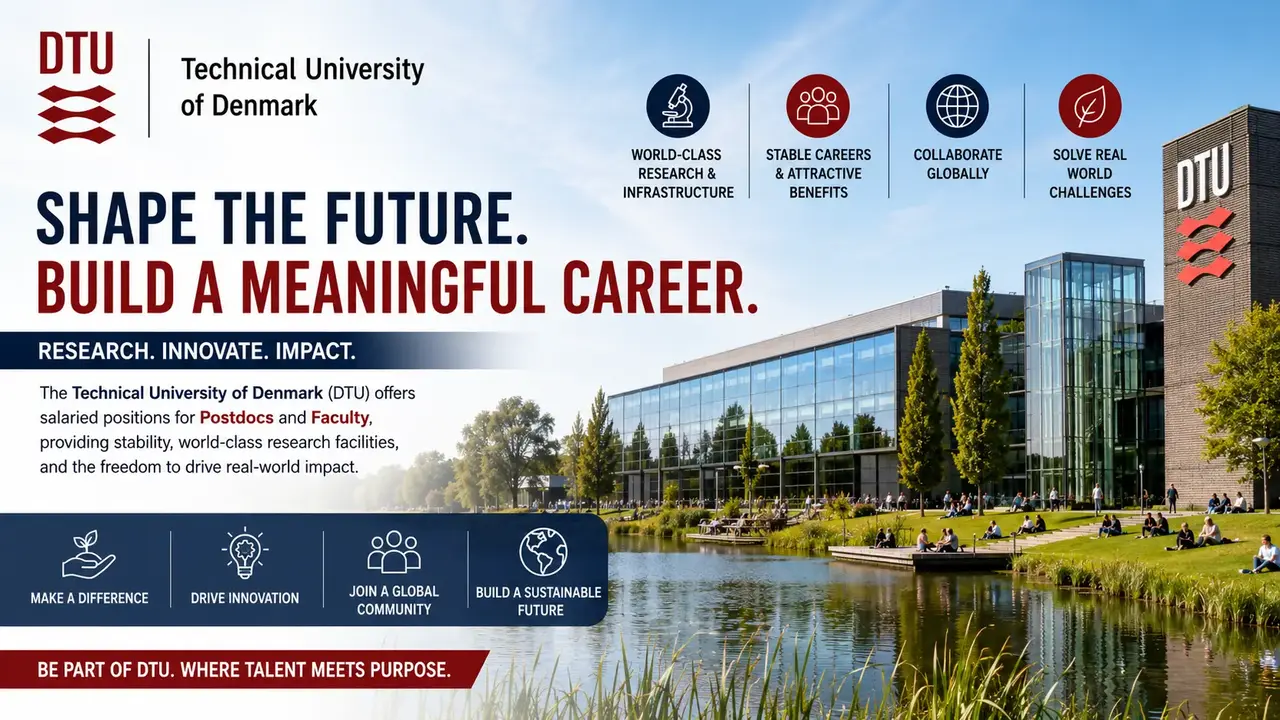
Postdoc and Faculty Positions at the Technical University of Denmark (DTU): Opportunities for International Researchers
The Technical University of Denmark (Danmarks Tekniske Universitet), commonly known as DTU, stands as a beacon of engineering excellence and scientific innovation in Northern Europe. For researchers aiming to push the boundaries of technology, sustainability, and health sciences, securing a position at DTU represents a career-defining opportunity. Unlike many other regions where academic roles are grant-dependent or precarious, Denmark offers a structured, salaried employment model for both postdoctoral researchers and faculty members. This model provides financial stability, comprehensive social benefits, and access to world-class infrastructure.
This article serves as an exhaustive guide for prospective candidates interested in Postdoctoral and Faculty positions at DTU. It delves into the university’s research ecosystem, the specifics of the employment contracts, salary structures, the rigorous application process, and the quality of life awaiting researchers in Denmark. Whether you are a recent PhD graduate looking for your first major research role or an experienced academic seeking a tenure-track position, understanding the nuances of the Danish system is crucial for success.
Check: Postdoc Positions at KTH Royal Institute of Technology, Sweden
About the Technical University of Denmark
Established in 1829, DTU is one of the oldest technical universities in Europe. It is consistently ranked among the top technical universities globally, renowned for its strong emphasis on applied science and engineering. The university’s mission is to create value for people and society through science and technology. This mission is reflected in its research priorities, which align with the United Nations Sustainable Development Goals (SDGs).
Campuses and Infrastructure
DTU is primarily located in Kongens Lyngby, just north of Copenhagen. This main campus is a hub of activity, featuring state-of-the-art laboratories, cleanrooms, and testing facilities. Additionally, DTU operates several specialized campuses:
- DTU Risø: Located in Roskilde, this is a global leader in wind energy and nuclear safety research.
- DTU Ballerup: Focuses on national food resources and biotechnology.
- DTU Copenhagen: Located in the heart of the capital, focusing on health technology and biomedical engineering.
The infrastructure available to staff is exceptional. Researchers have access to supercomputing resources, advanced material testing centers, and pilot plants that allow for scaling research from theory to industrial application. This proximity to hardware and industrial partners distinguishes DTU from purely theoretical institutions.
Research Departments
DTU is organized into several departments, each acting as a distinct research community. Key departments include:
- Department of Physics: Focuses on quantum technology, sustainability, and health.
- Department of Electrical Engineering: Covers power systems, electronics, and photonics.
- Department of Chemical Engineering: Specializes in process technology and biotechnology.
- Department of Mechanical Engineering: Focuses on solid mechanics, fluid mechanics, and production engineering.
- National Institute of Aquatic Resources (DTU Aqua): A leader in marine research and fisheries.
- National Food Institute (DTU Food): Focuses on food safety and nutrition.
This departmental structure ensures that Postdocs and Faculty members are embedded in specialized communities while retaining the flexibility to collaborate across disciplines.
Understanding the Positions: Postdoc vs. Faculty
Navigating academic job titles can be confusing, as systems vary by country. At DTU, the roles are clearly defined within the Danish collective agreement system.
Postdoctoral Positions
A Postdoctoral Fellow (Postdoc) at DTU is a fixed-term employee. The primary purpose of this role is to conduct independent research under the supervision of a senior professor, while also developing the skills necessary for an independent research career.
- Duration: Typically 2 to 3 years. Extensions are possible depending on funding.
- Focus: 80% research, 20% teaching and administration.
- Expectations: Publishing in high-impact journals, acquiring external funding, and mentoring PhD students.
- Career Path: A Postdoc position is often a stepping stone to an Assistant Professorship or a research role in the industry.
Faculty Positions (Assistant, Associate, Full Professor)
DTU has adopted a Tenure Track system similar to the North American model, particularly for Assistant Professors.
- Assistant Professor (Tenure Track): This is a permanent position with a probationary period (usually 4 years). During this time, the candidate is evaluated on research, teaching, and leadership. Successful evaluation leads to permanent tenure as an Associate Professor.
- Associate Professor: A permanent position requiring a solid track record of research and teaching. These roles involve significant supervision of PhD students and course responsibility.
- Professor: The senior academic rank, involving strategic leadership of research groups, major grant acquisition, and high-level administration.
The Tenure Track System
The Tenure Track at DTU is designed to attract top international talent. It offers a clear pathway to permanence. During the track period, the Assistant Professor is provided with resources to build their own research group. The evaluation criteria are transparent and agreed upon at the start of employment. This system reduces the uncertainty often associated with early academic careers.
Salary and Benefits: The Danish Employment Model
One of the most compelling reasons to work at DTU is the compensation package. In Denmark, academic positions are not stipends; they are full-time employment contracts with all associated rights.
Salary Structure
Salaries are negotiated individually based on qualifications and experience, but they follow the collective agreement between the Danish Ministry of Finance and the Academic Staff Union (AC).
- Postdoc: The monthly gross salary typically starts around 35,000 DKK to 40,000 DKK (approximately €4,700 – €5,400), depending on seniority.
- Assistant Professor: The monthly gross salary typically ranges from 40,000 DKK to 50,000 DKK.
- Associate/Full Professor: Salaries can range from 50,000 DKK to 70,000+ DKK monthly.
Note: These are gross figures. Denmark has a high income tax rate, but this covers healthcare, education, and social security.
Additional Benefits
- Pension: DTU contributes significantly to your pension fund (approximately 17% of the salary), ensuring long-term financial security.
- Holiday: Employees are entitled to 5 weeks of paid holiday per year, plus holiday allowance (feriepenge).
- Research Funding: Faculty members are expected to acquire external funding, but start-up packages are often provided for Tenure Track positions to establish labs and hire PhD students.
- Parental Leave: Denmark offers generous parental leave policies. Parents can share up to 52 weeks of leave with partial salary compensation.
- Healthcare: As a tax-paying resident, you have access to the universal Danish healthcare system.
Eligibility Criteria and Requirements
Competition for positions at DTU is fierce. The university attracts candidates from around the globe, so meeting the baseline requirements is essential but not always sufficient.
For Postdoctoral Candidates
- PhD Degree: You must hold a PhD degree equivalent to a Danish PhD. If your degree is from outside the EU, it may need assessment by the Danish Agency for Higher Education and Science.
- Research Record: A strong publication record in international peer-reviewed journals is mandatory. The quality of the journals matters more than the quantity.
- Relevance: Your research expertise must align closely with the specific project or department advertising the position.
- Language: English is the working language. Danish is not required for research roles but is an asset for integration.
For Faculty Candidates
- Scientific Excellence: A documented track record of high-impact research is required. For Professor positions, international recognition is key.
- Teaching Experience: Faculty members must demonstrate competence in teaching. A teaching portfolio is often required during the application process.
- Leadership: For senior roles, experience in leading research groups, managing budgets, and strategic planning is evaluated.
- Grant Acquisition: Evidence of success in securing external funding (e.g., from the European Research Council or Danish Innovation Fund) is highly valued.
The Application Process: Step-by-Step
Applying for a job at DTU is a formal process that requires attention to detail. The university uses an online recruitment system for all vacancies.
Step 1: Finding Vacancies
DTU does not accept unsolicited applications for permanent faculty positions; you must apply to advertised vacancies. Postdoc positions are advertised regularly as funding becomes available.
Official Application Link: All vacant positions are listed on the DTU career website.
Link: https://www.dtu.dk/english/career/vacant-positions
It is advisable to check this page weekly. You can also subscribe to job alerts if available or follow DTU on LinkedIn.
Step 2: Preparing Your Application Package
A standard application includes:
- Cover Letter: Address the specific requirements listed in the job advertisement. Explain your motivation and how your research fits the department’s strategy.
- Curriculum Vitae (CV): Include a full list of publications, highlighting your most significant works.
- Research Statement: Describe your past research, current interests, and future plans. For faculty positions, outline how you intend to build a research group.
- Teaching Portfolio: (For Faculty) Document your teaching philosophy, courses taught, and student evaluations.
- References: Contact information for at least three professional referees.
Step 3: Submission
Applications must be submitted via the “Apply Now” button on the vacancy page. Ensure all documents are in PDF format. Late applications are strictly not accepted.
Step 4: Assessment and Interview
An assessment committee evaluates all applicants. They produce a report ranking the candidates. If you are among the top candidates, you will be invited for an interview.
- The Interview: This is often a two-stage process. First, a digital interview. Second, a visit to the campus for a presentation and meeting with the department head.
- The Presentation: For faculty roles, you will likely be asked to present your research and a sample lecture to the staff.
Step 5: Offer and Contract
If selected, you will receive a contract offer. HR will assist with salary negotiation within the collective agreement framework. Once signed, the relocation process begins.
Life as a Researcher in Denmark
Moving to Denmark involves more than just a job change; it is a lifestyle adjustment. Denmark is consistently ranked as one of the best countries in the world for work-life balance and happiness.
Work Culture
The hierarchy at DTU is flat. PhD students, Postdocs, and Professors often interact as colleagues rather than subordinates. Decision-making is consensus-driven, and there is a strong emphasis on trust. Employees are expected to manage their own time effectively. Overtime is not common; the culture encourages leaving on time to attend to family or personal interests. This balance prevents burnout and fosters sustainable creativity.
Cost of Living and Housing
Denmark has a high cost of living, particularly in the Copenhagen area where DTU is located. Housing is the biggest challenge. The rental market is competitive, and deposits can be high (up to 3-6 months’ rent).
- DTU Housing Service: DTU offers a housing service for international employees to help find accommodation. It is highly recommended to register with this service immediately upon receiving a job offer.
- Budgeting: While salaries are high, taxes are also high (approx. 37-42%). However, this covers healthcare, education, and childcare.
Integration and Family
Denmark is very family-friendly.
- Childcare: Subsidized daycare is available for children, though there may be waiting lists.
- Spouse Employment: If you move to Denmark on a work permit, your spouse or partner is generally allowed to work full-time without needing a separate work permit.
- Language: While you can work in English, learning Danish helps with social integration. DTU often offers free Danish language courses for employees.
The CPR Number
Upon arrival, you must register with the Danish Civil Registration System to get a CPR number (personal ID). This number is essential for everything: opening a bank account, getting a phone plan, visiting a doctor, and receiving your salary. DTU’s International Staff Office provides guidance on this process.
Career Development and Future Prospects
A position at DTU is not just a job; it is a career accelerator. The university invests in the professional development of its staff.
For Postdocs
The goal of a Postdoc at DTU is to transition to independence. Support is available for writing grant proposals (e.g., Marie Curie Fellowships, ERC Starting Grants). Many Postdocs leverage their time at DTU to secure permanent positions either within Denmark or at other top universities globally. The DTU brand is well-recognized in industry, so transitions to R&D roles in companies like Novo Nordisk, Vestas, or Ørsted are also common.
For Faculty
The Tenure Track system provides a clear route to permanence. DTU offers leadership training programs for new Assistant Professors. There are also opportunities for sabbaticals and research stays at partner institutions worldwide. Senior faculty members often play a key role in shaping national research strategies and advising government bodies on technology policy.
Industry Collaboration
DTU has a unique proximity to industry. The “Innovation Center” facilitates collaboration between researchers and companies. Faculty members are encouraged to engage in consultancy and contract research, which can supplement income and enhance the practical impact of their work. This bridge between academia and industry ensures that research remains relevant and funded.
Strategic Tips for a Successful Application
Given the high competition, a generic application will not suffice. Here are strategic tips to enhance your candidacy:
- Align with SDGs: DTU places a huge emphasis on sustainability. Frame your research in the context of the UN Sustainable Development Goals. Show how your work contributes to green transition, health, or digitalization.
- Network Before Applying: If possible, attend conferences where DTU researchers are present. Establishing a connection before applying can provide insights into the department’s current needs.
- Tailor the Research Statement: Do not reuse an old research statement. Read the recent publications of the department you are applying to. Reference their work and explain how your expertise complements theirs.
- Highlight Collaboration: DTU values interdisciplinary work. Highlight any experience you have working across departments or with international partners.
- Prepare for the Teaching Question: Even for research-heavy roles, teaching is part of the job. Be prepared to discuss your approach to supervising PhD students and designing courses.
- Check the “About Us” Section: Each department has a specific culture. Read the department’s strategy plan (usually available on their website) and reference it in your cover letter.
Frequently Asked Questions
Q: Is the application process different for EU and non-EU citizens?
A: The merit assessment is the same. However, non-EU citizens will need a work permit. DTU’s HR department assists with the visa application process once a job offer is made.
Q: Can I apply for multiple positions at once?
A: Yes, but you must submit a separate application for each vacancy. Tailor each application to the specific role.
Q: What is the probation period for Faculty?
A: For Tenure Track Assistant Professors, the probation period is typically 4 years. An evaluation is conducted before the end of this period to determine tenure.
Q: Does DTU support dual-career couples?
A: DTU participates in dual-career services to help spouses find employment in the region, though placement is not guaranteed.
Q: Are there opportunities for part-time work?
A: Most research positions are full-time. Part-time arrangements can sometimes be negotiated for personal reasons, but this is assessed on a case-by-case basis.
Conclusion
The Technical University of Denmark offers a premier environment for researchers who wish to make a tangible impact on the world’s technological challenges. The combination of cutting-edge facilities, a supportive employment model, and a high quality of life makes DTU a top choice for global talent. Whether you are seeking the focused research environment of a Postdoc position or the leadership opportunities of a Faculty role, DTU provides the resources and stability needed to excel.
The journey to securing a position requires preparation, persistence, and a clear alignment of your research goals with the university’s mission. By understanding the application process, preparing a robust portfolio, and embracing the Danish work culture, you can position yourself as a competitive candidate.
The future of technology is being written in laboratories and lecture halls across Kongens Lyngby. If you are ready to contribute to this legacy, we encourage you to explore the current opportunities. Take the next step in your academic journey and join a community dedicated to innovation and sustainability.
Start your application today by visiting the official DTU career portal:
https://www.dtu.dk/english/career/vacant-positions
At DTU, you are not just an employee; you are a partner in shaping the future. Embrace the opportunity to work at one of Europe’s leading technical universities, where your expertise can drive change and your career can reach new heights.