PhD Scholarships at the University of Southern Denmark: Complete Guide for International Students
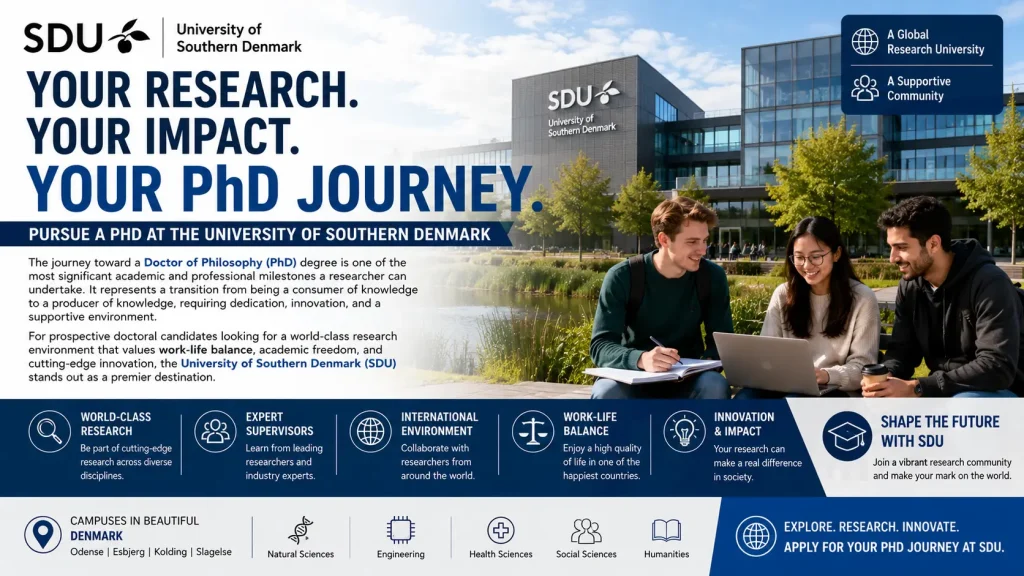
The journey toward a Doctor of Philosophy (PhD) degree is one of the most significant academic and professional milestones a researcher can undertake. It represents a transition from being a consumer of knowledge to a producer of knowledge, requiring dedication, innovation, and a supportive environment. For prospective doctoral candidates looking for a world-class research environment that values work-life balance, academic freedom, and cutting-edge innovation, the University of Southern Denmark (SDU) stands out as a premier destination.
Often, international students search for “PhD scholarships” at Danish universities. However, it is crucial to understand a unique aspect of the Danish higher education system: in Denmark, PhD positions are typically treated as salaried employment positions rather than traditional scholarships. This distinction offers significant financial security and social benefits to researchers. The University of Southern Denmark, with its multiple campuses and diverse research portfolios, offers numerous opportunities for qualified candidates to embark on this journey.
This article provides an in-depth analysis of the PhD opportunities at SDU. It covers the structure of the program, funding details, eligibility criteria, the application process, and what life is like for a PhD fellow in Denmark. Whether you are a recent master’s graduate or an experienced researcher looking to specialize further, this guide will equip you with the knowledge needed to navigate the application process successfully.
Check: PhD Positions at Chalmers University of Technology, Sweden
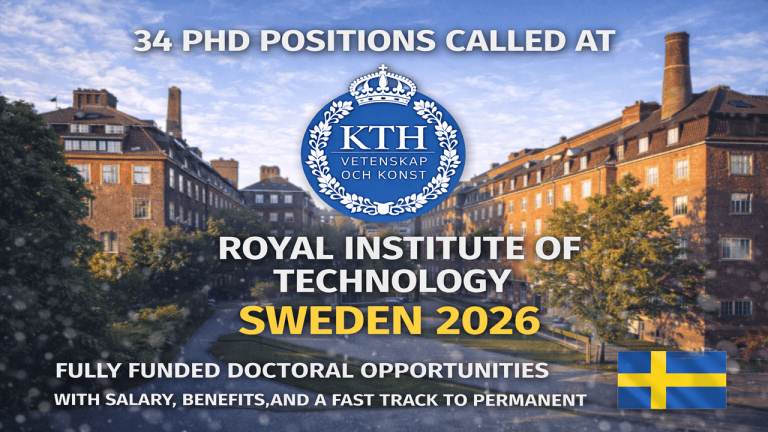
Check: Postdoc Positions at KTH Royal Institute of Technology, Sweden
About the University of Southern Denmark
The University of Southern Denmark (Syddansk Universitet) is one of the largest and most renowned universities in Denmark. Established in 1966, it has grown into a modern institution with a strong international profile. SDU is not confined to a single location; it operates across five campuses in Odense, Kolding, Esbjerg, Sønderborg, and Copenhagen. This multi-campus structure allows for specialized research environments tailored to specific industries and academic disciplines.
- Odense: The main campus, hosting a wide range of faculties including Humanities, Social Sciences, and Science.
- Kolding: Known for its focus on business, design, and communication.
- Esbjerg: A hub for engineering, energy technologies, and health sciences.
- Sønderborg: Specializes in mechatronics, robotics, and international business.
- Copenhagen: Focuses primarily on public health and medical research.
SDU is consistently ranked among the top young universities globally. It is a member of the Coimbra Group and the Utrecht Network, emphasizing its commitment to international collaboration. The university places a heavy emphasis on interdisciplinary research, encouraging PhD fellows to work across traditional faculty boundaries. This approach fosters innovation and prepares researchers for complex real-world problems. Furthermore, SDU maintains strong ties with industry partners, ensuring that research is not only theoretically sound but also practically applicable.
The Danish PhD Model: Employment vs. Scholarship
One of the most attractive features of pursuing a doctorate in Denmark is the employment model. Unlike many other countries where PhD students rely on stipends that may barely cover living expenses, PhD fellows at the University of Southern Denmark are employed by the university. This status comes with a full salary, pension contributions, and paid holiday allowance.
Salary and Benefits
As a PhD fellow at SDU, you are placed on the collective agreement salary scale. The monthly salary is competitive and designed to allow researchers to live comfortably in Denmark. As of recent data, the gross monthly salary starts at approximately 30,000 DKK (Danish Kroner) and increases annually. From this salary, tax and pension contributions are deducted.
In addition to the base salary, benefits include:
- Pension: A significant contribution is made by the employer to your pension fund.
- Holiday Allowance: You accrue paid holiday (typically 5 weeks per year) with holiday pay.
- Social Security: As an employee, you are covered by the Danish social security system.
- Research Budget: PhD fellows are often allocated a specific budget to attend international conferences, workshops, and fieldwork, ensuring they can network and present their findings globally.
Duration and Structure
The standard duration of a PhD program at SDU is three years of full-time study. However, some positions are advertised as “4-year positions.” In these cases, the fourth year is dedicated to teaching duties or other work tasks within the department, while the first three years are devoted exclusively to research. This structure provides valuable pedagogical experience, which is beneficial for those aiming for academic careers.
The program is structured around individual research projects. While there may be some mandatory coursework (typically around 30 ECTS points), the primary focus is on the production of a PhD thesis. The environment is informal and egalitarian; PhD fellows are colleagues to their supervisors, fostering a relationship based on mutual professional respect rather than a strict hierarchy.
Research Faculties and Areas of Study
The University of Southern Denmark is divided into several faculties, each offering distinct PhD opportunities. Understanding these faculties is vital for targeting your application effectively.
1. The Faculty of Science
This faculty covers a broad spectrum of natural sciences, including Biology, Chemistry, Physics, Mathematics, and Computer Science. Research here is often linked to sustainability, climate change, and digital transformation. SDU is particularly known for its research in robotics and autonomous systems, often in collaboration with the robotics cluster in Odense.
2. The Faculty of Engineering
With campuses in Odense, Sønderborg, and Esbjerg, this faculty focuses on Mechanical, Electrical, and Chemical Engineering. There is a strong emphasis on Industry 4.0, renewable energy, and welfare technology. PhD projects here often involve direct collaboration with engineering firms, providing a pathway to industrial R&D careers.
3. The Faculty of Health Sciences
This faculty is a leader in medical research, public health, and sports science. Research areas include cancer biology, cardiovascular diseases, and health promotion. The faculty works closely with Odense University Hospital, providing PhD fellows with access to clinical data and patient cohorts.
4. The Faculty of Humanities
Research in the humanities at SDU explores culture, language, history, and philosophy. There is a strong focus on digital humanities, where traditional analysis is combined with computational methods. PhD fellows in this faculty often engage in archival work, fieldwork, and cross-cultural studies.
5. The Faculty of Social Sciences
This faculty covers Law, Business, Economics, and Political Science. Research often addresses societal challenges, such as migration, economic inequality, and corporate governance. The SDU Centre for Corporate Governance is a notable hub for research in this area.
Eligibility Criteria for PhD Positions
To be considered for a PhD position at the University of Southern Denmark, applicants must meet specific academic and administrative requirements. These criteria are strictly enforced to ensure the quality of the research program.
Academic Qualifications
The primary requirement is a completed Master’s degree (or equivalent) that is relevant to the PhD project. The degree must be recognized by the Danish Agency for Higher Education and Science. In terms of grades, applicants generally need a grade average that corresponds to a Danish grade of 8.0 or higher on the 7-point grading scale. For international grades, this usually translates to a high distinction or a GPA in the top tier of your graduating class.
ECTS Requirements
Danish universities pay close attention to the European Credit Transfer and Accumulation System (ECTS). Typically, your Master’s degree should comprise 120 ECTS, with a significant portion dedicated to the thesis. If your degree is from outside the EU/EEA, an assessment of your transcript will be conducted to ensure equivalence.
Language Proficiency
Since the working language at SDU is English for most research projects, proficiency in English is mandatory. If your Master’s degree was not taught in English, you may need to provide documentation such as IELTS or TOEFL scores. However, for many positions, the application process itself (CV and cover letter in English) serves as proof of proficiency. Knowledge of Danish is not required for the PhD itself but can be beneficial for daily life and integration.
Research Proposal
For advertised projects, you do not usually need to write a new proposal; you must demonstrate how your background fits the existing project description. However, for some faculties, you may be asked to refine the project outline during the interview process. If you are applying for a self-funded or open application PhD, a detailed research proposal (5-10 pages) is required.
Step-by-Step Application Guide
Securing a PhD position at SDU is competitive. The process requires careful preparation and attention to detail. Below is a comprehensive guide to navigating the application process.
Step 1: Finding Vacancies
PhD positions at SDU are advertised as job vacancies. They are not always available year-round; they open when funding is secured for a specific project. Therefore, regular monitoring of the official job portal is essential.
Official Application Link: To view current PhD vacancies and submit applications, you must visit the official SDU job portal.
Link: https://www.sdu.dk/en/om-sdu/job+sdu/phd-stillinger
Bookmark this page and check it frequently. You can also set up job alerts if the portal allows, or follow SDU’s LinkedIn page where vacancies are often promoted.
Step 2: Preparing Your Documents
A complete application usually consists of the following documents:
- Cover Letter: This should be tailored to the specific project. Explain why you are interested in this topic, how your skills match the requirements, and what you hope to achieve. Avoid generic templates.
- Curriculum Vitae (CV): Use a European format (Europass) or a clean, academic layout. Include your education, publications, conference presentations, teaching experience, and technical skills.
- Degree Certificates and Transcripts: Scanned copies of your Bachelor’s and Master’s diplomas and grade transcripts. If they are not in English or a Scandinavian language, include authorized translations.
- Publication List: Highlight any peer-reviewed articles, even if they are under review.
- References: Contact details for two or three academic referees who can vouch for your research potential.
Step 3: Submission
Applications are submitted digitally through the link provided in the job advertisement. Ensure all files are in PDF format and clearly named (e.g., Surname_CV.pdf). Late applications are generally not accepted, so aim to submit at least a day before the deadline.
Step 4: Assessment and Interview
Once the deadline passes, an assessment committee reviews the applications. They shortlist candidates based on academic merit and fit. If shortlisted, you will be invited for an interview. This may be conducted via video conference (Zoom or Teams) or in person. The interview is a two-way process: they assess you, and you assess the department. Be prepared to discuss your past research in depth and ask questions about the supervision team and facilities.
Step 5: Offer and Onboarding
If successful, you will receive a contract offer. Upon acceptance, the university’s HR department will guide you through the onboarding process, which includes obtaining a Danish tax card and CPR number (personal identification number).
Life as a PhD Fellow in Denmark
Moving to a new country for doctoral studies is a life-changing experience. Denmark is consistently ranked as one of the happiest countries in the world, known for its high quality of life, safety, and social welfare system. However, there are practical aspects to consider.
Cost of Living and Housing
While the PhD salary is generous, Denmark has a high cost of living, particularly regarding housing and taxation. Odense, the main campus city, is more affordable than Copenhagen, but finding accommodation can still be challenging. It is advisable to start looking for housing as soon as you receive your offer. SDU often assists international staff with housing guidance, but securing a lease is ultimately the responsibility of the fellow. Student dormitories are available but may have waiting lists.
The CPR Number and Tax
Upon arrival, you must register with the Danish Civil Registration System to obtain a CPR number. This number is your key to society; you need it to open a bank account, see a doctor, and sign a mobile phone contract. As a tax resident, you will pay income tax, which funds the free healthcare and education systems. The tax rate is progressive, but the benefits you receive in return are substantial.
Work-Life Balance
Danish culture places a high value on work-life balance. It is common to work standard hours (37 hours per week) and leave on time to spend with family or pursue hobbies. This culture extends to the PhD environment. While research requires dedication, burnout is taken seriously, and supervisors are generally supportive of maintaining a healthy balance. This environment fosters sustainable productivity over the three-year period.
Integration and Culture
Danes are known for being reserved initially but warm and loyal once a friendship is established. As a PhD fellow, you will be part of a department, which is the best way to integrate. Participate in Friday cakes (a common tradition), department lunches, and social events. Additionally, SDU offers integration programs for international employees, including Danish language courses, which are often free for staff. Learning the language, even at a basic level, helps significantly with daily errands and social integration.
Career Prospects After the PhD
Completing a PhD at the University of Southern Denmark opens doors to various career paths. The skills acquired—critical thinking, project management, data analysis, and communication—are highly transferable.
Academic Career
Many PhD graduates aim for postdoctoral positions or assistant professorships. SDU’s reputation supports applications to universities worldwide. The teaching experience gained during the optional fourth year of the PhD is particularly valuable for academic job markets.
Industry and R&D
Given SDU’s strong industry links, many graduates transition into Research and Development roles in the private sector. This is especially true for engineering, science, and health graduates. Companies value the problem-solving abilities of PhD holders. The “Industrial PhD” scheme is also an option, where the research is conducted in collaboration with a company, often leading to direct employment upon graduation.
Public Sector and NGOs
Graduates from the social sciences and humanities often find roles in government agencies, think tanks, and non-governmental organizations. The ability to conduct rigorous policy analysis is in high demand in these sectors.
Frequently Asked Questions
Q: Can I bring my family with me?
A: Yes. As a PhD employee, you have the right to family reunification. Your spouse and children can apply for residence permits. Your spouse may also be eligible to work in Denmark full-time.
Q: Is tuition free?
A: Yes. Since PhD fellows are employees, there are no tuition fees. You receive a salary instead of paying fees.
Q: Do I need to know Danish to apply?
A: No. Most research environments at SDU operate in English. However, learning Danish is encouraged for social integration.
Q: What if my degree is not from an EU country?
A: Your degree will be assessed for equivalence. You may need to provide detailed course descriptions to verify that your Master’s level matches Danish standards.
Q: Are there scholarships for travel?
A: Yes. PhD departments usually have travel grants available for attending conferences. You apply for these internally once you are employed.
Strategic Tips for a Successful Application
To maximize your chances of securing a position at SDU, consider the following strategic advice:
- Tailor Your Narrative: Do not send the same cover letter to every position. Read the project description thoroughly. If the project mentions specific methodologies (e.g., qualitative interviews, machine learning), highlight your experience with those specific tools in your application.
- Contact the Supervisor: While not always mandatory, sending a polite email to the contact person listed in the job advertisement can be beneficial. Express your interest and ask a specific question about the research project. This shows initiative and genuine engagement.
- Highlight Publications: If you have published papers during your Master’s, make sure they are prominent in your CV. If you have papers under review, state their status clearly. Research output is the primary metric for PhD selection.
- Prepare for the Interview: Research the department’s recent publications. During the interview, show that you understand the broader context of the project and how it fits into the department’s research strategy.
- Be Mindful of Deadlines: Danish administrative processes are strict. Missing a deadline by even an hour can disqualify your application. Set your own internal deadline 24 hours before the official one.
Conclusion
The University of Southern Denmark offers a robust, supportive, and financially secure environment for doctoral research. The model of treating PhD candidates as employees rather than students sets Denmark apart, providing a level of professional stability that allows researchers to focus on their work without the stress of financial insecurity. With its multi-campus structure, SDU provides access to diverse research facilities and industry partnerships, ensuring that the work done is both academically rigorous and socially relevant.
Pursuing a PhD is a demanding endeavor, but the rewards extend beyond the degree itself. It is an opportunity to develop expertise, contribute to global knowledge, and build a professional network that spans continents. The combination of high-quality supervision, excellent research infrastructure, and the high quality of life in Denmark makes SDU an ideal choice for ambitious scholars.
If you are ready to take the next step in your academic career, we encourage you to explore the current vacancies. Prepare your documents meticulously, highlight your research potential, and embrace the opportunity to join a vibrant international community. The path to a PhD at the University of Southern Denmark is competitive, but for those who are prepared and passionate, it is a pathway to a rewarding future.
Ready to apply? Visit the official portal today to find your next research opportunity:
https://www.sdu.dk/en/om-sdu/job+sdu/phd-stillinger
Embark on your journey of discovery at the University of Southern Denmark, where innovation meets tradition, and where your research can make a tangible impact on the world.