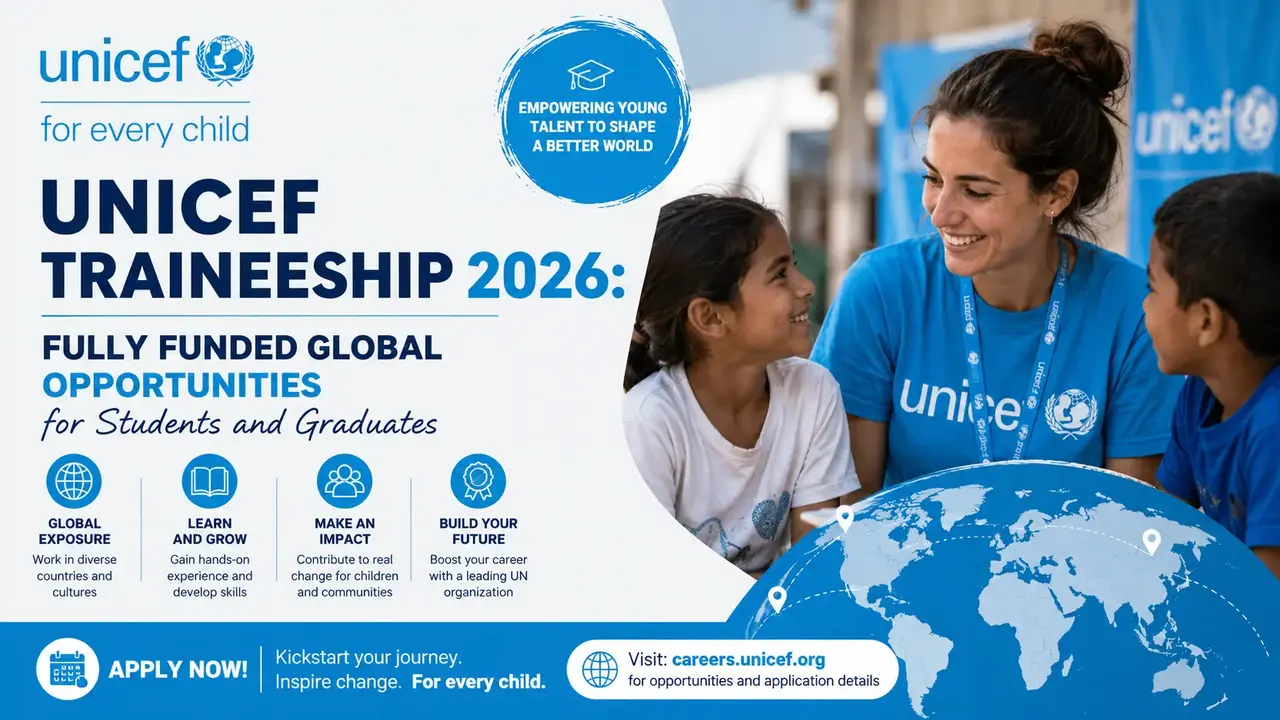
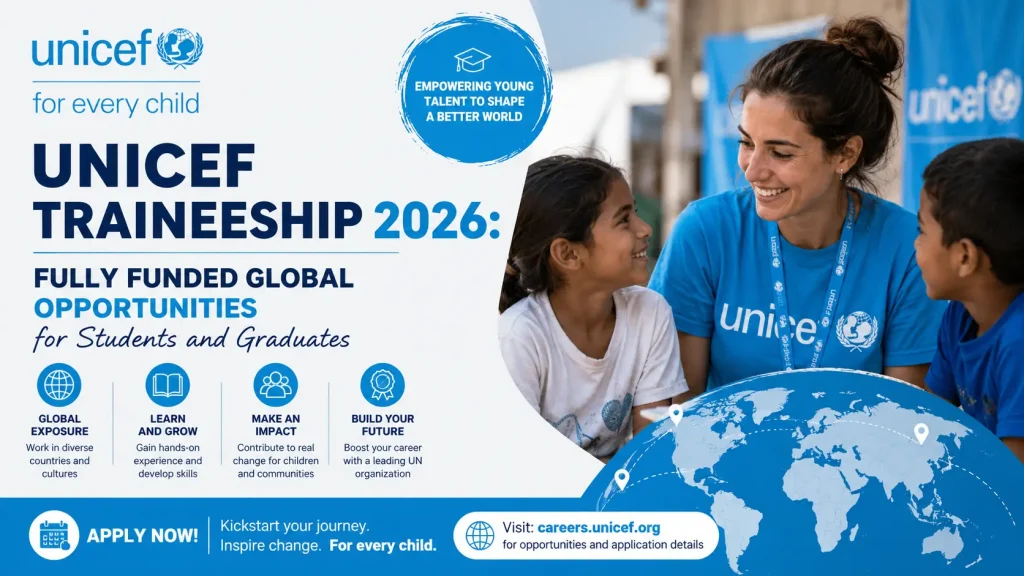
UNICEF Traineeship 2026: Fully Funded Global Opportunities
Imagine working on the frontlines of global development—helping children access clean water, building climate-resilient schools, or designing emergency response systems for vulnerable communities. Now imagine doing that with a world-class organization like UNICEF, while receiving a monthly stipend, travel support, and professional mentorship.
This is not a distant dream. It is the UNICEF Traineeship / Internship 2026 – a fully funded program open to students and recent graduates from all nationalities. Whether you are an engineer, a policy enthusiast, or a project management professional, UNICEF offers a unique platform to apply your skills to the world’s most pressing challenges.
In this article, we break down everything you need to know about the UNICEF Traineeship 2026: eligibility, benefits, application process, official links, and why this program is a game-changer for your career.
Check: A Comprehensive Guide to PhD Positions at the University of Bern
Overview of UNICEF Traineeship 2026
| Feature | Details |
|---|---|
| Organization | UNICEF (United Nations Children’s Fund) |
| Program | UNICEF Internship / Traineeship 2026 |
| Coverage | Fully Funded (stipend, travel, mentorship) |
| Eligible Nationalities | All nationalities worldwide |
| Location | Worldwide (multiple countries and remote opportunities) |
| Application Deadline | Open throughout the year (varies by vacancy) |
| Official Careers Portal | https://www.unicef.org/careers/internships |
UNICEF operates in over 190 countries. Its internships are designed to provide hands-on experience in international development, humanitarian action, and policy work. Whether you are in Accra, New York, Bangkok, or working remotely, you will be part of a global mission: to save and improve the lives of children.
Eligibility Criteria
UNICEF seeks talented, motivated individuals from diverse academic backgrounds. The requirements vary by internship position, but the general criteria are:
- Educational status: You must be enrolled in a degree program (undergraduate, graduate, or PhD) or have graduated within the past two years.
- Language proficiency: Fluency in English is required. Knowledge of another UN language (French, Spanish, Arabic, Chinese, Russian) is an asset.
- Age: You must be at least 18 years old.
- No close relatives working at UNICEF: To avoid conflicts of interest.
- Visa/work authorization: You must have the legal right to live and work in the country of the internship (UNICEF can sometimes assist with visa processes).
Important: There is no “one-size-fits-all” eligibility. Each vacancy lists specific requirements (e.g., background in civil engineering, public health, data analysis, or communications). Always read the job description carefully.
Benefits: Why This Is a Fully Funded Opportunity
UNICEF internships are fully funded – meaning you do not need to worry about financial barriers. The benefits package typically includes:
| Benefit | Details |
|---|---|
| Monthly Stipend | Varies by location (covers living expenses; approximate range USD 1,000–2,000 per month) |
| Travel Support | Round-trip airfare or transportation allowance (for on-site internships) |
| Remote Options | Many positions are fully remote, allowing you to work from your home country |
| Professional Training | Access to UNICEF’s learning platform, webinars, and mentorship programs |
| Career Development | Networking with UN professionals, potential references, and possible extension or conversion to consultant roles |
| Work Experience | Real-world projects in international development, humanitarian response, and policy |
Note: Benefits vary per position. Remote internships may not include travel support, but they still offer a stipend and valuable experience.
Application Process – Step by Step
Applying for a UNICEF Traineeship is straightforward. Follow these steps:
- Visit the UNICEF Careers Website
Go to the official internship portal: https://www.unicef.org/careers/internships - Search Open Internship Vacancies
Use the search filters to find internships by location, function, or keyword (e.g., “WASH,” “climate,” “engineering,” “programme management”). - Review Eligibility Criteria
Click on each vacancy to read the detailed requirements. Ensure you meet the educational background, language skills, and any specific technical qualifications. - Prepare Your Documents
Typically, you will need:- Updated CV/Resume (max 2 pages)
- Cover letter (tailored to the specific internship)
- Academic transcripts (optional, but helpful)
- Proof of enrollment or recent graduation
- Two reference letters (sometimes required)
- Update Your CV/Resume
Highlight relevant coursework, projects, volunteer work, and any previous experience in development, engineering, or research. - Submit Your Online Application
Complete the application form on the UNICEF career portal. Attach all documents and submit before the deadline.
Deadline: There is no single deadline. Vacancies are posted throughout the year. Check the portal regularly – or better yet, set up job alerts.
Why a UNICEF Traineeship Is Invaluable
An internship at UNICEF is not just a line on your CV. It is a transformative experience that offers:
1. Exposure to International Development
You will work alongside experts in child protection, education, health, and emergency response. You will learn how large-scale humanitarian projects are planned, funded, and executed.
2. Hands-On Humanitarian Projects
UNICEF responds to crises – from earthquakes in Turkey to floods in Pakistan. Interns often contribute directly to emergency operations, gaining real-world experience that few other opportunities can match.
3. Climate Resilience and Sustainability Initiatives
UNICEF is increasingly focused on climate resilience, sustainable infrastructure, and water, sanitation, and hygiene (WASH) programs. If you have a background in environmental or civil engineering, this is where you can make a tangible impact.
4. Project Management and Policy Work
Interns assist in monitoring and evaluation, budget planning, policy analysis, and stakeholder coordination. These skills are transferable to any career in the public, private, or non-profit sector.
5. Global Networking
You will build relationships with UN staff, government officials, NGOs, and other interns from around the world. These connections can open doors to future roles at UNICEF, other UN agencies, or leading development organizations.
Relevance to Your Profile (Civil Engineering, Environmental Engineering, Sustainable Infrastructure, Project Management)
The user note specifically highlights that with a background in civil engineering, environmental engineering, sustainable infrastructure, and project management, certain UNICEF internships are highly relevant. Here is why:
UNICEF operates large-scale programs in:
- Water, Sanitation, and Hygiene (WASH) – Designing and constructing water supply systems, sanitation facilities, and hygiene promotion campaigns.
- Climate Resilience – Building infrastructure that withstands extreme weather, such as climate-proof schools and health centers.
- Sustainable Infrastructure – Managing construction projects for schools, hospitals, and emergency shelters.
- Programme Management – Overseeing budgets, timelines, and deliverables for development projects.
- Construction and Facilities Management – Ensuring UNICEF’s own offices and field accommodations meet safety and environmental standards.
If you search the UNICEF careers portal for keywords like “WASH,” “engineering,” “construction,” “infrastructure,” or “climate adaptation,” you will find positions that match your skills.
Pro tip: Instead of applying for general administrative internships, target WASH Officer internships, Programme Associate internships, or Climate Resilience internships. These roles will leverage your technical expertise and provide deeper project experience.
Remote vs. On-Site Opportunities
UNICEF offers both remote and on-site internships. Remote positions are ideal if you cannot relocate or are balancing studies. On-site internships provide immersion in a country office, cultural exposure, and stronger networking.
Where to find remote internships: Use the “Location” filter on the UNICEF careers page and select “Remote” or “Home-based.”
Official Links Summary
| Resource | Link |
|---|---|
| UNICEF Internships Main Page | https://www.unicef.org/careers/internships |
| Search All Current Internship Vacancies | https://jobs.unicef.org/en-us/listing/ |
| Frequently Asked Questions (FAQs) about Internships | https://www.unicef.org/careers/internships-faq |
| UNICEF Careers Home | https://www.unicef.org/careers |
| UNICEF WASH Programme | https://www.unicef.org/wash |
| UNICEF Climate Action | https://www.unicef.org/climate-action |
Bookmark these pages and check them weekly. New vacancies are posted frequently.
Conclusion
The UNICEF Traineeship 2026 is more than just an internship – it is a launchpad for a career in global development. With full funding, diverse locations, and the chance to work on projects that matter, it is an opportunity you cannot afford to miss.
This is not a shadowing experience or a passive observational role. UNICEF trainees are actively involved in meaningful work. Depending on the position, a trainee might support the design of a water and sanitation program, analyze data for an education initiative, assist with communications and advocacy campaigns, contribute to climate resilience planning, or help manage logistics for a humanitarian response. The work is real, the expectations are professional, and the learning is immense.
For professionals and students in engineering, sustainability, and project management, UNICEF offers a direct path to apply your technical skills to the world’s most urgent challenges. Whether you want to design climate-resilient schools in Uganda or manage water supply projects in Bangladesh, UNICEF has a place for you.
Start your application today. Visit the careers portal, find a vacancy that excites you, and take the first step toward a career that changes lives – including your own.
👉 Apply for UNICEF Internships Now
Frequently Asked Questions (FAQs)
1. Do I need to be a student to apply?
You must be enrolled in a degree program (any level) or have graduated within the past two years. Recent graduates are eligible.
2. Is the internship paid?
Yes. UNICEF internships are fully funded. You receive a monthly stipend to cover living expenses. Travel support is provided for on-site positions in many cases.
3. Can I apply for a remote internship?
Yes. UNICEF offers many remote internships. Use the location filter on the careers page and select “Remote” or “Home-based.”
4. How long does a UNICEF internship last?
Typically between 6 weeks and 6 months. Some internships can be extended up to 12 months.
5. What documents do I need?
A CV/resume, cover letter, proof of enrollment or graduation, and sometimes a writing sample or references. Each vacancy specifies the required documents.
6. Are there internship opportunities specifically for engineers?
Yes. UNICEF has a dedicated WASH (Water, Sanitation, Hygiene) program and Climate Resilience initiatives that actively recruit civil, environmental, and sustainable infrastructure engineers. Search for keywords like “WASH,” “engineering,” or “infrastructure” on the careers portal.
Start your journey with UNICEF today – because every child deserves a future, and you can help build it.