Australian Government Research Training Program (RTP)
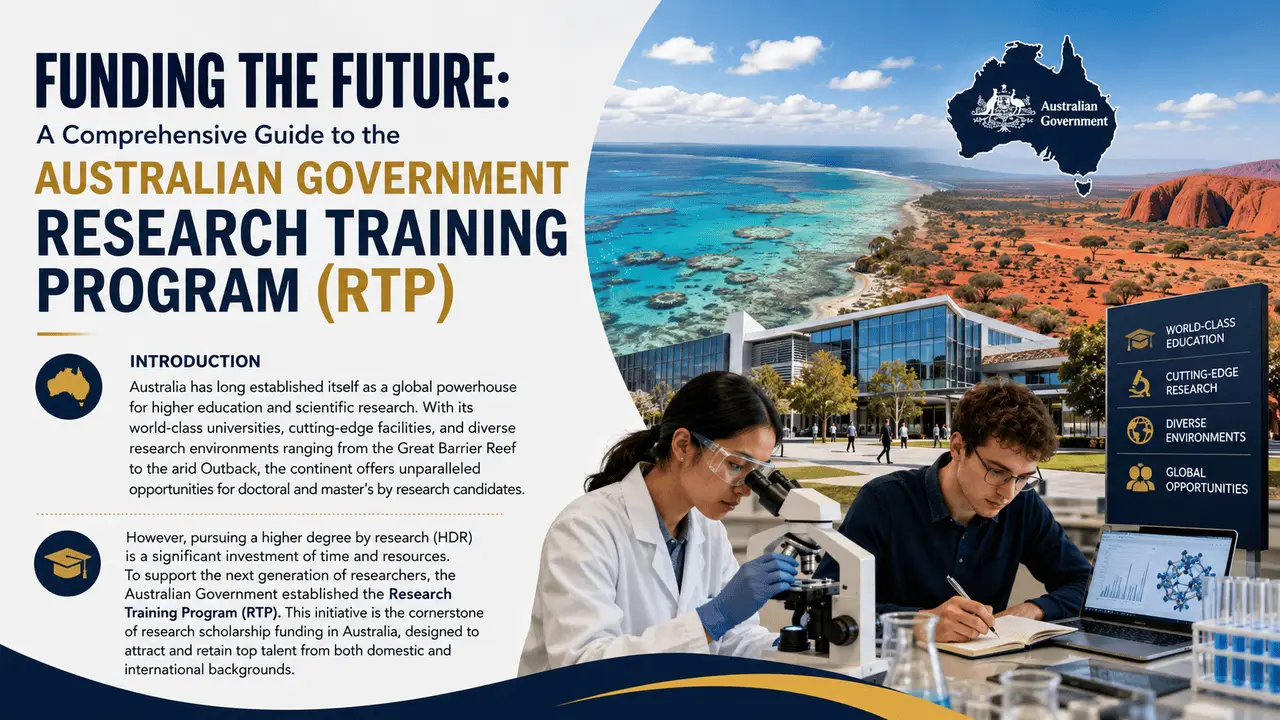
Australia has long established itself as a global powerhouse for higher education and scientific research. With its world-class universities, cutting-edge facilities, and diverse research environments ranging from the Great Barrier Reef to the arid Outback, the continent offers unparalleled opportunities for doctoral and master’s by research candidates. However, pursuing a higher degree by research (HDR) is a significant investment of time and resources. To support the next generation of researchers, the Australian Government established the Research Training Program (RTP). This initiative is the cornerstone of research scholarship funding in Australia, designed to attract and retain top talent from both domestic and international backgrounds.
For prospective students, understanding the RTP is crucial. It is not merely a scholarship; it is a comprehensive support package that covers tuition fees, provides a living allowance, and offers additional grants for research costs. Navigating the complexities of this program can be the difference between a successful application and a missed opportunity. This article provides an exhaustive guide to the Australian Government Research Training Program. It details the structure of the funding, eligibility criteria, the nuanced application process, and what life looks like for an RTP scholar in Australia. Whether you are a local student aiming to contribute to national innovation or an international researcher seeking a global platform, this guide will equip you with the knowledge to secure this prestigious funding.
Check: PhD Scholarships at the University of Southern Denmark: Complete Guide for International Students
Check: PhD Positions at Chalmers University of Technology, Sweden
What is the Research Training Program (RTP)?
The Research Training Program (RTP) is an Australian Government initiative administered by the Department of Education. It replaced the previous International Postgraduate Research Scholarship (IPRS) and Australian Postgraduate Award (APA) schemes in 2017. The primary objective of the RTP is to support students undertaking a research higher degree, such as a Doctor of Philosophy (PhD) or a Master’s by Research, at an Australian university.
Unlike many scholarships that are awarded directly by a central government body, the RTP allocations are distributed to eligible higher education providers (universities). The universities then manage the selection and allocation of these scholarships to candidates based on merit. This decentralized approach ensures that funding is aligned with the specific research strengths and strategic priorities of each institution. The program is highly competitive, reflecting the Australian Government’s commitment to building research capacity and fostering innovation that benefits the economy and society.
The RTP is designed to be inclusive. While there are specific quotas for international students to ensure Australia remains a attractive destination for global talent, a significant portion of the funding is reserved for domestic students to support national research goals. The program covers a wide array of disciplines, including science, technology, engineering, mathematics (STEM), health, medicine, humanities, arts, and social sciences. This breadth ensures that research into cultural heritage, social policy, and human behavior is valued alongside technological innovation.
The Three Pillars of RTP Support
The RTP is not a single lump sum but rather a structured package composed of three main components. Understanding these pillars is vital for financial planning during your doctoral journey.
1. RTP Fees Offset
The most significant financial burden for research students, particularly international candidates, is tuition fees. The RTP Fees Offset scholarship covers the cost of tuition fees for the duration of the research degree. For domestic students, this aligns with the Commonwealth Supported Places (CSP) system, ensuring they do not pay upfront fees. For international students, this is a massive benefit, as research degree tuition can be substantial. The Fees Offset is paid directly to the university on behalf of the student. It is typically valid for the standard duration of the degree (e.g., three years for a PhD, two years for a Master’s by Research). Extensions may be granted in certain circumstances, but this is not guaranteed and depends on university policy and remaining allocation.
2. RTP Stipend
Living expenses in Australia can be high, particularly in major cities like Sydney and Melbourne. The RTP Stipend is a living allowance paid directly to the student to cover accommodation, food, transport, and personal costs. The stipend amount is indexed annually. As of recent years, the tax-free stipend is approximately $35,000 AUD per year, though this figure can vary slightly depending on the university and specific scholarship supplements. This stipend is designed to allow the researcher to focus fully on their studies without the need for excessive part-time work. It is paid fortnightly or monthly into the student’s bank account. It is important to note that for international students, this stipend is generally tax-exempt, whereas domestic students may have tax obligations depending on their residency status for tax purposes.
3. RTP Allowances
Beyond fees and living costs, research requires resources. The RTP Allowances component provides funding for specific research-related expenses. These can include:
- Relocation Allowance: A one-off payment to help cover the cost of moving to the university city, particularly for students moving from regional areas or overseas.
- Thesis Allowance: A contribution towards the costs associated with printing and submitting the final thesis.
- Health Insurance: For international students, the allowance can cover the Overseas Student Health Cover (OSHC), which is a visa requirement.
- Fieldwork and Conference Travel: Some universities allocate a portion of the allowance to support data collection travel or attendance at international conferences to present findings.
Eligibility Criteria: Domestic vs. International
Eligibility for the RTP is strict and varies depending on whether you are classified as a domestic or international student. Misunderstanding this classification is a common pitfall for applicants.
Domestic Students
To be eligible as a domestic student, you must be an Australian citizen, a New Zealand citizen, or an Australian Permanent Resident (including a Permanent Humanitarian Visa holder). Domestic students compete for the domestic allocation of RTP places. The competition is fierce, as the pool of qualified local candidates is large. Domestic applicants must demonstrate academic excellence and research potential. There are no age limits, but applicants must not have already completed a higher degree by research at the same level unless there are compelling circumstances.
International Students
International students are those who require a student visa to study in Australia. The Australian Government sets a cap on the number of RTP places available for international candidates to ensure a balance between domestic and global support. Consequently, the bar for international applicants is often higher. You must meet the same academic merit criteria as domestic students but are competing for a smaller number of spots. Additionally, international students must meet English language proficiency requirements, typically demonstrated through IELTS, TOEFL, or PTE Academic scores. Some universities may waive this if you have completed previous degrees in English-speaking countries, but this is at the discretion of the institution.
Academic Requirements
Regardless of residency status, all applicants must hold a bachelor’s degree with first-class or second-class upper division honors, or a master’s degree with a significant research component. Your academic transcripts must show a strong grade point average (GPA). Research experience is heavily weighted; publications in peer-reviewed journals, conference presentations, or a high-quality master’s thesis can significantly boost your application.
The Application Process: A Step-by-Step Guide
One of the most confusing aspects of the RTP is that there is no central government application portal. You do not apply to the Department of Education; you apply to the university. This decentralized system means processes and deadlines vary between institutions.
Step 1: Identify a Supervisor
Before applying for funding, you must secure the interest of a potential supervisor. Research the university’s faculty pages to find academics whose work aligns with your interests. Contact them with a concise email outlining your research idea and attaching your CV. A supervisor’s support is often a prerequisite for an RTP application. They can advise on the feasibility of your project and the likelihood of funding availability within their department.
Step 2: Prepare Your Research Proposal
Most universities require a research proposal as part of the application. This document should be between 2,000 to 5,000 words, depending on the institution. It must clearly state your research question, methodology, literature review, and expected outcomes. The proposal should demonstrate originality and significance. Why does this research matter? How does it contribute to existing knowledge? A well-written proposal shows the selection committee that you are capable of independent research.
Step 3: Gather Documentation
You will need to submit certified copies of your academic transcripts, degree certificates, and proof of English language proficiency. You will also need contact details for academic referees. Choose referees who know your research capabilities well, such as former thesis supervisors. Generic character references are not sufficient; the university needs academic assessments of your potential.
Step 4: Submit via the University Portal
Once you have identified the university and prepared your documents, submit your application through the university’s online admissions portal. You will usually apply for admission to the PhD or Master’s program and indicate that you wish to be considered for the RTP scholarship simultaneously. There is rarely a separate form for the scholarship; the admission application serves as the scholarship application.
Official Information Link: For the most accurate and up-to-date information on the program guidelines, always refer to the Department of Education’s official page.
Link: https://www.education.gov.au/research-training-program
Step 5: Interview and Offer
If shortlisted, you may be invited for an interview. This could be via video conference or in person. The interview assesses your communication skills and your depth of knowledge regarding your proposed topic. If successful, you will receive a letter of offer detailing the terms of the scholarship, including the duration and value.
Strategic Tips for a Successful Application
Given the competitive nature of the RTP, a generic application is unlikely to succeed. To maximize your chances, consider the following strategic advice.
Align with National Priorities
The Australian Government prioritizes research that addresses national challenges. Themes such as climate change, health and medical research, advanced manufacturing, and digital economy are highly valued. Frame your research proposal to highlight how your work contributes to these broader goals. Even in humanities or social sciences, connecting your work to social cohesion, policy development, or cultural understanding can strengthen your case.
Demonstrate Research Capacity
Selection committees look for evidence that you can complete the degree. If you have published papers, highlight them. If you have assisted in grant writing or managed research projects, include this experience. For international students, demonstrating that you have the financial means to support yourself if the scholarship is not granted (for visa purposes) is also important, though the RTP aims to cover this.
Tailor to the University
Each university has different strengths. A project suitable for the University of Melbourne might not fit the University of Queensland. Research the department’s recent outputs and mention how your work complements their existing research groups. Showing that you have done your homework proves your genuine interest.
Start Early
Deadlines for RTP scholarships often close months before the academic year begins. For a start date in Semester 1 (February/March), applications may close as early as August or October of the previous year. Missing these deadlines means waiting another year. Create a timeline that accounts for contacting supervisors, writing proposals, and gathering documents.
Life as an RTP Scholar in Australia
Securing the RTP is only the beginning. Life as a research student in Australia offers a unique blend of professional development and lifestyle benefits.
Cost of Living and Budgeting
While the stipend is generous, budgeting is essential. Rent is the largest expense. In Sydney, a shared apartment might cost $300-$400 AUD per week, while in Adelaide or Hobart, it might be $200-$250 AUD. The stipend is designed to cover these costs, but living frugally allows you to save for travel or emergencies. Most universities offer subsidized accommodation or help finding homestays for international students.
Work Rights
RTP scholars on student visas are generally permitted to work part-time during the semester and full-time during breaks. However, the stipend is intended to be your primary income. Working too much can delay your research progress. Domestic students have no work restrictions. It is important to balance any employment with your research commitments to ensure you complete your degree within the scholarship tenure.
Support Services
Australian universities are equipped with extensive support services for HDR candidates. This includes writing centers, statistical consulting services, and mental health support. The “Graduate Research School” at each university acts as a central hub for workshops on thesis writing, time management, and career development. Taking advantage of these services is crucial for maintaining productivity and well-being.
Cultural Experience
Australia is a multicultural society with a high quality of life. As an RTP scholar, you will join a diverse community of researchers. Universities often host social events, seminars, and networking opportunities. The casual Australian culture extends to the academic environment; hierarchies are flatter than in many other countries, and students are encouraged to challenge ideas and engage in open debate with professors.
Visa Implications for International Students
For international candidates, the RTP scholarship plays a significant role in the visa application process. To obtain a Subclass 500 Student Visa, you must demonstrate financial capacity. The RTP Stipend and Fees Offset satisfy the financial requirements for the visa, simplifying the process.
When you receive the RTP offer, the university will issue a Confirmation of Enrolment (CoE). This document is required for your visa application. It is important to maintain your visa conditions throughout your study. This includes maintaining adequate health insurance (OSHC), attending classes or research meetings as required, and making satisfactory progress in your course. Failure to meet these conditions can jeopardize both your visa and your scholarship. The RTP scholarship conditions usually require you to make satisfactory academic progress. If your progress is deemed unsatisfactory by the university, the scholarship may be terminated, which would subsequently affect your visa status.
Post-Study Opportunities and Career Pathways
Completing a PhD or Master’s by research under the RTP opens doors to significant career opportunities. Australia faces a skills shortage in many research-intensive industries, making HDR graduates highly employable.
Academic Careers
Many RTP graduates pursue postdoctoral positions within Australia or internationally. The reputation of Australian universities is strong globally, particularly in fields like medicine, astronomy, and marine biology. The teaching experience gained during your PhD can also qualify you for lecturer positions.
Industry and Innovation
There is a strong push for industry collaboration in Australian research. Many projects are funded in partnership with private companies. This network can lead to direct employment upon graduation. Sectors such as mining, renewable energy, agriculture, and biotechnology actively recruit research graduates for R&D roles.
Post-Study Work Visa
International graduates may be eligible for the Temporary Graduate Visa (Subclass 485). This visa allows you to stay and work in Australia for a period after completing your studies. For PhD graduates, this period can be up to four years or more, depending on current immigration policies. This provides a valuable window to gain professional experience in Australia.
Permanent Residency Pathways
While not guaranteed, having an Australian PhD can assist with points-based migration for permanent residency. Skilled independent visas often award points for Australian qualifications and study. Research occupations are frequently on the skilled occupation lists, facilitating the pathway to permanent settlement for those who wish to remain.
Common Mistakes to Avoid
To ensure your application is not disqualified on technicalities, be aware of these common errors:
- Missing Deadlines: University deadlines are strict. Late applications are rarely accepted.
- Generic Proposals: Submitting a research proposal that looks like it was sent to ten different universities shows a lack of commitment.
- Ignoring Eligibility: Ensure you meet the residency criteria. Applying as a domestic student when you are on a temporary visa will lead to rejection.
- Poor Referee Selection: Choosing referees who cannot speak to your research ability weakens your application. Academic referees are preferred over employers unless the employer supervised research work.
- Overlooking English Requirements: Even if you are a brilliant researcher, failing to meet the minimum English score is an automatic barrier. Check if you need to take the test before applying.
Frequently Asked Questions
Q: Can I hold another scholarship alongside the RTP?
A: In many cases, yes. You can hold other scholarships, but there may be restrictions on the total value of income you can receive. You must declare all other funding sources during your application.
Q: Is the RTP stipend taxable?
A: For international students, the RTP stipend is generally tax-exempt. For domestic students, it depends on your tax residency status. You should consult the Australian Taxation Office (ATO) or a tax professional for advice specific to your situation.
Q: What happens if I need to take a leave of absence?
A: You can apply for a leave of absence for medical or compassionate reasons. During this period, your scholarship payments are usually paused, and the end date of your scholarship is extended by the duration of the leave.
Q: Can I transfer universities?
A: Transferring is possible but complex. You would need to be admitted to the new university and they must have RTP allocation available to support you. The original university must also agree to release you.
Q: Does the RTP cover Master’s by Coursework?
A: No. The RTP is strictly for research higher degrees (Master’s by Research or PhD). It does not cover coursework master’s degrees or bachelor’s degrees.
Conclusion
The Australian Government Research Training Program (RTP) represents one of the most robust and supportive scholarship schemes available to researchers globally. It removes the financial barriers to high-level education, allowing scholars to dedicate themselves to the pursuit of knowledge. The combination of tuition coverage, a living stipend, and additional allowances provides a stable foundation for a successful research career.
However, the path to securing an RTP scholarship requires diligence, preparation, and strategic planning. From identifying the right supervisor to crafting a compelling research proposal, every step of the application process is an opportunity to demonstrate your potential. The competition is stiff, but the rewards are substantial. Beyond the financial support, becoming an RTP scholar grants you access to a vibrant academic community, world-class facilities, and a lifestyle that balances professional ambition with personal well-being.
Australia is investing in its research future, and through the RTP, it is inviting you to be part of that journey. Whether your passion lies in decoding the human genome, modeling climate change, or exploring the depths of human history, the RTP provides the resources you need to make an impact. By understanding the program’s intricacies and preparing a meticulous application, you can position yourself as a top candidate.
Take the first step today. Research the universities that align with your goals, reach out to potential supervisors, and prepare your documents. The opportunity to contribute to global knowledge while living in one of the world’s most dynamic countries awaits.
For official guidelines, policy details, and further information, please visit the Department of Education’s Research Training Program page:
https://www.education.gov.au/research-training-program
Embark on your research journey with confidence. The Australian Government RTP is more than just funding; it is a partnership in innovation, designed to empower you to shape the future through discovery.