
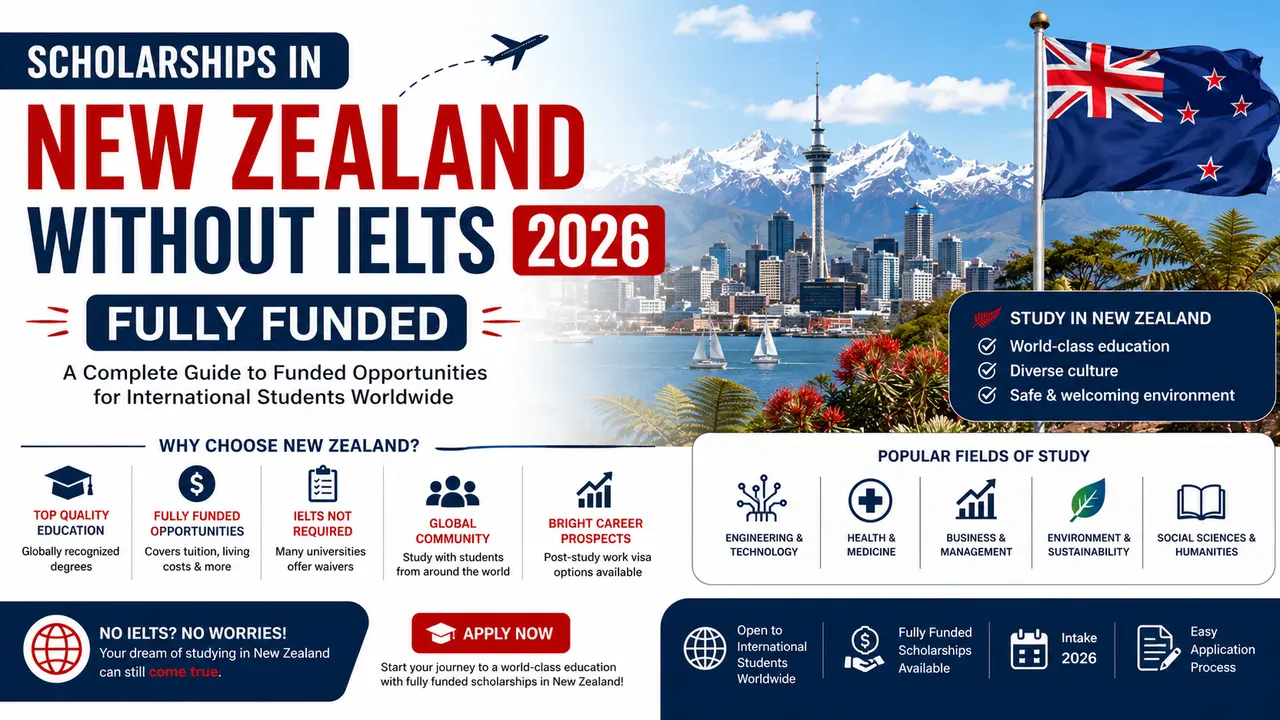
Scholarships in New Zealand Without IELTS 2026 | Fully Funded
A Complete Guide to Funded Opportunities for International Students Worldwide
Check: Research Scholarships at the University of Melbourne
Check: PhD Scholarships at the University of Luxembourg
Introduction: Why New Zealand?
New Zealand has rapidly emerged as one of the most sought-after study destinations in the world, and for good reason. Known for its world-class education system, safe and multicultural society, breathtaking natural landscapes, and post-study work opportunities, New Zealand offers international students an experience that blends academic excellence with quality of life. In 2026, the New Zealand government, in collaboration with leading universities, continues to invest heavily in scholarships that are open to students from over 100 countries — including Pakistan, India, the Philippines, Sri Lanka, Fiji, and Pacific Island nations — without necessarily requiring an IELTS score.
This comprehensive guide covers everything you need to know about Scholarships in New Zealand Without IELTS in 2026, including fully funded opportunities, eligibility requirements, application procedures, official apply links, and a detailed FAQ section to address all your concerns.
Understanding the New Zealand Scholarship Landscape
New Zealand offers a diverse range of scholarships at the undergraduate, postgraduate (Masters and PhD), and doctoral levels. These scholarships are broadly categorized into three main types:
1. New Zealand Scholarships (NZS) – Government-Funded
The New Zealand Scholarships (NZS) program is the flagship international scholarship initiative of the New Zealand Government. Managed by the Ministry of Foreign Affairs and Trade (MFAT), these scholarships are offered to students from selected developing countries, particularly in the Pacific, Asia, Africa, and Latin America.
- Funding Coverage: Full tuition fees, living allowance, establishment allowance, medical and travel insurance, and economy airfare.
- Study Levels: Undergraduate, Masters, and PhD.
- Fields of Study: Science, engineering, education, public health, environmental studies, governance, agriculture, and more.
- Official Website: https://www.mfat.govt.nz/en/scholarships-and-funding/new-zealand-scholarships
2. Manaaki New Zealand Scholarships
The Manaaki New Zealand Scholarships program is a prestigious initiative designed specifically for students from the Pacific Islands, Southeast Asia, and select countries in the Middle East and Africa. These scholarships are short-course awards focused on professional development and capacity building.
- Funding Coverage: Tuition fees, living costs, establishment allowance, health insurance, and travel costs.
- Duration: Short courses ranging from 2 weeks to 2 years.
- Eligible Countries: Over 140 countries including Samoa, Tonga, Papua New Guinea, Indonesia, Thailand, Vietnam, Bangladesh, Nepal, and many more.
- Official Website: https://www.manaaki.nzscholars.govt.nz/
3. University-Specific Scholarships Without IELTS
Several top-ranked New Zealand universities offer their own scholarship programs that either waive the IELTS requirement or accept alternative English proficiency evidence. These are particularly beneficial for international students who may not have taken the IELTS exam but have completed previous education in English-medium institutions.
How to Qualify Without IELTS
One of the most common barriers international students face is the IELTS requirement. However, New Zealand universities and scholarship programs provide several alternatives:
Alternative English Proficiency Tests Accepted:
- TOEFL iBT (Test of English as a Foreign Language) – Most New Zealand universities accept TOEFL scores.
- PTE Academic (Pearson Test of English) – Widely accepted across all institutions.
- Cambridge English Qualifications (CAE, CPE) – Recognized by many universities.
- Occupational English Test (OET) – Accepted for health-related programs.
IELTS Waiver Conditions:
If you meet any of the following criteria, you may be eligible for an IELTS waiver:
- Previous Education in English Medium: If you completed your previous degree (bachelor’s or master’s) from a recognized university where the medium of instruction was English, many New Zealand universities will waive the IELTS requirement.
- Native English Speaker: Students from countries where English is the sole official language are typically exempt.
- University Pathway Programs: Many universities offer English language pathway programs (also called Foundation or Pre-Master’s programs). Successful completion of these programs fulfills the English language entry requirement.
- Internal English Assessment: Some universities conduct their own English language assessment as part of the admissions process.
Universities Offering IELTS Waivers and Scholarships:
University of Auckland
New Zealand’s top-ranked university offers numerous scholarships including the International Student Excellence Scholarship and Doctoral Scholarships. IELTS may be waived for students with prior English-medium education.
University of Canterbury
Offers the UC International First Year Scholarship and UC Doctoral Scholarship. Accepts TOEFL and PTE as IELTS alternatives.
University of Waikato
Known for its flexible English language entry requirements. Offers the International Excellence Scholarship and International Merit Scholarship.
Lincoln University
Specializes in land-based studies and offers scholarships for international students with flexible English requirements.
Auckland University of Technology (AUT)
Offers the AUT International Scholarship and Vice-Chancellor’s Doctoral Scholarship. Accepts multiple English proficiency tests.
- Website: https://www.aut.ac.nz/study-at-aut/scholarships-and-fees/scholarships/international-scholarships
Massey University
Provides the Massey University International Scholarship and various doctoral funding packages.
Victoria University of Wellington
Offers the Victoria University of Wellington International Excellence Scholarship with flexible English entry criteria.
Detailed Funding Coverage
Fully Funded Scholarships (NZS and Manaaki):
| Benefit | Coverage |
|---|---|
| Tuition Fees | Full tuition for the entire program duration |
| Living Allowance | NZD $300–$500+ per week depending on scholarship type |
| Establishment Allowance | One-time payment upon arrival (approximately NZD $1,000–$3,000) |
| Airfare | Economy class return airfare from home country to New Zealand |
| Health Insurance | Comprehensive medical and accident insurance (ACC-covered) |
| Academic Costs | Thesis/dissertation printing, fieldwork costs (where applicable) |
| Dependent Allowance | Additional support for accompanying spouse and/or children (for some programs) |
University Scholarships:
University-specific scholarships typically cover partial or full tuition fee waivers, ranging from 25% to 100% of tuition fees. Some also include a living stipend.
Eligibility Criteria
While specific requirements vary by scholarship and institution, the general eligibility criteria include:
- Nationality: Must be a citizen of an eligible country (check the specific scholarship’s country list).
- Academic Excellence: Strong academic record — typically a minimum GPA of 3.0 on a 4.0 scale or equivalent.
- Study Level: Scholarships are available for undergraduate, postgraduate, and doctoral studies.
- Age Limits: Some scholarships (especially NZS) have age caps, typically between 25 and 40 years depending on the program level.
- Work Experience: Some programs, particularly for Masters and PhD, may require relevant professional experience.
- English Proficiency: IELTS, TOEFL, PTE, or proof of prior English-medium education (waiver eligible).
- Return Commitment: Many government scholarships require recipients to return to their home country upon completion of studies and contribute to national development.
Step-by-Step Application Guide
Step 1: Research and Choose Your Program
Visit the official New Zealand Scholarships website and university scholarship pages to identify programs aligned with your academic and career goals.
Step 2: Check Eligibility
Carefully review the eligibility criteria for your chosen scholarship, including nationality requirements, age limits, and academic qualifications.
Step 3: Prepare Required Documents
Typical documents include:
- Academic transcripts and certificates
- Valid passport
- Research proposal (for PhD applicants)
- Letters of recommendation (usually 2–3)
- Statement of purpose
- Proof of English proficiency (or IELTS waiver documentation)
- Work experience certificates (if applicable)
Step 4: Apply Online
Submit your application through the official portal before the deadline.
Step 5: Interview (If Shortlisted)
Some scholarships require an interview — either in-person or via video conference.
Step 6: Acceptance and Visa Application
Upon receiving the scholarship offer, apply for a student visa through Immigration New Zealand.
- Immigration New Zealand: https://www.immigration.govt.nz/new-zealand-visas/apply-for-a-visa/about-visa/visitor-visa/student-visa
Important Application Deadlines
Deadlines vary by scholarship program. Generally:
- New Zealand Scholarships (NZS): Applications typically open in February–March and close by April–May each year. Exact dates are published on country-specific pages.
- Manaaki New Zealand Scholarships: Rolling applications with varying deadlines per country.
- University Scholarships: Most have deadlines in July–October for programs starting the following February (Semester 1).
⚠️ Always check the official websites for the most up-to-date 2026 deadline information.
Official Apply Links
Frequently Asked Questions (FAQs)
Q1: Can I study in New Zealand without IELTS?
Yes. Many New Zealand universities and scholarship programs accept alternative English proficiency tests such as TOEFL, PTE Academic, and Cambridge English. Additionally, if your previous education was conducted entirely in English, you may qualify for an IELTS waiver. Contact the admissions office of your chosen university for specific waiver policies.
Q2: Are there fully funded scholarships in New Zealand for international students?
Yes. The New Zealand Scholarships (NZS) program offers fully funded opportunities covering tuition, living allowance, airfare, health insurance, and establishment grants. Manaaki New Zealand Scholarships also provide comprehensive funding for short-term and long-term study.
Q3: What is the application deadline for New Zealand Scholarships 2026?
Application deadlines vary by program and country of origin. Generally, NZS applications open in February and close by May. University-specific scholarships have deadlines typically between July and October. Always refer to the official scholarship page for exact dates.
Q4: Which universities in New Zealand do not require IELTS?
Several universities offer IELTS waivers or accept alternative English tests, including the University of Auckland, University of Waikato, AUT, Lincoln University, Massey University, and Victoria University of Wellington. Each university has its own policy, so it is essential to check with the specific institution.
Q5: What is the Manaaki New Zealand Scholarship?
The Manaaki New Zealand Scholarship is a government-funded program offering short-course study opportunities to students from the Pacific Islands, Asia, Africa, and the Middle East. It covers tuition, living expenses, travel, and insurance.
Q6: Can I work while studying in New Zealand on a scholarship?
Most New Zealand student visas allow part-time work (up to 20 hours per week during semesters and full-time during holidays). However, scholarship terms may have specific restrictions, so it is important to review the conditions of your scholarship agreement.
Q7: What fields of study are covered under New Zealand Scholarships?
NZS and Manaaki Scholarships cover a wide range of disciplines including science, engineering, education, public health, agriculture, environmental studies, governance, business, and technology. University-specific scholarships may cover additional fields such as arts, humanities, law, and creative industries.
Q8: Do I need to return to my home country after completing my studies?
Many government-funded scholarships (especially NZS and Manaaki) require recipients to return to their home country after completing their studies and contribute to national development. This is a condition of the scholarship agreement. University scholarships typically do not have this requirement.
Q9: How competitive are New Zealand scholarships?
New Zealand scholarships are highly competitive, particularly the fully funded NZS and Manaaki programs. Strong academic performance, a compelling research proposal (for PhD applicants), relevant work experience, and clear career goals significantly improve your chances.
Q10: Can I apply for multiple scholarships at the same time?
Yes. You can apply for multiple scholarships simultaneously, provided you meet the eligibility criteria for each. However, you can typically only hold one government scholarship at a time. If you receive multiple offers, you will need to choose one.
Q11: What is the cost of living in New Zealand for students?
The average cost of living for an international student in New Zealand ranges from NZD $15,000 to $20,000 per year, depending on the city and lifestyle. Auckland and Wellington tend to be more expensive, while smaller cities like Hamilton, Palmerston North, and Christchurch are more affordable.
Q12: Are there scholarships available for undergraduate students?
Yes. While many scholarships target postgraduate and doctoral students, some programs — including NZS and several university-specific awards — also accept undergraduate applicants. Check individual scholarship pages for level-specific eligibility.
Tips for a Successful Application
- Start Early: Begin your research and preparation at least 6 months before the application deadline.
- Tailor Your Application: Customize your statement of purpose and research proposal to align with the scholarship’s goals and the host institution’s strengths.
- Secure Strong Recommendations: Choose referees who know your academic and professional capabilities well.
- Highlight Leadership and Community Engagement: Scholarship committees value candidates who demonstrate leadership potential and a commitment to community development.
- Proofread Your Application: Ensure all documents are error-free, properly formatted, and submitted before the deadline.
- Prepare for Interviews: If shortlisted, practice answering questions about your academic goals, research interests, and plans after completing your studies.
Conclusion
New Zealand continues to be one of the most generous and welcoming countries for international students seeking fully funded and partially funded scholarship opportunities. With programs like the New Zealand Scholarships (NZS), Manaaki New Zealand Scholarships, and numerous university-specific awards, students from over 100 countries can pursue their academic dreams in a country renowned for its educational quality, safety, and natural beauty.
The added flexibility of IELTS waivers and alternative English proficiency acceptance makes New Zealand even more accessible to talented students worldwide. Whether you are pursuing an undergraduate degree, a Master’s, or a PhD, there is a scholarship opportunity waiting for you in New Zealand in 2026.
Take the first step today — research your options, prepare your documents, and apply through the official links provided above. Your fully funded journey to New Zealand begins now.
Disclaimer: Scholarship details, eligibility criteria, and deadlines are subject to change. Always verify the latest information on the official scholarship websites before applying.