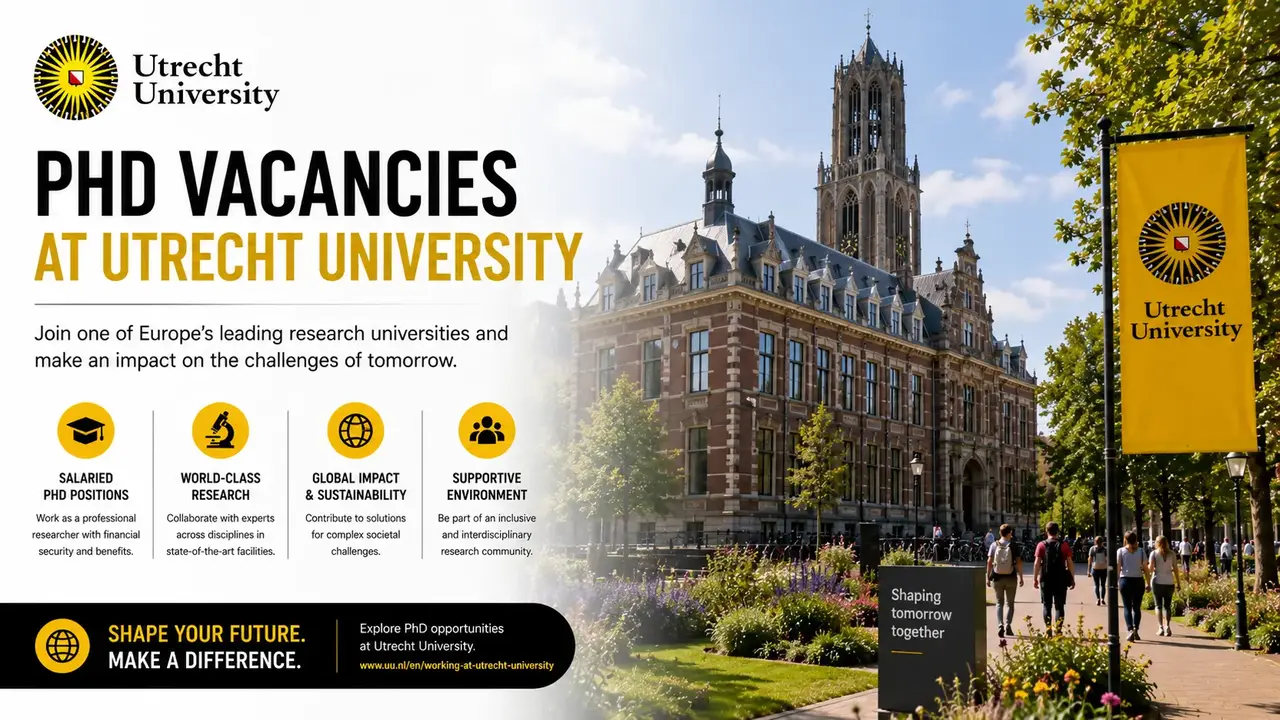
PhD Vacancies at Utrecht University, Netherlands
Utrecht University, established in 1636, stands as one of the oldest and most prestigious research institutions in the Netherlands. Consistently ranked among the top universities globally, it is renowned for its interdisciplinary approach, commitment to sustainability, and impactful research that addresses complex societal challenges. For doctoral candidates seeking a dynamic, supportive, and professionally rewarding environment, Utrecht University offers a unique proposition. Unlike many countries where PhD candidates are classified as students, in the Netherlands, PhD positions are typically salaried employment contracts. This distinction provides financial security, social benefits, and professional status from the very beginning of the research journey.
The university regularly advertises a wide array of PhD vacancies across its seven faculties. These positions cover a vast spectrum of disciplines, from molecular biology and chemistry to law, geography, and veterinary medicine. The current list of vacancies highlights Utrecht University’s focus on critical global issues such as climate change, planetary health, sustainable technology, and social equity. For prospective researchers, these vacancies represent an opportunity to contribute to cutting-edge science while enjoying the high quality of life offered by the Netherlands.
This article provides an exhaustive guide to the current PhD vacancies at Utrecht University. It details the specific research projects available, explains the benefits of the Dutch employment model, outlines the application process and deadlines, and offers insights into life as a researcher in Utrecht. Whether you are interested in microbial genome evolution, nanomedicine, or financial law, this guide will equip you with the knowledge to navigate the application process successfully.
Check: PhD Positions at Chalmers University of Technology, Sweden
Check: Postdoc Positions at KTH Royal Institute of Technology, Sweden
The Dutch PhD Employment Model
Before exploring the specific vacancies, it is crucial to understand the structural framework of doctoral research in the Netherlands. At Utrecht University, a PhD candidate is officially known as a “Promovendus” (in Dutch) or simply a PhD candidate. They are employed by the university under a fixed-term contract, usually lasting four years.
Salary and Benefits
As an employee, a PhD candidate receives a gross monthly salary that increases annually. According to the Collective Labour Agreement for Dutch Universities (CAO), the salary starts at a specific scale and progresses as the candidate moves from year one to year four. Typically, the gross monthly salary ranges from approximately €2,800 in the first year to over €3,500 in the fourth year. This income is designed to cover living expenses comfortably, even in a country with a relatively high cost of living.
In addition to the salary, employees receive significant benefits:
- Holiday Allowance: An additional 8% of the gross annual salary is paid out in May.
- End-of-Year Bonus: A fixed 8.3% bonus is paid in December.
- Pension: The university contributes to a pension fund, securing the candidate’s financial future.
- Paid Leave: Employees are entitled to 29 days of paid annual leave, plus public holidays.
- Social Security: Full coverage under the Dutch social security system, including health insurance and unemployment benefits.
Research Environment
Utrecht University fosters a collaborative and informal research culture. Hierarchies are flat, and PhD candidates are encouraged to engage in open dialogue with their supervisors. The university provides extensive support services, including training programs for teaching skills, scientific writing, and career development. This structured support ensures that candidates not only complete their thesis but also develop transferable skills for careers in academia, industry, or the public sector.
Current PhD Vacancies: A Thematic Overview
The current list of vacancies at Utrecht University reflects the institution’s strategic focus on sustainability, health, and societal impact. The 17 available positions span four major faculties: the Faculty of Geosciences, the Faculty of Science, the Faculty of Veterinary Medicine, and the Faculty of Law, Economics and Governance. Below is a detailed breakdown of these opportunities, grouped by research theme.
Theme 1: Sustainability, Earth Systems, and Planetary Health
The Faculty of Geosciences is heavily represented in the current vacancy list, underscoring Utrecht’s commitment to understanding and mitigating environmental change. These positions focus on the intricate relationships between human activity, geological processes, and ecosystem resilience.
- Impacts of Human-Induced Air-Water Pollution on Planetary Health: This project seeks to quantify how nitrogen pollution affects ecosystems and human well-being under a changing climate. The candidate will work at the Department of Earth Sciences, analyzing data to inform policy and mitigation strategies. Deadline: 1 July 2026.
- Island Geologic History and Ecosystem Resilience: This research explores whether an island’s geological past can predict its ecosystem’s ability to withstand human-induced environmental change. It is a compelling mix of geology and ecology, based in the Department of Earth Sciences. Deadline: 15 June 2026.
- Industrial Wastewater Permits for Sustainable Water Quality: Focused on the Department of Physical Geography, this position investigates how regulatory permits for industrial wastewater discharge can be improved to support water quality goals. It bridges law, policy, and physical geography. Deadline: 21 June 2026.
- Fine Particles in Shallow Groundwater Systems: This project investigates particle dynamics in groundwater and the Quaternary sedimentology hosting it. It is crucial for promoting sustainable groundwater utilization and understanding subsurface environments. Deadline: 21 June 2026.
- Parenting and Caregiving in Contaminated Water Landscapes: An interdisciplinary project at the Department of Human Geography and Spatial Planning. It examines the social impact of raising children in environments with PFAS water contamination, highlighting the human side of environmental science. Deadline: 10 June 2026.
- Relational Monitoring for Liveable Futures: This position contributes to developing knowledge infrastructures to support novel approaches to monitoring. It is based in the Department of Sustainable Development and focuses on how we measure and achieve sustainability. Deadline: 27 May 2026.
- Global Talent Interdependence and Europe’s Strategic Innovation Ambitions: Also within Human Geography and Spatial Planning, this role studies global talent mobility to shape Europe’s innovation future using cutting-edge data. Deadline: 25 May 2026.
- Geosciences Students’ Professional Identity Development: This educational research project explores how education can support geoscience students in developing confidence and a professional identity. Deadline: 7 June 2026.
Theme 2: Health, Biology, and Veterinary Science
The life sciences are another pillar of Utrecht University’s research strength. These positions range from molecular microbiology to animal health and human data interaction.
- Microbial Genome Evolution: Based in the Department of Biology (Faculty of Science), this project asks how archaeal genomes evolve. It is a fundamental science position contributing to our understanding of life’s building blocks. Deadline: 7 June 2026.
- Molecular Microbiology (Promovendus Moleculaire Microbiologie): This Dutch-listed position investigates whether fungi can be used to remove lignocellulose from wastewater. It is a practical application of microbiology for environmental cleanup. Deadline: 28 May 2026.
- Infectious Disease Phylodynamics: Located in the Faculty of Veterinary Medicine, this role sits at the intersection of molecular epidemiology and animal health. The candidate will study the evolution and transmission of the PRRS virus, which is critical for livestock health. Deadline: 14 June 2026.
- Improving Immunity in Neonatal Piglets: Part of the BABE project, this position focuses on developing interventions to support immune development in neonatal pigs. It aims to improve piglet health and reduce the need for antibiotics. Deadline: 27 May 2026.
- Human Data Interaction for Health and Wellbeing: Based in the Department of Information and Computing Sciences, this project shapes how personal health data is experienced. It advances the design of systems that support reflection in everyday life, merging technology with human behavior. Deadline: 15 June 2026.
Theme 3: Chemistry, Technology, and Innovation
The Faculty of Science offers positions that drive innovation in materials, diagnostics, and sustainable technology.
- Mechano-catalytic Conversion of Plastic Waste: This position pioneers a sustainable plastic waste recycling pathway through mechano-catalytic conversion. It is a direct response to the global plastic crisis, aiming to shape a greener future through chemistry. Deadline: 2 June 2026.
- Analytical Chemistry: This role uses advanced analytical chemistry to drive innovation in glycoscience. The work enables breakthroughs in diagnostics, biotherapeutics, and functional foods, based in the Department of Pharmaceutical Sciences. Deadline: 27 May 2026.
- Nanomedicine and Society: This unique position at the Department of Sustainable Development (Faculty of Geosciences) focuses on fostering mutual learning between science and society. It asks how new technologies like nanomedicine can be embedded in society responsibly. Deadline: 18 June 2026.
Theme 4: Law, Economics, and Governance
Social sciences and law are essential for regulating the technologies and environmental changes studied by other faculties.
- Financial Vulnerability of Families (Promovendus Financiële kwetsbaarheid van gezinnen): This Dutch-listed position within the Department of Law (Faculty of Law, Economics and Governance) asks whether the financial vulnerability of families is a concern for the government. It explores the legal and social obligations of the state towards vulnerable citizens. Deadline: 10 June 2026.
Application Process and Deadlines
Applying for a PhD position at Utrecht University is a formal process that requires careful preparation. Each vacancy is treated as a job application, and competition can be high. The deadlines for the current cycle range from late May to early July 2026. It is crucial to adhere strictly to these dates, as late applications are generally not accepted.
Step 1: Review the Vacancy Details
Each position has a specific job description available on the university’s website. Candidates should read these thoroughly to understand the specific research questions, required methodologies, and team structure. The descriptions provided in this article are summaries; the official listings contain detailed eligibility criteria.
Step 2: Prepare Your Documents
A standard application package includes:
- Cover Letter: Tailored to the specific project. Explain your motivation, relevant experience, and how your skills match the research goals.
- Curriculum Vitae (CV): Include your education, research experience, publications, and technical skills.
- Academic Transcripts: Certified copies of your Bachelor’s and Master’s degrees.
- References: Contact information for two or three academic referees who can attest to your research potential.
Step 3: Submit Online
Applications must be submitted through the Utrecht University working portal. You will need to create an account and upload your documents in PDF format. Ensure all files are clearly named.
Step 4: Interview and Selection
Shortlisted candidates are invited for an interview, which may be conducted via video conference or in person. For some positions, candidates may be asked to give a presentation on their past research or a proposed plan for the PhD project.
Important Deadlines
Prospective applicants should note the following upcoming deadlines for the current cycle:
- Late May 2026: Positions in Relational Monitoring, Analytical Chemistry, Molecular Microbiology, Immunity in Piglets, and Global Talent Interdependence.
- Early June 2026: Positions in Plastic Waste Conversion, Microbial Genome Evolution, Geosciences Identity, Financial Vulnerability, and Parenting in Contaminated Landscapes.
- Mid-to-Late June 2026: Positions in Infectious Disease, Human Data Interaction, Island Geology, Nanomedicine, and Industrial Wastewater.
- July 2026: The position on Air-Water Pollution has a deadline of 1 July 2026.
Life as a PhD Candidate in Utrecht
Choosing a PhD position is not just about the research; it is also about the location and lifestyle. Utrecht is a vibrant city in the heart of the Netherlands, known for its historic center, canals, and strong student community.
The City of Utrecht
Utrecht is the fourth-largest city in the Netherlands but retains a cozy, manageable scale. It is highly bike-friendly, with extensive cycling paths that make commuting easy and sustainable. The city center is filled with cafes, restaurants, and cultural venues, offering a rich social life outside of work. The university buildings are integrated into the city, meaning researchers are never far from urban amenities.
International Community
Utrecht University is highly international. English is the primary working language for most PhD projects, especially in the sciences. This makes it accessible for researchers from around the world. The university offers support services for international staff, including assistance with housing, visa applications, and integration programs. Many PhD candidates join social clubs and networks specifically designed for international researchers, fostering a sense of belonging.
Work-Life Balance
The Dutch culture places a high value on work-life balance. While research requires dedication, the employment contract ensures that candidates are entitled to full vacation time. It is common for researchers to work standard hours and leave time for family, hobbies, and rest. This balanced approach helps prevent burnout and promotes sustainable productivity over the four-year doctoral period.
Career Prospects
Completing a PhD at Utrecht University opens doors to various career paths. The university’s strong reputation ensures that graduates are recognized globally. Many candidates pursue postdoctoral positions at other top universities, while others transition into industry roles, particularly in sectors like pharmaceuticals, environmental consulting, and technology. The skills gained during the PhD—critical thinking, project management, and data analysis—are highly transferable.
Strategic Tips for Success
Given the competitive nature of these positions, a generic application will not suffice. To maximize your chances of securing a PhD vacancy at Utrecht University, consider the following strategic advice:
- Align with Strategic Themes: Utrecht University places a strong emphasis on sustainability and societal impact. In your cover letter, highlight how your research interests align with these broader goals. For example, if applying for the plastic waste conversion position, discuss the global importance of circular economy solutions.
- Demonstrate Interdisciplinary Potential: Many of the listed projects are interdisciplinary (e.g., combining geography with health, or chemistry with society). Highlight any experience you have working across disciplines or collaborating with researchers from different fields.
- Contact the Supervisor: While not always mandatory, sending a polite email to the contact person listed in the vacancy can demonstrate initiative. Ask specific questions about the research project to show genuine engagement.
- Highlight Technical Skills: For science and technology positions, be specific about your laboratory techniques, coding languages, or analytical methods. For social science positions, highlight your methodological expertise (qualitative, quantitative, or mixed methods).
- Prepare for the Interview: Be ready to discuss your Master’s thesis in depth. The selection committee will want to see that you have the endurance and critical thinking skills required for a four-year project.
Conclusion
The PhD vacancies at Utrecht University represent a diverse and impactful range of research opportunities. From protecting planetary health and developing sustainable technologies to understanding social vulnerability and advancing veterinary science, these positions offer the chance to make a tangible contribution to global knowledge. The employment-based model provides financial stability and professional benefits that are rare in other academic systems, allowing researchers to focus on their work without financial stress.
The current cycle of vacancies offers deadlines ranging from May to July 2026, providing a clear timeline for prospective applicants. Whether you are drawn to the laboratories of the Faculty of Science, the fieldwork of the Faculty of Geosciences, or the policy analysis of the Faculty of Law, Utrecht University provides the infrastructure and support to help you succeed.
If you are ready to advance your research career in a dynamic, international, and supportive environment, we encourage you to explore these opportunities. Prepare your application meticulously, highlight your research potential, and consider the unique quality of life that awaits in the Netherlands. The path to a PhD at Utrecht University is competitive, but for those who are prepared and passionate, it is a pathway to a rewarding future.
Ready to apply? Visit the official Utrecht University vacancies portal today:
https://www.uu.nl/en/vacancies
Specific Job Listings and Details:
https://www.uu.nl/en/vacancies/phd-vacancies
Embark on your journey of discovery at Utrecht University, where innovation meets tradition, and where your research can make a lasting impact on the world.