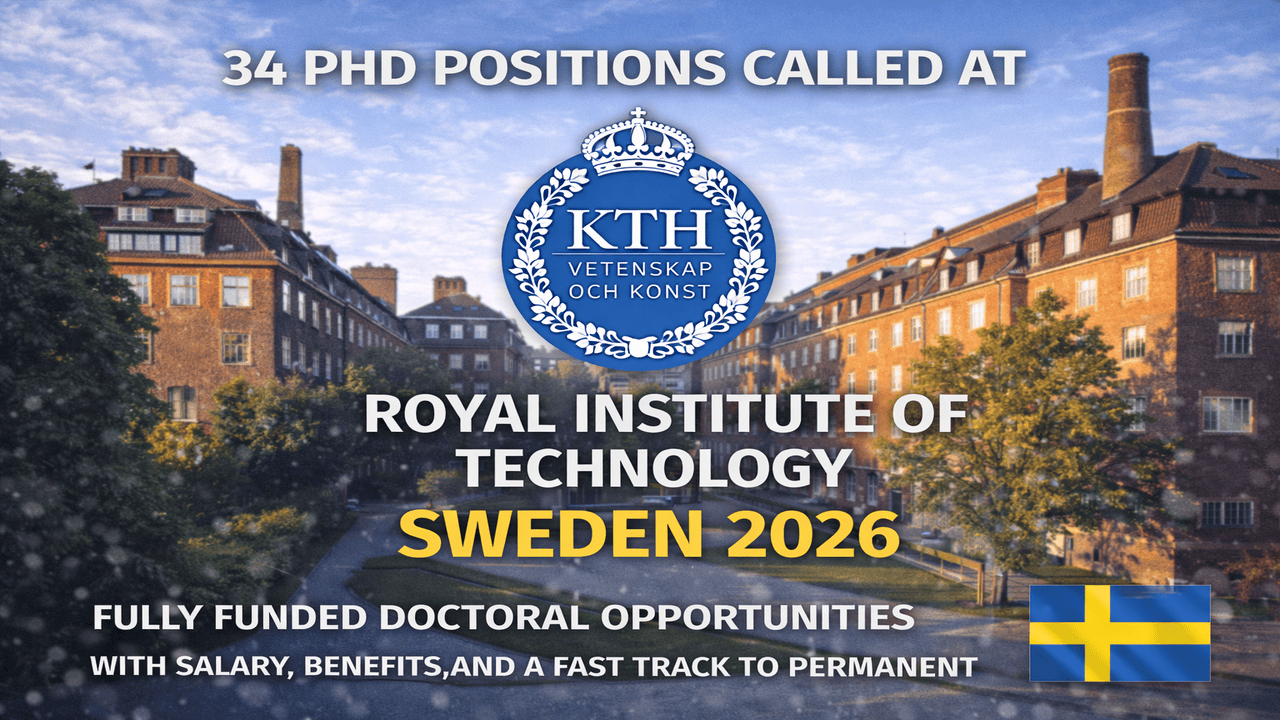
34 PhD Positions Called at KTH Royal Institute of Technology, Sweden 2026
Fully Funded Doctoral Opportunities with Salary, Benefits, and a Fast Track to Permanent Residency
KTH Royal Institute of Technology has announced 34 fully funded PhD positions across multiple departments and research areas for the 2026 intake. Located in the vibrant capital city of Stockholm, KTH consistently ranks among the top 100 universities globally and offers doctoral students an exceptional combination of world-class research, competitive salary, and an unmatched quality of life.
Whether you are a recent master’s graduate, a working professional looking to transition into research, or an international scholar seeking new opportunities, these positions represent a life-changing chance to advance your academic career while building a future in Sweden.
In this comprehensive guide, we will walk you through everything you need to know — from finding vacant positions and understanding admission requirements to navigating the selection process and securing your employment contract. We will also share groundbreaking news about Sweden’s new Permanent Residency policy that makes pursuing a PhD in Sweden more attractive than ever before.
Check: Scholarships in Belgium (2026–2027) — The Complete Detailed Guide
check: Norway Funded Scholarships for International Students 2026
Check: PhD Scholarships in Engineering at the University of Sydney, Australia 2026
About KTH Royal Institute of Technology
Founded in 1827, KTH Royal Institute of Technology is Sweden’s oldest and largest technical university. With over 13,000 full-time students and more than 1,800 doctoral students, KTH plays a central role in Sweden’s innovation ecosystem. The university maintains deep partnerships with industry leaders like Ericsson, Scania, ABB, Volvo, and Spotify, ensuring that research carried out at KTH has real-world impact and that graduates are highly sought after in the global job market.
KTH is organized into five schools covering a vast range of disciplines:
- School of Architecture and the Built Environment (ABE)
- School of Electrical Engineering and Computer Science (EECS)
- School of Engineering Sciences (SCI)
- School of Engineering Sciences in Chemistry, Biotechnology and Health (CBH)
- School of Industrial Engineering and Management (ITM)
The 34 PhD positions announced for 2026 span across these schools, covering research areas including artificial intelligence, sustainable energy, quantum computing, biomedical engineering, materials science, urban planning, cybersecurity, robotics, environmental engineering, and many more cutting-edge fields.
How to Apply for Doctoral Studies at KTH
Applying for a PhD position at KTH is a structured, transparent process. Unlike many countries where you must independently find a supervisor and secure funding before applying, the Swedish model is refreshingly straightforward. PhD positions at KTH are advertised as employment opportunities, meaning you apply for a specific, funded position, and if selected, you become a university employee from day one.
Here is a step-by-step breakdown of the entire process:
Step 1: Find a Vacant Doctoral Position
The first step in your journey is to identify a PhD position that matches your academic background, research interests, and career goals.
Where to find open positions:
- KTH’s Official Jobs Portal: All doctoral positions at KTH are advertised on the university’s official recruitment page at https://www.kth.se/en/studies/phd. This is the primary and most reliable source.
- Universitetsjobbportalen (Swedish University Job Portal): Many Swedish universities, including KTH, list their positions on centralized national portals.
- Euraxess: The European Commission’s researcher mobility portal also lists KTH positions.
- Academic Job Boards: Websites like AcademicPositions.com, FindAPhD.com, and ScholarshipDb.net regularly feature KTH openings.
Tips for finding the right position:
- Set up email alerts on KTH’s jobs page so you are notified as soon as new positions are posted.
- Read each job advertisement carefully. Every listing includes a detailed description of the research project, the department, the required qualifications, desired skills, and the application deadline.
- Pay attention to the Reference Number assigned to each position — you will need this when submitting your application.
- Note that different positions may have different deadlines. The 34 positions for 2026 will be posted on a rolling basis, so check the portal regularly throughout the year.
Step 2: Check the Admission Requirements
Before investing time in your application, make sure you meet the eligibility criteria. KTH has both general admission requirements and specific admission requirements for each doctoral position.
General Admission Requirements
To be eligible for doctoral studies at KTH, you must hold:
- A second-cycle degree (master’s degree or equivalent), OR
- At least 240 ECTS credits of higher education studies, of which at least 60 ECTS are at the second-cycle (master’s) level, OR
- Equivalent qualifications obtained in Sweden or abroad.
KTH evaluates international qualifications on a case-by-case basis. If your degree is from outside Sweden, it does not necessarily need to be formally recognized by the Swedish Council for Higher Education (UHR), but it must be deemed equivalent by the admitting department.
Specific Admission Requirements
Each PhD position has its own set of specific requirements, which are detailed in the job advertisement. These typically include:
- A master’s degree in a relevant field (e.g., a PhD in Machine Learning may require a master’s in Computer Science, Mathematics, Electrical Engineering, or a closely related discipline).
- Demonstrated knowledge or experience in specific research methods, tools, or subject areas relevant to the project.
- English language proficiency. Since most doctoral programs at KTH are conducted in English, you must demonstrate strong English skills. Accepted proofs include TOEFL (minimum 90 iBT), IELTS (minimum 6.5), or a degree taught entirely in English. Native English speakers or graduates from English-medium programs are typically exempt from this requirement.
- Some positions may also list desired qualifications such as programming skills, publication experience, industry experience, or knowledge of Swedish (though Swedish is rarely a mandatory requirement for PhD positions).
Important Notes on Eligibility:
- You must meet the admission requirements by the application deadline, not at a later date.
- If you are in the final semester of your master’s program and expect to graduate before the PhD start date, you may still be eligible to apply. However, you must clearly state your expected graduation date in your application and provide your degree certificate before enrollment.
- KTH values diversity and equal opportunity. The university actively encourages applications from candidates of all backgrounds, genders, and nationalities.
Step 3: Apply for the Position
Once you have found a suitable position and confirmed that you meet the requirements, it is time to prepare and submit your application.
Required Application Documents
While exact requirements vary by position, most KTH doctoral applications require the following:
- Curriculum Vitae (CV): A comprehensive academic CV detailing your education, research experience, publications, technical skills, work experience, and any relevant extracurricular activities.
- Cover Letter / Letter of Motivation: A well-crafted letter (typically 1–2 pages) explaining why you are interested in the specific position, how your background aligns with the research project, and what you hope to achieve during your doctoral studies.
- Degree Certificates and Transcripts: Official copies of your bachelor’s and master’s degree certificates and academic transcripts, including course names, grades, and ECTS credits. If your documents are not in English or Swedish, you must provide certified translations.
- Proof of English Language Proficiency: TOEFL, IELTS scores, or other accepted documentation (unless exempted).
- Letters of Recommendation: Typically 2–3 reference letters from academic supervisors, professors, or professional mentors who can speak to your research abilities and academic potential. Some positions may ask for contact details of referees instead of actual letters.
- Writing Sample or Master’s Thesis: Many positions require you to submit your master’s thesis or a representative sample of your academic writing. If your thesis is not in English, a summary in English is usually acceptable.
- Research Statement or Proposal (if applicable): Some positions may ask you to outline your research ideas or respond to a specific research question posed in the advertisement.
- Publication List (if applicable): If you have published journal articles, conference papers, or other scholarly works, include a complete list.
How to Submit Your Application
- Applications are submitted online through KTH’s official recruitment system. Each job advertisement includes a direct link to the application portal.
- Create an account, fill in the required fields, and upload your documents in PDF format.
- Double-check that all documents are complete, properly formatted, and clearly legible before submitting.
- Submit your application before the deadline. Late applications are generally not accepted.
Pro Tips for a Strong Application:
- Tailor every application. Do not send a generic cover letter. Address the specific research project, mention the principal investigator (PI) by name, and explain concretely how your skills and experience make you the ideal candidate.
- Contact the supervisor. Before applying, consider reaching out to the listed supervisor or contact person for the position. Introduce yourself briefly, express your interest, and ask any questions about the project. This shows initiative and can help you write a more targeted application.
- Highlight research experience. KTH is a research-intensive university. Emphasize any hands-on research experience you have, whether from your master’s thesis, internships, or independent projects.
- Be specific about technical skills. If the position requires expertise in Python, MATLAB, lab techniques, or specific methodologies, explicitly state your proficiency and provide examples.
Step 4: Pass the Selection Process
After the application deadline closes, KTH’s selection committee reviews all submitted applications and evaluates candidates based on their qualifications, research potential, and fit with the project.
What the Selection Process Looks Like:
- Initial Screening: The recruitment team and the principal investigator review all applications to identify candidates who meet the admission requirements and demonstrate strong alignment with the position.
- Shortlisting: A shortlist of the most promising candidates is created. Depending on the position, this may include anywhere from 3 to 10 candidates.
- Interviews: Shortlisted candidates are invited for interviews, which may be conducted in person or via video conferencing (Zoom, Teams, etc.) for international applicants. Interviews typically last 30–60 minutes and cover your academic background, research interests, motivation, problem-solving abilities, and interpersonal skills.
- Presentation or Test (in some cases): For certain positions, you may be asked to give a short presentation on your master’s thesis or a related topic. Some departments may also administer a written test or technical assessment.
- Reference Checks: The selection committee may contact your listed references to verify your qualifications and gather additional insights about your research capabilities.
- Final Decision: The principal investigator, in consultation with the selection committee, makes the final hiring decision. KTH follows a merit-based selection process, and the decision is based on the candidate’s ability to benefit from doctoral education.
Timeline:
The selection process typically takes 4 to 12 weeks from the application deadline to the final decision. However, this can vary depending on the department and the number of applicants.
What If You Are Not Selected?
If you are not selected for a particular position, do not be discouraged. KTH posts new doctoral positions throughout the year. Take any feedback offered, refine your application, and apply for other opportunities. Persistence is key in academia.
Step 5: Become Admitted as a Doctoral Student
Once you are selected for the position, the formal admission process begins.
Admission Steps:
- Offer Letter: You will receive a formal offer from KTH, outlining the terms of your doctoral position, including the research project, the supervising professor, the department, and the expected start date.
- Acceptance: You must formally accept the offer within the specified timeframe.
- Individual Study Plan (ISP): Before or shortly after your start date, you and your supervisor will create an Individual Study Plan. This is a comprehensive document that outlines your research plan, coursework requirements, timeline, milestones, and supervision arrangements. The ISP is reviewed and updated annually throughout your doctoral studies.
- Registration as a Doctoral Student: You will be officially registered in KTH’s doctoral program. This grants you access to university facilities, the library, IT systems, student services, and more.
- Residence Permit (for international students): If you are a non-EU/EEA citizen, you will need to apply for a Swedish residence permit for doctoral studies through the Swedish Migration Agency (Migrationsverket). KTH’s International Staff Services will assist you with this process. The residence permit is typically granted for 1–2 years at a time and is renewable for the duration of your studies.
Key Details About Doctoral Studies at KTH:
- Duration: A full-time doctoral program at KTH is 4 years (240 ECTS). If you undertake departmental duties such as teaching (up to 20% of your time), the program may be extended to a maximum of 5 years.
- Licentiate Option: After approximately 2 years, you have the option of completing a Licentiate degree, which is a recognized intermediate qualification unique to the Swedish system.
- Coursework: Doctoral students are required to complete approximately 60 ECTS of coursework alongside their research. Courses are selected in consultation with your supervisor and may include advanced technical courses, research methodology, ethics, and transferable skills.
- Supervision: Every doctoral student is assigned at least one principal supervisor and typically one or more co-supervisors. Regular supervision meetings ensure you stay on track and receive the guidance you need.
- Thesis Defense: Your doctoral journey culminates in a public thesis defense (disputation), where you present and defend your research before an examination committee that includes an external opponent.
Step 6: Receive Your Employment
Here is where the Swedish PhD model truly shines. At KTH, doctoral students are not students in the traditional sense — they are employees.
What This Means for You:
- Employment Contract: Upon starting your PhD, you will sign an employment contract with KTH. You are hired as a “Doktorand” (doctoral student employee), which is a formal employment category under Swedish labor law.
- Monthly Salary: You will receive a competitive monthly salary that is deposited directly into your Swedish bank account. The starting salary for doctoral students at KTH is approximately 33,000–34,000 SEK per month (roughly $3,100–$3,200 USD), and this amount increases annually as you progress through your studies. By the end of your PhD, your salary will be noticeably higher than when you started.
- No Tuition Fees: There are absolutely zero tuition fees for doctoral studies at KTH. Your research, coursework, supervision, and access to facilities are all fully funded.
- Full Employee Benefits: As a KTH employee, you are entitled to the same benefits as any other employee in Sweden:
- 28–35 days of paid vacation per year
- Paid parental leave (Sweden’s generous parental leave policy applies to you)
- Paid sick leave
- Full access to the Swedish public healthcare system from Day 1
- Occupational pension contributions
- Wellness allowance (friskvårdsbidrag) for gym memberships, sports, or other health-related activities
- Union Membership: Most doctoral students at KTH are members of SACO-S or ST, the trade unions that represent academic and professional staff at Swedish universities. Union membership provides additional job security and support.
- Tax and Social Security: Your salary is subject to Swedish income tax, but in return, you gain full access to Sweden’s world-renowned social safety net.
The Overview of 34 PhD Positions at KTH for 2026
The 34 positions span a wide range of disciplines and departments. While specific openings are posted on a rolling basis, the following are representative of the research areas currently recruiting doctoral students:
| Research Area | Department / School |
|---|---|
| Artificial Intelligence & Machine Learning | EECS |
| Quantum Computing & Quantum Information | SCI |
| Sustainable Energy Systems | ITM |
| Biomedical Engineering | CBH |
| Cybersecurity & Privacy | EECS |
| Robotics & Autonomous Systems | EECS |
| Materials Science & Engineering | CBH / SCI |
| Urban Planning & Smart Cities | ABE |
| Environmental Engineering | ABE / CBH |
| Applied Mathematics & Computational Science | SCI |
| Semiconductor Physics & Nanoelectronics | EECS / SCI |
| Chemical Engineering & Biotechnology | CBH |
| Vehicle Engineering & Transportation | ITM / SCI |
| Construction Management & Building Technology | ABE |
| Data Science & Information Systems | EECS / ITM |
Note: This is a representative list. For the complete and up-to-date list of all 34 positions, visit KTH’s official recruitment portal.
🇸🇪 The Big News: A Faster Path to Permanent Residency for PhD Students
Now, here is the announcement that changes everything for international doctoral students considering Sweden.
Starting March 2026, the Swedish government is officially shortening the path to Permanent Residency (PR) for PhD students and researchers from 4 years down to just 3 years.
This means you could become a permanent resident before you even finish your degree!
Think about that for a moment. In most countries, international PhD students spend years on temporary visas with uncertain futures. In Sweden, you will be able to secure permanent residency — the right to live and work in Sweden indefinitely — after just 3 years of legal residence. Since a full-time PhD at KTH takes 4 years, you could obtain your PR status with an entire year of your doctoral program still remaining.
This is not just a policy tweak. It is a game-changer for international researchers and their families. Permanent residency in Sweden provides:
- The right to live and work in Sweden indefinitely without needing to renew your residence permit
- The ability to travel freely within the Schengen Area
- Access to all social benefits available to Swedish residents
- A clear pathway to Swedish citizenship (eligible after 5 years of residence)
- Security and stability for your spouse and children, who can also benefit from your residency status
🇸🇪 Why a PhD in Sweden Is Actually a “Career Move”
Let’s be honest. In many parts of the world, pursuing a PhD means years of financial struggle, uncertain funding, and an unclear career path. Sweden is fundamentally different. Here’s why a PhD at KTH is not just an academic pursuit — it is one of the smartest career moves you can make:
🔹 Get Paid to Learn
Most PhD students at KTH — and across Sweden — are university employees. You receive a monthly salary starting at around 33,000 SEK (~$3,100 USD), which increases every year as you progress through your program. This is not a stipend, a fellowship, or a grant that could be revoked. It is a contractual salary with all the protections of Swedish labor law.
You are not paying for your education. Your education is paying you.
🔹 Zero Tuition
Research is completely free. There are no tuition fees, no student loans, no hidden fees, no lab charges, and no surprise administrative costs. Everything related to your doctoral education — courses, supervision, conference travel, equipment, and facilities — is funded by the university or the research grant supporting your position.
🔹 Full Social Benefits
From the moment you start your employment at KTH, you are fully integrated into the Swedish social welfare system. This means:
- 28–35 days of paid vacation per year — yes, even as a PhD student
- Paid parental leave — Sweden offers some of the most generous parental leave policies in the world (up to 480 days per child, shared between parents)
- Full access to the Swedish healthcare system from Day 1 — affordable, high-quality healthcare for you and your family
- Paid sick leave — because your health matters
- Pension contributions — your employer contributes to your retirement fund
These are not perks. They are your rights as an employee in Sweden.
🔹 The 18-Month Safety Net
What happens after you finish your PhD? In many countries, your visa expires almost immediately, forcing you to either find a job under extreme time pressure or leave the country.
Sweden offers a different approach. If you choose not to apply for Permanent Residency immediately after becoming eligible, you can apply for an 18-month “job seeker” permit after graduation. This permit allows you to stay in Sweden for up to 18 months to search for employment, start a business, or explore career opportunities in Sweden’s thriving tech, biotech, cleantech, and engineering hubs.
Stockholm alone is home to companies like Spotify, Klarna, Ericsson, King, iZettle, Northvolt, and hundreds of innovative startups. With a PhD from KTH on your résumé and 18 months to find the perfect role, you are in an incredibly strong position.
Why KTH? Why Now?
The combination of factors makes this a uniquely compelling opportunity:
✅ 34 funded positions across diverse, high-impact research fields
✅ Competitive salary with annual increases — no financial stress
✅ Zero tuition fees — your research is fully funded
✅ World-class research environment at a top-100 global university
✅ Full employee benefits including healthcare, vacation, and parental leave
✅ New 3-year path to Permanent Residency starting March 2026
✅ 18-month post-graduation job seeker visa as a safety net
✅ Stockholm — one of the world’s most innovative, livable, and beautiful cities
✅ A global network of KTH alumni working at leading companies and institutions worldwide
How to Stay Updated and Apply
The 34 PhD positions for 2026 are being posted on a rolling basis. To ensure you don’t miss any opportunities:
- Bookmark the KTH Jobs Page: www.kth.se/en/om/work-at-kth
- Set Up Email Alerts: Subscribe to notifications for new doctoral positions.
- Follow KTH on Social Media: LinkedIn, Twitter/X, and Instagram for announcements.
- Prepare Your Documents Now: Don’t wait until the last minute. Start gathering your transcripts, writing your CV, and reaching out to potential referees today.
- Reach Out to Supervisors: If a position interests you, email the listed contact person to learn more about the project and express your interest.
Final Thoughts
A PhD at KTH Royal Institute of Technology is more than a degree. It is a salaried position at one of Europe’s premier research universities, located in one of the world’s most innovative cities, with a clear and newly accelerated pathway to permanent residency in one of the world’s highest-quality-of-life countries.
The 34 positions opening for 2026 represent a rare convergence of opportunity — world-class research, financial security, personal well-being, and long-term immigration benefits that are virtually unmatched anywhere in the world.
The doors are open. The positions are funded. The path to your future is clear.
Apply now and take the first step toward a career and a life in Sweden.
Disclaimer: Information in this article is based on publicly available data from KTH Royal Institute of Technology, the Swedish Migration Agency, and official Swedish government sources as of the publication date. Applicants are encouraged to verify all details, deadlines, and requirements directly on KTH’s official website and the Swedish Migration Agency (Migrationsverket) website before applying. Salary figures and policy details are subject to change.
FAQs
1. Do I need to know Swedish to apply for a PhD at KTH?
No. The vast majority of PhD positions at KTH are conducted entirely in English. Swedish language skills are not required for admission or research. However, learning basic Swedish during your stay can enhance your daily life and long-term career prospects in Sweden.
2. Can my family join me in Sweden during my PhD?
Yes. As a salaried PhD employee, you have the right to bring your spouse/partner and children to Sweden. They can apply for residence permits as your dependents through the Swedish Migration Agency. Your spouse will also have the right to work in Sweden without any restrictions.
3. What happens if I don’t finish my PhD in 4 years?
Don’t worry. The standard duration is 4 years of full-time research. If you take on departmental duties such as teaching (up to 20%), your contract can be extended to a maximum of 5 years. Extensions due to parental leave, sick leave, or other valid reasons are also accommodated under Swedish employment law, so your position remains secure.
4. Is there an application fee to apply for PhD positions at KTH?
No. There is absolutely no application fee. Applying for doctoral positions at KTH is completely free. Simply submit your application through KTH’s online recruitment portal before the stated deadline.
5. Can I apply if I haven’t completed my master’s degree yet?
Yes, in most cases. If you are in the final semester of your master’s program and expect to graduate before the PhD start date, you are generally eligible to apply. However, you must clearly state your expected graduation date in your application and submit your final degree certificate before formal enrollment at KTH.
6. Are the 34 PhD positions at KTH fully funded?
Yes. All advertised PhD positions at KTH are fully funded and employment-based. Doctoral candidates receive a monthly salary and full social benefits.
7. Do I need to contact a supervisor before applying?
In most cases, you apply directly to the advertised PhD position. While contacting the listed supervisor is not mandatory, it can sometimes strengthen your application if you have relevant research questions.
8. Is IELTS or TOEFL required for admission?
If your previous degree was not taught in English, you may need to provide proof of English proficiency (such as IELTS or TOEFL). Always check the specific requirements listed in the job advertisement. Visit University Admissions to see all recognized English tests and what applies to your country of previous studies