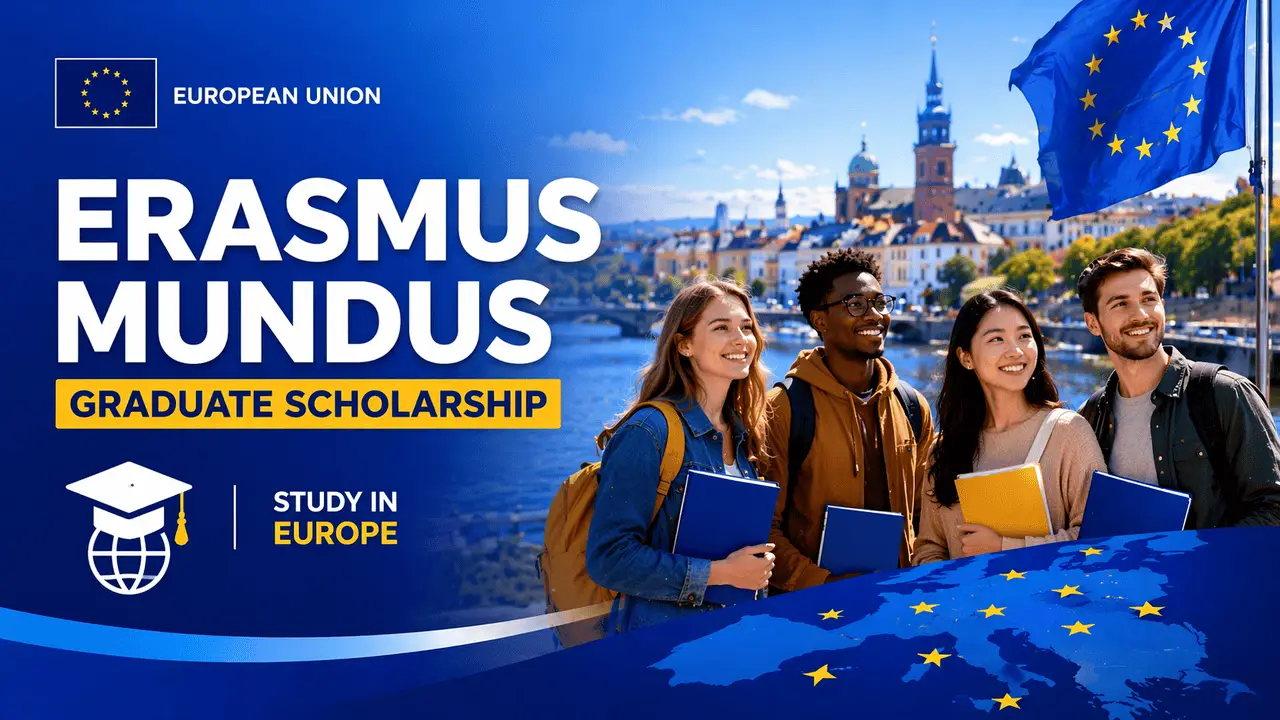
Erasmus Mundus Graduate Scholarship Program 2026 (Fully Funded): Complete Guide, Benefits, Eligibility, and How to Apply
Imagine earning a master’s degree not just in one, but in at least two different European countries. Imagine graduating with a double degree, a global network, and zero student debt. This isn’t a fantasy; it’s the reality of the Erasmus Mundus Joint Master’s Degrees (EMJMD).
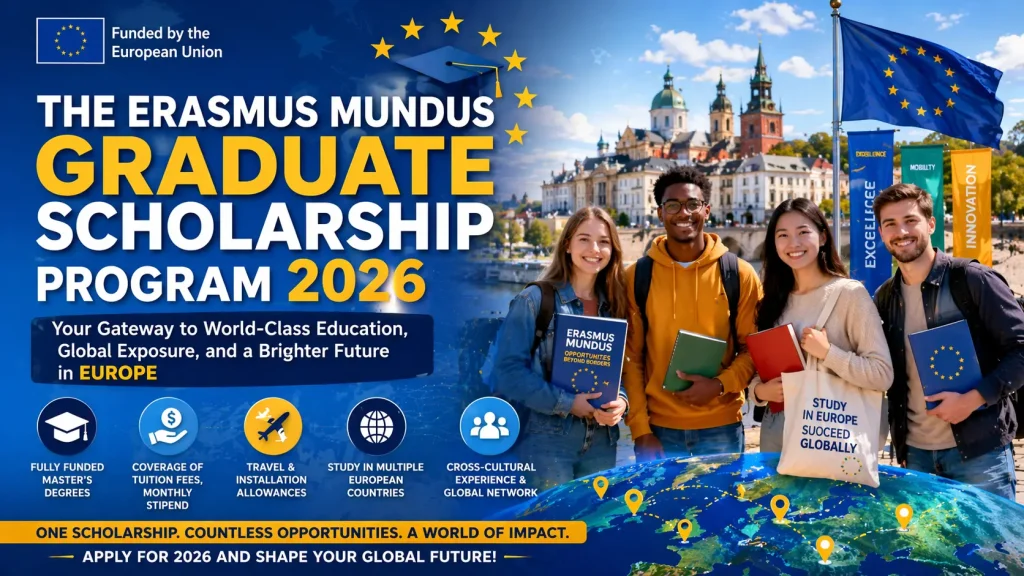
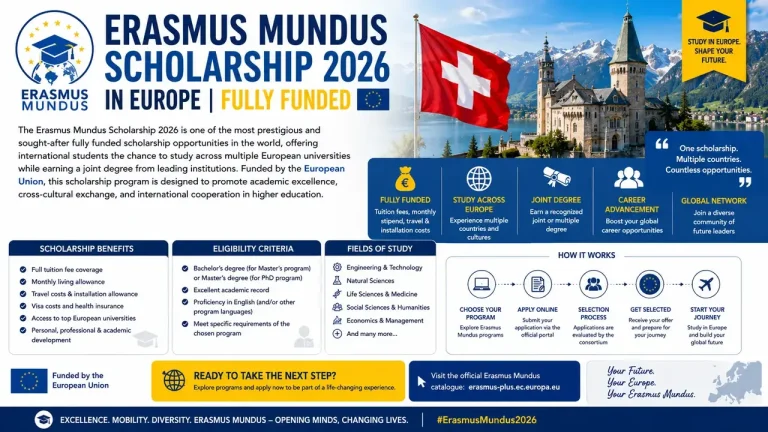
For the 2026 intake, the European Union has reaffirmed its commitment to this flagship program. The Erasmus Mundus Graduate Scholarship Program for 2026 represents one of the most prestigious and comprehensive funding opportunities available to international students seeking advanced education in Europe. Supported by the European Union, this initiative is designed to promote academic excellence, cross-cultural exchange, and global collaboration through fully funded master’s degree programs.
At its core, the program enables students to study across multiple European universities, offering a unique academic experience that goes beyond traditional single-institution education. Participants gain exposure to diverse teaching methodologies, research environments, and cultural perspectives, significantly enhancing both their academic and professional development.
One of the strongest appeals of the Erasmus Mundus scholarship lies in its extensive financial support. The program typically covers full tuition fees, ensuring that students can focus entirely on their studies without financial burden. In addition, recipients receive a monthly stipend—generally ranging between €1,000 and €1,200—to support living expenses. Travel allowances, health insurance, and accommodation support further reinforce its status as a truly “fully funded” opportunity.
Eligibility criteria are designed to attract high-achieving candidates from around the world. Applicants must hold a recognized bachelor’s degree and demonstrate strong academic performance. English language proficiency is usually required, although some programs may offer flexibility depending on specific requirements. Importantly, the scholarship is open to all nationalities, making it a highly inclusive program.
Beyond financial benefits, the Erasmus Mundus experience provides access to extensive academic networks, international research collaborations, and enhanced career prospects. Graduates of the program are well-positioned to contribute to global challenges, particularly in fields such as engineering, sustainability, and technology.
Overall, the Erasmus Mundus Graduate Scholarship Program stands as a gateway to world-class education and international mobility, empowering students to become globally competent professionals.
Click: DAAD Scholarship 2026 in Germany
Click: Scholarships in Belgium (2026–2027) — The Complete Detailed Guide
What Exactly is Erasmus Mundus?
To understand the scholarship, you must first understand the degree. Erasmus Mundus is not a standard Erasmus exchange semester. It is a specific type of Master’s Degree called a Joint Master’s Degree (JMD).
Here’s how it works:
- Consortium: A group of 4 to 8 universities from different European countries teams up to create one specific program (e.g., “Master’s in Journalism, Media, and Globalization”).
- Mobility: You must study in at least two of these countries. For example, Year 1 in Denmark, Year 2 in Spain. Some programs even require a third semester in a non-European partner country.
- Double/Multiple Degrees: Upon graduation, you receive degrees from every university you studied at. If you study at two, you get a double degree.
This structure is what makes it so valuable to employers. It proves you are adaptable, culturally aware, and capable of thriving in different academic systems.
The Financial Breakdown: What Does “Fully Funded” Really Mean?
The EMJMD scholarship is generous, but it’s important to understand the categories, as the amount you receive depends on your nationality. The EU divides countries into two categories:
- Programme Countries (PC): EU member states + a few associated countries (like Norway, Turkey, Serbia).
- Partner Countries (PC): The rest of the world (USA, Canada, India, Nigeria, Brazil, China, etc.).
Partner Country students receive significantly more funding.
| Feature | Partner Country Students | Programme Country Students |
|---|---|---|
| Tuition Fees | Fully Covered (€9,000/year) | Fully Covered (€9,000/year) |
| Monthly Stipend | €1,100 – €1,200 / month | €600 – €750 / month |
| Travel Contribution | €1,000 / year (or €3,000 if >4,000km away) | €300 / year |
| Installation Fee | €1,000 (One-time payment on arrival) | €0 |
| Total Est. Value | ~€45,000 – €50,000 for 2 years | ~€20,000 – €25,000 for 2 years |
Note: Exact figures for the 2026 cycle will be confirmed in the official call for proposals, usually released in autumn 2025. The above is based on the 2025 cycle and is highly unlikely to change drastically.
Eligibility Criteria: Can You Apply?
The barrier to entry is academic excellence, not wealth. Here is the checklist:
1. Academic Background
You must hold a Bachelor’s degree (or be in your final year) that gives you access to Master’s studies in your home country. While a 1st Class or high GPA is preferred, there is no hard minimum. However, this is a competitive scholarship—the higher your GPA, the better.
2. Nationality
Citizens of any country can apply. However, you cannot apply for a scholarship from an EU Program Country if you have already spent more than 12 months in Europe in the last 5 years (Erasmus+ mobility rule).
3. Language Proficiency
Most EMJMD programs are taught in English. You will need an IELTS (6.5+) or TOEFL (90+) certificate. Some programs are taught in French, Spanish, or German. Check the specific program website.
4. The “No Prior EMJMD” Rule
You cannot have already received an Erasmus Mundus scholarship in the past. If you did a standard Erasmus exchange for 6 months, you are still eligible.
Popular Fields of Study for 2026
There are over 100 different Erasmus Mundus programs. They cover almost every subject, but some fields are more popular than others:
- Engineering & Technology: Robotics, Sustainable Materials, Nuclear Energy.
- Data Science & IT: Big Data, Cybersecurity, AI.
- Environment & Sustainability: Climate Change, Marine Environment, Circular Economy.
- Social Sciences & Humanities: Public Policy, Journalism, Women’s Studies, Migration.
- Business & Economics: Global Management, Finance.
How to Apply: A Step-by-Step Strategy
The application process is rigorous. Do not leave it to the last week. Applications for the 2026 intake will likely open in October/November 2025 and close in January/February 2026.
Step 1: Choose Your Programs (The Most Important Step)
You can apply to a maximum of 3 programs. You must rank them: 1st choice, 2nd choice, 3rd choice.
- Strategy: Pick one “Dream Program,” one “Good Fit,” and one “Safe Bet.”
- Action: Browse the official catalog here: Erasmus Mundus Programme Catalogue
Step 2: Gather Documents (Start Now!)
Each consortium asks for slightly different documents, but the core set is:
- Motivation Letter: This is 50% of your application. It must be tailored to that specific program. Explain why you want to move between Country A and Country B.
- CV / Resume: Use the Europass format (standard in Europe).
- Recommendation Letters: 2 academic letters are standard. Ask professors who know you well.
- Degree Certificate & Transcripts: Official translations into English (or the language of the program).
- Language Certificate: IELTS/TOEFL.
- ID/Passport Copy.
Step 3: Submit via the Specific Website
CRITICAL: You do not apply to a central “Erasmus website.” You apply directly to the consortium’s website.
- Example: If you apply for the “Master in Chic,” you apply on the University of Paris’s application portal, not the EU’s portal.
- The links are found on the program page in the catalogue.
8 Frequently Asked Questions (FAQs)
1. Is there an age limit?
No. The Erasmus Mundus program has no upper age limit. We have seen scholars in their 40s and 50s receive the scholarship. It is purely based on academic merit and potential.
2. Can I work part-time while studying?
Yes. As a student in Europe, you are usually allowed to work 15-20 hours per week. The stipend (€1,100+) is generally enough to live on comfortably in most European cities, but a part-time job is great for experience.
3. Can I bring my spouse and children?
Yes. If you receive the scholarship, your family can join you. You may receive an additional “family allowance” (approx. €500/month), and your family has the right to reside in the EU with you.
4. I am already in Europe. Can I apply?
It depends. If you are a Partner Country citizen, you can apply even if you are currently in Europe. However, if you are a Programme Country citizen, you cannot have lived in Europe for more than 12 months in the last 5 years.
5. What if I don’t get the scholarship?
Every year, thousands of students apply for the scholarship but are put on a “Reserve List” or marked as “Self-Financing.” If you are accepted as a self-financing student, you can still do the program, but you must pay the tuition fees yourself (approx. €9,000/year). Many students take a bank loan in their home country to cover this.
6. How competitive is it?
Extremely. There are roughly 1,400 scholarships available per year for the whole world. In recent years, there have been over 20,000 applications. Your Motivation Letter and academic transcript must be outstanding.
7. Do I need to know the local language of the countries?
No. The programs are conducted in English. However, learning basic phrases for Country A and Country B will make your life infinitely better and is looked upon favorably by the selection committee.
8. When will I know the result?
The selection process takes time. You will usually hear back by April or May 2026. If you are selected, you must accept or decline quickly, as they will offer your spot to someone on the waiting list.
Official Links & Resources
| Resource | Link | Purpose |
|---|---|---|
| EACEA Erasmus Mundus Website | ec.europa.eu/programmes/erasmus-plus/opportunities/individuals/erasmus-mundus-joint-masters_en | The mothership. Official rules and guidelines. |
| Programme Catalogue | emjmdcatalogue.eacea.ec.europa.eu | START HERE. Search all 100+ available programs. |
| Funding & Tenders Portal | ec.europa.eu/info/funding-tenders/opportunities/portal/screen/opportunities/topic-search | Where official calls for proposals are published (for advanced users). |
| EM Student & Alumni Association | esaa-em.org | Connect with current students and alumni for advice. |
Final Thoughts: Why You Should Apply
The Erasmus Mundus scholarship is more than money. It is a life-altering label. When you graduate, you are not just a “Master of Science”; you are an “Erasmus Mundus Scholar.”
In a global job market, this signals to employers that you are independent, adaptable, and have a worldview that single-university graduates lack. The 2026 cycle is approaching. Start polishing your CV, contact your professors for letters, and draft that motivation letter today. Your journey across Europe starts with a single click.
Disclaimer: Information regarding scholarship amounts and deadlines is based on the 2024/2025 cycle. The 2026 official call for proposals will be published by the European Education and Culture Executive Agency (EACEA) in late 2025. Always verify details on the official EACEA website.