
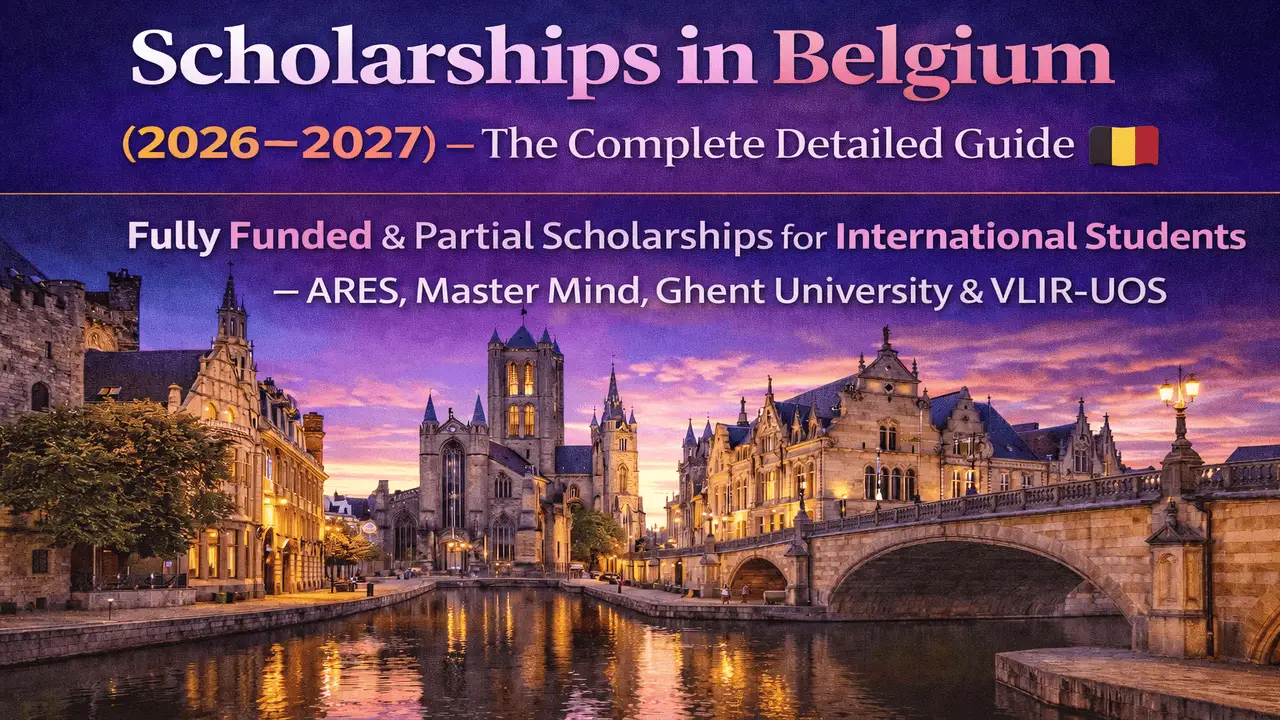
Scholarships in Belgium (2026–2027) — The Complete Detailed Guide 🇧🇪
Fully Funded & Partial Scholarships for International Students — ARES, Master Mind, Ghent University & VLIR-UOS
Belgium may be one of Europe’s smallest countries, but when it comes to higher education, research excellence, and scholarship opportunities for international students, it punches far above its weight. Home to some of the world’s oldest and most prestigious universities, a thriving multilingual culture, and the headquarters of the European Union, NATO, and countless international organizations, Belgium offers a uniquely strategic and enriching environment for students from around the globe.
For the 2026–2027 academic year, Belgium is offering several major scholarship programs that cover tuition fees, living expenses, travel costs, health insurance, and more. Whether you are from a developing country seeking a fully funded master’s degree, a high-achieving student looking for a prestigious Flemish government award, or a researcher hoping to pursue doctoral studies at one of Europe’s top universities, Belgium has a scholarship pathway designed for you.
In this comprehensive guide, we break down the four most important Belgian scholarship programs for international students in 2026–2027:
- ARES Scholarships — Belgian Government Fully Funded Scholarships
- Master Mind Scholarships — Flemish Government Merit-Based Awards
- Ghent University Scholarships — Institutional Funding at a World Top-100 University
- VLIR-UOS Scholarships — Belgian Development Cooperation Scholarships
Each section provides full details on eligibility, benefits, covered programs, application procedures, deadlines, and expert tips to maximize your chances of success.
Check: 34 PhD Positions Called at KTH Royal Institute of Technology, Sweden 2026
Check: PhD Scholarships in Engineering at the University of Sydney, Australia 2026
Check: Norway Funded Scholarships for International Students 2026
Why Study in Belgium?
Before exploring the scholarships, let’s understand why Belgium is an increasingly popular destination for international students:
🏛️ World-Class Universities
Belgium is home to globally ranked universities including KU Leuven (#1 in Belgium, consistently ranked in the global top 50), Ghent University, Université libre de Bruxelles (ULB), Vrije Universiteit Brussel (VUB), Université catholique de Louvain (UCLouvain), and the University of Antwerp. These institutions are renowned for cutting-edge research, Nobel Prize-winning faculty, and innovative teaching methods.
🌍 The Heart of Europe
Brussels is the de facto capital of the European Union, hosting the European Commission, the European Parliament, the Council of the European Union, and NATO headquarters. Studying in Belgium places you at the epicenter of European and global policy-making, offering unparalleled networking and career opportunities in international relations, law, business, and public policy.
🗣️ Multilingual & Multicultural
Belgium has three official languages — Dutch (Flemish), French, and German — and its universities offer programs in all three languages as well as a rapidly growing number of English-taught programs. The country’s multicultural character means international students feel welcome and integrated from day one.
💰 Affordable Compared to Peers
Compared to the UK, the US, Australia, or even the Netherlands, Belgium offers significantly lower tuition fees and living costs. When combined with the scholarships described in this guide, studying in Belgium can be remarkably affordable — or even completely free.
🔬 Research Powerhouse
Belgium invests heavily in research and development. Belgian universities are leaders in fields such as biotechnology, nanotechnology, artificial intelligence, microelectronics, space science, sustainable energy, and health sciences. PhD and research master’s programs benefit from strong government and industry funding.
📍 Strategic Location
Belgium’s central location in Europe makes it easy to travel to Paris, Amsterdam, London, Luxembourg, and Cologne — all within 1 to 3 hours by train. This connectivity enriches your academic and personal experience.
Understanding Belgium’s Education System
Belgium’s higher education system is divided along linguistic lines:
French-Speaking Community (Wallonia-Brussels Federation)
- Governed by the French Community of Belgium
- Universities include: UCLouvain, ULB, Université de Liège (ULiège), Université de Mons (UMons), Université de Namur, and others
- Scholarships coordinated by ARES (Academy of Research and Higher Education)
Dutch-Speaking Community (Flanders)
- Governed by the Flemish Community
- Universities include: KU Leuven, Ghent University, VUB, University of Antwerp, Hasselt University, and others
- Scholarships coordinated by VLIR-UOS and the Flemish Ministry of Education
German-Speaking Community
- A small community in eastern Belgium with its own education institutions
- Limited but growing international programs
This guide covers scholarships from both the French-speaking (ARES) and Dutch-speaking (Master Mind, Ghent University, VLIR-UOS) communities, giving you a complete picture of the opportunities available across all of Belgium.
1️⃣ ARES Scholarships (Belgian Government — Fully Funded)
Overview
The ARES Scholarships are among Belgium’s most prestigious and comprehensive scholarship programs for international students from developing countries. Funded by the Belgian Federal Government through the Wallonia-Brussels Federation and administered by the Academy of Research and Higher Education (ARES), these scholarships enable talented students and professionals to pursue master’s degrees, advanced training programs, and doctoral research at French-speaking Belgian universities.
🔗 Official Website: https://www.ares-ac.be/en/cooperation-au-developpement/scholarships
Types of ARES Scholarships
ARES offers several scholarship categories:
A. Master’s Scholarships (Bourses de Master de Spécialisation)
These scholarships fund international students to pursue one-year or two-year specialized master’s programs at French-speaking Belgian universities.
Duration: 1–2 years (depending on the program)
Host Institutions: UCLouvain, ULB, ULiège, UMons, Université de Namur, and other ARES-affiliated institutions
Available Programs Include:
- Master in Public Health
- Master in Microfinance
- Master in International Relations and Development
- Master in Environmental Science and Management
- Master in Urban Planning and Regional Development
- Master in Food Science and Technology
- Master in Transport and Logistics
- Master in Risk Management
- Master in Aquaculture
- Master in Animal Health and Production
- And many more across engineering, health, agriculture, social sciences, and humanities
B. Training and Internship Scholarships (Bourses de Stage)
Short-term scholarships for professionals seeking advanced training, internships, or professional development courses at Belgian institutions.
Duration: Typically 1–6 months
C. Doctoral Scholarships (Bourses de Doctorat)
Scholarships for PhD candidates conducting doctoral research at French-speaking Belgian universities. These are typically structured as “sandwich PhD” programs, where the candidate splits time between Belgium and their home institution.
Duration: Up to 4 years (with alternating stays in Belgium and home country)
What ARES Scholarships Cover (Benefits)
The ARES scholarship is fully funded and covers the following:
| Benefit | Details |
|---|---|
| Tuition Fees | Fully covered — all academic and registration fees paid |
| Monthly Living Allowance | Approximately €1,000–€1,200 per month (adjusted periodically) |
| International Airfare | Round-trip economy class ticket from your home country to Belgium |
| Health & Accident Insurance | Comprehensive medical insurance for the duration of your stay in Belgium |
| Thesis/Research Allowance | Additional funding for research materials, field work, and thesis preparation |
| Reintegration Allowance | A one-time reintegration grant upon return to your home country (for some programs) |
| Visa Support | Assistance with Belgian student visa application |
| Housing Assistance | Support in finding accommodation (though housing is typically the student’s responsibility to arrange) |
Estimated Total Value: €15,000–€35,000+ per year (depending on program duration and level)
Eligibility Criteria
To be eligible for an ARES scholarship, you must meet the following requirements:
Nationality
ARES scholarships are specifically targeted at students from developing countries. The list of eligible countries is defined by Belgian development cooperation policy and includes nations across:
- Sub-Saharan Africa: Benin, Burkina Faso, Burundi, Cameroon, Democratic Republic of Congo, Ethiopia, Guinea, Kenya, Madagascar, Mali, Morocco, Mozambique, Niger, Rwanda, Senegal, Tanzania, Uganda, and others
- Asia: Bangladesh, Cambodia, Myanmar, Nepal, Palestine, Philippines, Vietnam, and others
- Latin America & Caribbean: Bolivia, Cuba, Ecuador, Haiti, Peru, and others
- Middle East & North Africa: Morocco, Tunisia, and others
The complete list of eligible countries is available on the ARES website and is updated periodically.
Academic Requirements
- A bachelor’s degree (minimum 4 years or equivalent) for master’s scholarships
- A master’s degree for doctoral scholarships
- Strong academic record demonstrating high achievement
- Degree must be from a recognized institution in an eligible country
Professional Experience
- For most master’s programs, at least 1–2 years of professional experience after completing your degree is required (or strongly preferred)
- The professional experience should be relevant to the program you are applying for
- ARES prioritizes candidates whose studies will directly benefit their home country’s development
Age Limit
- Master’s candidates: Generally under 40 years of age at the start of the program
- Doctoral candidates: Generally under 45 years of age
- Age limits may vary by program — check specific listings
Language Requirements
- Most ARES-funded programs are taught in French
- You must demonstrate strong French language proficiency (typically B2 or C1 level on the CEFR scale)
- Some programs may accept English proficiency — check individual program requirements
- Accepted proof: DELF/DALF certificates, TCF, or equivalent
Other Requirements
- You must be a national and resident of an eligible developing country at the time of application
- You must not be currently residing in Belgium or another EU country
- You must commit to returning to your home country after completing your studies to contribute to its development
- Previous ARES scholarship holders are generally not eligible for a second scholarship
How to Apply for ARES Scholarships
Step 1: Browse Available Programs
Visit the ARES website to view the complete list of eligible master’s programs, training courses, and doctoral opportunities for 2026–2027. Each program listing includes detailed information about the curriculum, host university, duration, and specific requirements.
Step 2: Check Eligibility
Verify that you meet all eligibility criteria, including nationality, academic background, professional experience, age, and language requirements.
Step 3: Prepare Your Application Documents
Typical required documents include:
- ✅ Completed ARES application form (available online)
- ✅ Certified copies of academic transcripts and diplomas
- ✅ CV / Resume detailing academic and professional experience
- ✅ Motivation letter explaining why you want to pursue the program, how it relates to your career, and how it will benefit your home country
- ✅ Letters of recommendation (usually 2–3) from academic or professional references
- ✅ Proof of French language proficiency (DELF/DALF or equivalent)
- ✅ Copy of passport or national identity document
- ✅ Proof of professional experience (employment certificates, letters from employers)
- ✅ Medical certificate of good health
- ✅ Passport-size photographs
- ✅ Any additional documents specified by the chosen program
All documents not in French or English must be accompanied by certified translations.
Step 4: Submit Your Application Online
Applications are submitted through the ARES online application platform. Create an account, fill in the required information, upload your documents, and submit before the deadline.
Step 5: Selection Process
- Applications are reviewed by selection committees at the host universities
- Shortlisted candidates may be invited for an interview (in person or online)
- Final selection is based on academic merit, professional experience, motivation, and the relevance of the studies to your home country’s development needs
- Results are typically announced 3–6 months after the deadline
Application Deadline
ARES scholarship applications typically open in October–November and close in January–February for programs starting in the following September. Exact dates vary by program year.
⚠️ For the 2026–2027 academic year, check the ARES website starting in October 2025 for the exact opening and closing dates.
Tips for a Strong ARES Application
- Emphasize Development Impact: ARES scholarships are development-focused. Your motivation letter should clearly explain how your studies will contribute to the development of your home country and community.
- Show Relevant Experience: Professional experience directly related to your chosen program significantly strengthens your application. Provide detailed evidence of your work and its impact.
- Demonstrate French Proficiency Early: If French is not your first language, start preparing for the DELF/DALF exam well in advance. A B2 or C1 certificate is a major asset.
- Choose the Right Program: Select a program that closely aligns with your professional background and future goals. A coherent narrative linking your past experience, proposed studies, and future plans is essential.
- Secure Strong References: Choose referees who know your work well and can speak specifically about your academic abilities, professional contributions, and potential for impact.
2️⃣ Master Mind Scholarships (Flemish Government)
Overview
The Master Mind Scholarship is a prestigious merit-based scholarship offered by the Flemish Government (Flemish Ministry of Education and Training) to attract outstanding international students to pursue master’s degree programs at universities and university colleges in Flanders (the Dutch-speaking region of Belgium).
Unlike development-focused scholarships, the Master Mind Scholarship is open to students from all countries worldwide and is awarded purely based on academic excellence and merit.
🔗 Official Website: https://www.studyinflanders.be/scholarships/master-mind-scholarships
What the Master Mind Scholarship Covers (Benefits)
| Benefit | Details |
|---|---|
| Tuition Fee Waiver | Tuition fees are reduced to the Flemish community rate (approximately €122.20–€942.90 per year instead of the standard international rate of €3,000–€9,000+) |
| Living Allowance | A monthly stipend to help cover living expenses in Flanders |
| Grant Amount | Up to €8,400 per academic year (total scholarship value combining tuition reduction and living allowance) |
| Duration | Covers the full duration of the master’s program (1 or 2 years) |
| Health Insurance | Scholarship recipients are expected to arrange their own health insurance, but guidance is provided |
Note: The exact scholarship amount may vary by year and is set by the Flemish Government. The figures above are based on recent years and may be updated for 2026–2027.
Eligible Universities in Flanders
The Master Mind Scholarship can be used at any of the following Flemish universities and university colleges:
| University | City | QS Ranking |
|---|---|---|
| KU Leuven | Leuven | Top 50 globally |
| Ghent University | Ghent | Top 100 globally |
| Vrije Universiteit Brussel (VUB) | Brussels | Top 200 globally |
| University of Antwerp | Antwerp | Top 250 globally |
| Hasselt University | Hasselt | Top 500 globally |
| University Colleges (Hogescholen) | Various cities | Nationally recognized |
You can apply for a Master Mind Scholarship for any English-taught or Dutch-taught master’s program offered at these institutions.
Eligibility Criteria
| Criterion | Requirement |
|---|---|
| Nationality | Open to students from all countries worldwide (non-Belgian citizens) |
| Degree | Must hold a bachelor’s degree (or equivalent) from a recognized institution outside Belgium |
| Academic Excellence | Strong academic record demonstrating outstanding achievement (typically top 10–20% of your class) |
| Program | Must be admitted to (or applying for) an initial master’s degree at a Flemish university or university college |
| Prior Study in Belgium | Candidates who have already obtained a degree in Belgium are generally not eligible |
| Language | Must meet the language requirements of the chosen master’s program (English or Dutch, depending on the program) |
How to Apply for the Master Mind Scholarship
The Master Mind Scholarship application process involves two parallel tracks: applying for admission to your chosen master’s program AND applying for the scholarship itself.
Step 1: Choose a Master’s Program in Flanders
- Browse English-taught master’s programs at Flemish universities through the Study in Flanders website or individual university websites
- Select a program that matches your academic background and career aspirations
- Note the program’s specific admission requirements and application deadlines
Step 2: Apply for Admission to the University
- Submit your application for admission directly to the Flemish university through their online application portal
- Each university has its own admission process, deadlines, and requirements
- You must secure admission to the university as part of the scholarship application process
Step 3: Apply for the Master Mind Scholarship
- The scholarship application is typically submitted through the university — each Flemish university has a Master Mind Scholarship coordinator
- Some universities allow you to indicate your interest in the Master Mind Scholarship as part of the regular admission application; others require a separate scholarship application form
- Contact the international admissions office of your chosen university for specific instructions
Step 4: Submit Required Documents
Common documents required for the Master Mind Scholarship include:
- ✅ Completed scholarship application form (university-specific)
- ✅ Certified copies of academic transcripts and degree certificates
- ✅ CV / Resume
- ✅ Motivation letter explaining your academic goals, why you chose Flanders, and how the scholarship will support your ambitions
- ✅ Letters of recommendation (usually 2)
- ✅ Proof of English language proficiency (IELTS, TOEFL, or equivalent — for English-taught programs)
- ✅ Copy of passport
- ✅ Evidence of academic excellence (awards, honors, class rank, publications, etc.)
Step 5: Selection Process
- Each Flemish university conducts its own internal selection of candidates to nominate for the Master Mind Scholarship
- Nominated candidates are then reviewed by the Flemish Government for final approval
- Selection is based on academic merit, motivation, and potential
- The number of scholarships awarded per year is limited (approximately 45 scholarships are available across all Flemish universities each year)
Application Timeline
| Step | Typical Timeline |
|---|---|
| Program and university research | September – December 2025 |
| University admission application | October 2025 – March 2026 (varies by university) |
| Master Mind Scholarship application | December 2025 – March 2026 (varies by university) |
| Selection and notification | April – June 2026 |
| Program start | September 2026 |
⚠️ Deadlines vary by university. Check the specific Master Mind Scholarship deadline at your chosen Flemish university well in advance.
Tips for Winning a Master Mind Scholarship
- Academic Excellence is Key: This is a merit-based scholarship. Your grades, class ranking, and academic achievements are the most important factors. If possible, provide evidence of being in the top 10% of your class.
- Apply to Top Programs: Choosing a highly competitive, internationally recognized master’s program at KU Leuven or Ghent University strengthens your overall profile.
- Start Early: Many universities have early application deadlines for scholarship consideration. Applying early shows initiative and gives you more time to prepare a polished application.
- Tailor Your Motivation Letter: Explain specifically why you want to study in Flanders (not just Belgium in general), what unique opportunities the program offers, and how it connects to your future career plans.
- Highlight Extracurricular Achievements: Beyond grades, mention research experience, leadership roles, volunteer work, publications, or awards that demonstrate your well-rounded profile.
- Contact the Scholarship Coordinator: Each Flemish university has a designated Master Mind Scholarship coordinator. Reach out to them early to understand the process and get personalized guidance.
3️⃣ Ghent University Scholarships
Overview
Ghent University (Universiteit Gent — UGent) is one of the top research universities in Belgium and consistently ranks among the top 100 universities globally. Founded in 1817, Ghent University has a long tradition of academic excellence, with 11 faculties, over 44,000 students, and a thriving international community.
Ghent University offers a range of scholarships and funding opportunities for international students at the master’s, doctoral, and postdoctoral levels. The university is particularly committed to supporting researchers and providing financial pathways for talented students from around the world.
🔗 Official Funding Page: https://www.ugent.be/en/work/science/funding
Types of Scholarships at Ghent University
A. Special Research Fund (BOF) Doctoral Scholarships
The BOF (Bijzonder Onderzoeksfonds / Special Research Fund) is Ghent University’s primary internal funding mechanism for doctoral research.
What it covers:
| Benefit | Details |
|---|---|
| Salary/Stipend | Full doctoral scholarship with a competitive monthly living allowance comparable to a junior researcher salary |
| Tuition Fees | Fully covered |
| Research Budget | Funding for research materials, equipment, conference travel, and fieldwork |
| Duration | Up to 4 years (full-time PhD) |
| Social Benefits | Access to Belgian social security, including health insurance |
Types of BOF Doctoral Scholarships:
- BOF Regular PhD Scholarships: Open to all nationalities. Linked to specific research projects proposed by Ghent University professors.
- BOF-GOA (Concerted Research Actions): Large-scale research projects that include funded PhD positions.
- BOF Doctoral Scholarships for Developing Countries: Specifically targeted at doctoral candidates from developing countries, often structured as “sandwich PhD” programs with periods in Belgium and the home country.
- BOF Co-funded PhD Scholarships: Joint funding between Ghent University and external partners (industry, international organizations, foreign universities).
Eligibility:
- Master’s degree in a relevant field
- Strong academic record
- Research proposal aligned with a Ghent University research group
- Must have identified a supervisor at Ghent University
- Some BOF schemes have specific nationality or country requirements
B. Ghent University Master’s Scholarships
Ghent University offers limited scholarships for international master’s students, particularly through:
- Master Mind Scholarship (Flemish Government): As described in Section 2, Ghent University is one of the participating institutions.
- Faculty-Specific Scholarships: Some faculties offer their own scholarships or fee waivers for exceptional international students.
- Bilateral Agreements: Ghent University has scholarship agreements with partner universities and governments worldwide.
- Erasmus Mundus Joint Master Degrees: Ghent University participates in several Erasmus Mundus programs with full scholarships for international students.
C. FWO (Research Foundation Flanders) Doctoral and Postdoctoral Fellowships
While not a Ghent University-specific scholarship, the FWO (Fonds Wetenschappelijk Onderzoek — Vlaanderen) provides prestigious research fellowships that can be held at Ghent University.
FWO Doctoral Fellowship:
- 4-year fully funded PhD fellowship
- Open to all nationalities
- Monthly salary comparable to a university researcher
- Research and travel budget included
- Highly competitive — awarded based on research quality and candidate excellence
FWO Postdoctoral Fellowship:
- 3-year fully funded postdoctoral fellowship
- For researchers who have recently completed their PhD
- Full salary and research budget
Application: FWO fellowships are applied for directly through the FWO website, with the candidate indicating Ghent University as their host institution.
D. VLIR-UOS Scholarships at Ghent University
Many VLIR-UOS-funded master’s and training programs (detailed in Section 4) are hosted at Ghent University, providing fully funded opportunities for students from developing countries.
E. Erasmus+ and International Exchange Scholarships
Ghent University participates actively in:
- Erasmus+ KA1 International Credit Mobility: Scholarships for exchange students from partner universities worldwide
- Erasmus Mundus Joint Master Degrees: Full scholarships for international students in joint programs
- Bilateral Exchange Agreements: Exchange opportunities with universities in Asia, Africa, the Americas, and beyond
Research Areas and Faculties at Ghent University
Ghent University offers PhD and master’s programs across 11 faculties:
| Faculty | Key Research Areas |
|---|---|
| Faculty of Arts and Philosophy | Linguistics, history, philosophy, literary studies |
| Faculty of Law and Criminology | International law, human rights, criminology |
| Faculty of Sciences | Biology, chemistry, physics, mathematics, geology |
| Faculty of Medicine and Health Sciences | Biomedical sciences, clinical research, public health |
| Faculty of Engineering and Architecture | Civil, electrical, mechanical, chemical, and biomedical engineering; architecture |
| Faculty of Economics and Business Administration | Finance, marketing, management, innovation |
| Faculty of Veterinary Medicine | Animal health, food safety, aquaculture |
| Faculty of Psychology and Educational Sciences | Clinical psychology, educational innovation |
| Faculty of Bioscience Engineering | Agriculture, environmental technology, food science, forestry |
| Faculty of Pharmaceutical Sciences | Drug development, pharmaceutical care |
| Faculty of Political and Social Sciences | Political science, sociology, communication, conflict studies |
How to Apply for Ghent University Scholarships
For PhD Scholarships (BOF):
- Identify a research group and supervisor at Ghent University whose work aligns with your interests
- Contact the supervisor directly to discuss potential PhD projects and funding opportunities
- Prepare a research proposal in collaboration with your supervisor
- Apply through Ghent University’s online system when a BOF call is open
- BOF calls are typically announced 1–2 times per year — check the Ghent University research funding page regularly
For Master’s Scholarships:
- Browse available master’s programs on the Ghent University website
- Apply for admission through the online application portal
- Indicate scholarship interest during the application process
- Check for Master Mind Scholarship eligibility and apply through the designated process
- Explore Erasmus Mundus programs hosted at Ghent University
For FWO Fellowships:
- Visit the FWO website (www.fwo.be)
- Identify Ghent University as your host institution
- Find a supervisor at Ghent University willing to host your fellowship
- Prepare your application (research proposal, CV, supervisor endorsement)
- FWO application deadlines are typically in February–March for fellowships starting in October
🔗 Ghent University Funding Page: https://www.ugent.be/en/work/science/funding
Tips for Securing a Ghent University Scholarship
- Contact Supervisors Early: For PhD scholarships, having a supervisor who supports your candidature is essential. Start reaching out to professors 6–12 months before application deadlines.
- Publish and Present Research: Publications, conference presentations, and research experience significantly strengthen PhD applications at Ghent University.
- Use the Research Portal: Ghent University’s Academic Bibliography and Research Explorer allow you to search for active researchers, their publications, and current projects. Use these tools to identify the best-fit supervisor.
- Apply to Multiple Funding Sources: Don’t limit yourself to one scholarship. Apply for BOF, FWO, VLIR-UOS, and Erasmus Mundus simultaneously to maximize your chances.
- Check Specific Faculty Opportunities: Some faculties have their own scholarship funds — contact the faculty’s international office directly.
4️⃣ VLIR-UOS Scholarships (Belgian Development Cooperation)
Overview
VLIR-UOS (Vlaamse Interuniversitaire Raad — Universitaire Ontwikkelingssamenwerking) is the Flemish university development cooperation body that manages scholarships and academic cooperation programs funded by the Belgian Federal Government’s Development Cooperation budget. VLIR-UOS scholarships are among the most well-known and generous fully funded scholarship programs for students from developing countries.
VLIR-UOS offers scholarships primarily for English-taught master’s programs, training courses, and international courses at Flemish universities in Belgium.
🔗 Official Website: https://www.vliruos.be/en/scholarships
Types of VLIR-UOS Scholarships
A. VLIR-UOS Scholarships for Master’s Programs (ICP — International Course Programme)
These are fully funded scholarships for students from developing countries to pursue 1- or 2-year English-taught master’s programs at Flemish universities.
What it covers:
| Benefit | Details |
|---|---|
| Tuition Fees | Fully covered |
| Monthly Living Allowance | Approximately €1,090 per month (adjusted periodically) to cover accommodation, food, local transport, and personal expenses |
| International Travel | Round-trip airfare (economy class) from your home country to Belgium |
| Health & Accident Insurance | Comprehensive insurance for the duration of your stay in Belgium |
| Settling-In Allowance | A one-time allowance upon arrival to help with initial costs |
| Thesis/Research Costs | Additional funding for thesis research, fieldwork, and study materials |
| Reintegration Grant | A one-time reintegration allowance upon return to your home country after graduation |
Estimated Total Value: €20,000–€40,000+ per year (depending on program duration)
B. VLIR-UOS Training and Refresher Courses (ITP — International Training Programme)
Short-term training scholarships for professionals from developing countries to attend specialized courses at Flemish universities. These are typically:
- Duration: 1–4 weeks
- Fully funded: Travel, accommodation, course fees, and daily allowances covered
- Topics: Public health, agriculture, water management, ICT, education, governance, and more
C. VLIR-UOS PhD Scholarships
VLIR-UOS funds doctoral research through its Institutional University Cooperation (IUC) and other partnership programs. These PhD scholarships are typically:
- Linked to research collaborations between Flemish universities and partner institutions in developing countries
- Structured as sandwich PhD programs (alternating periods in Belgium and the home country)
- Fully funded, covering travel, living expenses, tuition, and research costs
Eligible VLIR-UOS Master’s Programs (ICP)
VLIR-UOS scholarships can be used for a specific list of approved International Course Programmes (ICPs) at Flemish universities. These are English-taught master’s programs specifically designed for an international student body.
Examples of VLIR-UOS ICP Programs (subject to change):
| Program | University | Duration |
|---|---|---|
| MSc in Nematology | Ghent University | 2 years |
| MSc in Aquaculture | Ghent University | 2 years |
| MSc in Food Technology | Ghent University | 2 years |
| MSc in Physical Land Resources | Ghent University | 2 years |
| MSc in Marine and Lacustrine Science | Ghent University / VUB / University of Antwerp | 2 years |
| MSc in Sustainable Development | KU Leuven | 1 year |
| MSc in Water Resources Engineering | KU Leuven | 2 years |
| MSc in Development Evaluation and Management | University of Antwerp | 1 year |
| MSc in Governance and Development | University of Antwerp | 1 year |
| MSc in Globalisation and Development | University of Antwerp | 1 year |
| MSc in Transport and Maritime Management | University of Antwerp | 1 year |
| MSc in Public Health | University of Antwerp | 1 year |
| MSc in Urban and Regional Planning | VUB | 2 years |
| MSc in Human Ecology | VUB | 2 years |
| MSc in Statistics | Hasselt University | 2 years |
The full and updated list of eligible ICP programs is available on the VLIR-UOS website. Programs are reviewed and updated periodically.
Eligibility Criteria for VLIR-UOS Scholarships
| Criterion | Requirement |
|---|---|
| Nationality | Must be a national of an eligible developing country (list defined by VLIR-UOS/Belgian development cooperation policy) |
| Residence | Must be residing in an eligible country at the time of application (not already in Belgium or another EU country) |
| Academic Background | Must hold a bachelor’s degree (minimum 4 years) or equivalent in a relevant field |
| Professional Experience | Minimum 2 years of relevant professional experience after graduation (strongly preferred for most programs) |
| Age | Generally under 35 years of age for master’s scholarships; under 40 for training programs (varies by program) |
| Language | Must demonstrate English language proficiency (IELTS 6.5+, TOEFL 90+ iBT, or equivalent) |
| Motivation | Must demonstrate strong motivation and commitment to contributing to the development of your home country after graduation |
| Previous Scholarships | Candidates who have previously received a VLIR-UOS or ARES scholarship may not be eligible for a second scholarship |
Eligible Countries
VLIR-UOS scholarships are available to nationals of countries in:
- Sub-Saharan Africa: Benin, Burkina Faso, Burundi, Cameroon, Democratic Republic of Congo, Ethiopia, Guinea, Kenya, Madagascar, Mali, Mozambique, Niger, Nigeria, Rwanda, Senegal, South Africa, Tanzania, Uganda, Zimbabwe, and others
- Asia: Bangladesh, Cambodia, India, Indonesia, Myanmar, Nepal, Philippines, Sri Lanka, Vietnam, and others
- Latin America & Caribbean: Bolivia, Colombia, Cuba, Ecuador, Guatemala, Haiti, Nicaragua, Peru, and others
- Middle East & North Africa: Morocco, Palestine, and others
The complete and updated list of eligible countries is available on the VLIR-UOS website.
How to Apply for VLIR-UOS Scholarships
Step 1: Browse Eligible Programs
Visit the VLIR-UOS website and browse the list of International Course Programmes (ICPs) available for the 2026–2027 academic year. Read the program descriptions carefully and identify the one that best matches your academic background and career goals.
Step 2: Check Eligibility
Verify that you meet all eligibility criteria, including nationality, academic qualifications, professional experience, age, and language requirements.
Step 3: Prepare Your Application Documents
Required documents typically include:
- ✅ Completed VLIR-UOS online application form
- ✅ Certified copies of academic transcripts and diplomas (all higher education)
- ✅ CV / Resume detailing education, professional experience, and achievements
- ✅ Motivation letter (usually structured around specific questions about your career plan and how the program will contribute to development in your home country)
- ✅ Letters of recommendation (usually 2–3, from academic and/or professional references)
- ✅ Proof of English language proficiency (IELTS, TOEFL, or equivalent)
- ✅ Copy of passport
- ✅ Proof of professional experience (employment certificates, contracts)
- ✅ Medical certificate (in some cases)
- ✅ Passport-size photographs
All documents not in English, French, or Dutch must be accompanied by certified translations.
Step 4: Submit Your Application Online
Applications are submitted through the VLIR-UOS online scholarship application portal. Create an account, select your desired ICP program, fill in all required fields, upload your documents, and submit before the deadline.
Important: You can apply for only one ICP program per application round. Choose carefully.
Step 5: Selection Process
- Screening: VLIR-UOS and the host university conduct an initial screening of all applications to verify eligibility.
- Academic Evaluation: Eligible applications are evaluated by the host university’s selection committee based on academic merit, professional experience, motivation, and relevance to development.
- Ranking: Candidates are ranked by the selection committee.
- Final Selection: VLIR-UOS makes the final scholarship award decision based on the universities’ rankings and the available budget.
- Notification: Successful candidates are notified via email and receive a formal scholarship offer letter.
Application Timeline
| Step | Typical Timeline |
|---|---|
| Applications open | October – November 2025 |
| Application deadline | February 1, 2026 (typical — may vary by program) |
| Selection process | February – May 2026 |
| Results announced | May – June 2026 |
| Visa and travel preparation | June – August 2026 |
| Program start | September 2026 |
⚠️ Exact deadlines are announced on the VLIR-UOS website each year. Check the website starting in October 2025 for 2026–2027 deadlines.
Tips for a Strong VLIR-UOS Application
- Focus on Development Impact: VLIR-UOS scholarships are fundamentally about development. Your motivation letter must convincingly explain how your studies will contribute to solving specific development challenges in your home country or region. Be specific — mention concrete projects, organizations, or sectors you plan to work in after graduation.
- Demonstrate Professional Commitment: Professional experience is a crucial selection criterion. Provide detailed evidence of your work experience, including your role, responsibilities, achievements, and how it relates to the master’s program.
- Choose the Right Program: Select an ICP program that genuinely aligns with your background and career plans. A mismatch between your profile and the program weakens your application.
- Strong Academic Record: While professional experience is important, your academic qualifications remain a key factor. Highlight your academic achievements, including grades, class rankings, honors, and any research experience.
- English Language Scores Matter: A strong IELTS or TOEFL score demonstrates your ability to succeed in an English-taught program. Aim for IELTS 7.0+ or TOEFL 100+ to be competitive.
- Plan Your Reintegration: VLIR-UOS wants to see a clear reintegration plan — how you will use your new knowledge and skills when you return home. Describe your post-graduation career plans in detail.
- Apply Early: The online application system can experience heavy traffic near the deadline. Submit your application at least 1–2 weeks before the deadline to avoid technical issues.
Comparison Table: All Four Belgian Scholarship Programs
| Feature | ARES | Master Mind | Ghent University | VLIR-UOS |
|---|---|---|---|---|
| Provider | Belgian Government (Wallonia-Brussels) | Flemish Government | Ghent University / FWO | Belgian Development Cooperation |
| Level | Master’s, PhD, Training | Master’s | Master’s, PhD, Postdoc | Master’s, PhD, Training |
| Eligible Nationalities | Developing countries | All countries worldwide | All countries (varies by scheme) | Developing countries |
| Language of Instruction | Primarily French | English or Dutch | English or Dutch | English |
| Tuition | Fully covered | Reduced to Flemish rate | Fully covered (PhD) | Fully covered |
| Living Allowance | ~€1,000–1,200/month | Included in grant (~€8,400/year) | Full salary (PhD) | ~€1,090/month |
| Airfare | ✅ Covered | ❌ Not covered | Varies by scheme | ✅ Covered |
| Health Insurance | ✅ Covered | Student arranges | ✅ Covered (employee) | ✅ Covered |
| Professional Experience Required | Yes (1–2 years) | No | No (but helps for PhD) | Yes (2+ years preferred) |
| Age Limit | ~40 (Master’s), ~45 (PhD) | No | No | ~35 (Master’s) |
| Approximate Positions/Year | ~150–200 | ~45 | Varies (50+ PhD/year) | ~100–150 |
| Application Deadline | Jan–Feb (typically) | Dec–Mar (varies by university) | Rolling / 1–2 times/year | Feb 1 (typically) |
Living in Belgium: What to Expect
Cost of Living
Belgium is more affordable than many Western European countries, especially compared to the UK, Switzerland, or Scandinavia.
| Expense | Monthly Estimate (EUR) |
|---|---|
| Student Accommodation | €350 – €600 |
| Food & Groceries | €200 – €350 |
| Transportation | €30 – €60 (student pass) |
| Health Insurance | €0 – €100 (depending on scholarship) |
| Books & Supplies | €50 – €100 |
| Personal & Entertainment | €100 – €200 |
| Total | €730 – €1,310 |
Money-Saving Tips:
- Live in a student residence (kot) — cheaper and more social than private apartments
- Use a student discount card for transportation, museums, and cultural events
- Shop at budget supermarkets like Colruyt, Aldi, and Lidl
- Cook at home — Belgian groceries are affordable and high quality
- Take advantage of free university events and activities
Student Life
- Belgium is famous for its chocolate, beer, waffles, and fries — and student life reflects this culinary culture
- University cities like Ghent, Leuven, Brussels, Antwerp, and Liège are vibrant, walkable, and full of cultural events
- Student organizations (studentenverenigingen) are central to Belgian university life — join one to meet locals and internationals
- Belgium’s excellent rail network makes weekend trips to other European cities easy and affordable
Frequently Asked Questions (FAQs)
1. Can I apply for multiple Belgian scholarships at the same time?
It depends. You can generally apply for scholarships from different providers (e.g., VLIR-UOS and Master Mind) simultaneously, as long as you meet the eligibility criteria for each. However, you typically cannot hold two full scholarships at the same time. If awarded multiple scholarships, you will usually need to choose one. Always check the specific rules of each scholarship program.
2. Do I need to speak French or Dutch to study in Belgium?
Not necessarily. Many master’s and PhD programs at Belgian universities are taught entirely in English, especially in Flanders (Dutch-speaking region). VLIR-UOS programs are English-taught. ARES programs are predominantly in French, so French proficiency is required for those. Check the language of instruction for your specific program before applying.
3. Can I work while studying in Belgium on a scholarship?
Yes, with limitations. International students in Belgium are generally permitted to work up to 20 hours per week during the academic year with a valid work permit (Type C permit, which is usually granted automatically to students). During holidays, you can work full-time. However, scholarship conditions may restrict outside employment — check your scholarship terms.
4. What are my chances of getting a Belgian scholarship?
Competitive but achievable. ARES and VLIR-UOS scholarships receive thousands of applications each year, with acceptance rates typically between 5% and 15%. Master Mind scholarships are also competitive, with approximately 45 awards per year across all Flemish universities. A strong academic record, relevant professional experience, a compelling motivation letter, and a clear development impact plan significantly improve your chances.
5. Can I stay in Belgium after completing my studies?
Yes. After graduation, international students in Belgium can apply for a job search visa (Orientation Year) that allows them to stay in Belgium for up to 12 months to seek employment. If you find a job, you can transition to a work permit. Belgium also offers pathways to long-term residency and citizenship for those who remain employed in the country. PhD graduates are especially well-positioned for academic and research careers in Belgium and across Europe.
6. Are these scholarships available for online or distance learning programs?
No. ARES, Master Mind, Ghent University, and VLIR-UOS scholarships are available only for on-campus, full-time programs in Belgium. Online or distance learning programs are not eligible.
7. Do I need to return to my home country after the scholarship ends?
For ARES and VLIR-UOS scholarships: Yes. These development-focused scholarships require you to return to your home country after completing your studies to contribute to its development. This is a core condition of the scholarship and is taken seriously during the selection process. For Master Mind and Ghent University scholarships, there is generally no mandatory return requirement, though you will need to comply with Belgian immigration rules.
Final Thoughts
Belgium offers a remarkable combination of world-class education, generous scholarship programs, cultural richness, and strategic location that makes it one of the best destinations for international students in 2026–2027.
Whether you are a professional from a developing country seeking a fully funded master’s through ARES or VLIR-UOS, a high-achieving student from any country aiming for the prestigious Master Mind Scholarship, or an aspiring researcher pursuing a PhD at Ghent University, Belgium provides funded pathways to transform your career and make a lasting impact.
The scholarships are available. The universities are world-class. And Belgium is ready to welcome you.
Start preparing your application today — your future in Belgium begins now.
🔗 Key Links:
| Scholarship | Official Website |
|---|---|
| ARES Scholarships | https://www.ares-ac.be/en/cooperation-au-developpement/scholarships |
| Master Mind Scholarships | https://www.studyinflanders.be/scholarships/master-mind-scholarships |
| Ghent University Funding | https://www.ugent.be/en/work/science/funding |
| VLIR-UOS Scholarships | https://www.vliruos.be/en/scholarships |
Disclaimer: All information in this article is based on publicly available data from the official websites of ARES, VLIR-UOS, Ghent University, Study in Flanders, and the Belgian government as of the publication date. Scholarship amounts, eligibility criteria, eligible countries, program listings, and deadlines are subject to change. Applicants are strongly encouraged to verify all details directly on the official websites before applying.
i will love to further my education in a great institution as yours in belgium