PhD Scholarships in Engineering at the University of Sydney, Australia 2026
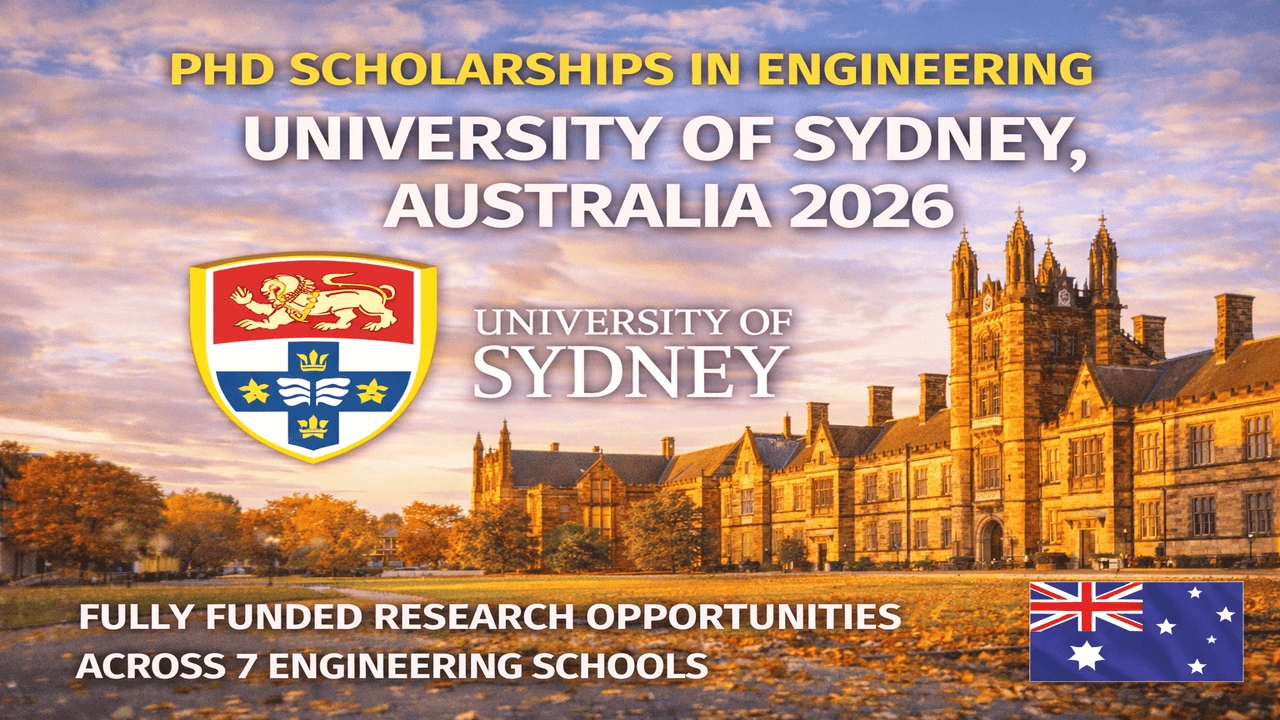
Fully Funded Research Opportunities Across 7 Engineering Schools — Tuition Waiver, Living Allowance & More
The University of Sydney, one of Australia’s most prestigious and globally recognized institutions, is offering a range of fully funded PhD scholarships in Engineering for domestic and international students. Ranked among the top 50 universities worldwide and home to one of Australia’s largest and most research-intensive engineering faculties, the University of Sydney provides doctoral researchers with exceptional facilities, world-class supervision, and generous financial support.
If you are passionate about solving the world’s most pressing engineering challenges — from sustainable infrastructure and renewable energy to biomedical devices, artificial intelligence, and aerospace systems — then a PhD in Engineering at the University of Sydney could be the opportunity that defines your career.
This article provides a complete guide to the available PhD scholarships, eligible research areas across all seven engineering schools, application requirements, and step-by-step instructions on how to apply.
Check: Scholarships in Belgium (2026–2027) — The Complete Detailed Guide
Check: Norway Funded Scholarships for International Students 2026
Check: 34 PhD Positions Called at KTH Royal Institute of Technology, Sweden 2026
About the Faculty of Engineering at the University of Sydney
The Faculty of Engineering at the University of Sydney has a proud history of innovation spanning over 140 years. It is one of the founding faculties of the university and has produced generations of engineers, researchers, and leaders who have shaped Australia and the world.
Today, the faculty is organized into seven specialized schools, each conducting cutting-edge research across a diverse range of disciplines:
1. School of Civil Engineering
The School of Civil Engineering focuses on research that addresses the design, construction, and maintenance of the physical and naturally built environment. Key research areas include:
- Structural engineering and mechanics
- Geotechnical engineering
- Water resources and environmental engineering
- Transport and infrastructure systems
- Construction management and project delivery
- Sustainable and resilient infrastructure
- Computational mechanics and structural health monitoring
- Fire safety engineering
The school works closely with industry partners and government agencies to deliver research that directly impacts urban development, disaster resilience, and infrastructure sustainability across Australia and the Asia-Pacific region.
2. School of Aerospace, Mechanical and Mechatronic Engineering (AMME)
This school is at the forefront of research in advanced manufacturing, robotics, and flight systems. Research strengths include:
- Aerospace structures and propulsion
- Autonomous systems and robotics
- Advanced manufacturing and 3D printing
- Thermodynamics and energy systems
- Biomechanics and human movement
- Computational fluid dynamics
- Mechanical design and materials engineering
- Unmanned aerial vehicles (UAVs) and drone technology
The AMME school has strong ties with Australia’s defense, aerospace, and advanced manufacturing sectors, offering PhD students unique opportunities to work on projects with national and global significance.
3. School of Biomedical Engineering
One of Australia’s leading biomedical engineering departments, this school bridges the gap between engineering innovation and healthcare. Key research areas include:
- Medical device design and development
- Neural engineering and brain-machine interfaces
- Tissue engineering and regenerative medicine
- Biomaterials and nanomedicine
- Medical imaging and signal processing
- Rehabilitation engineering
- Computational biology and bioinformatics
- Wearable health technologies
PhD students in this school often collaborate with clinicians at the University of Sydney’s affiliated hospitals, translating laboratory discoveries into real-world medical solutions.
4. School of Chemical and Biomolecular Engineering
This school tackles some of humanity’s biggest challenges — clean energy, sustainable chemistry, and food security — through chemical engineering innovation. Research areas include:
- Reaction engineering and catalysis
- Membrane science and separation technologies
- Energy storage and battery technologies
- Environmental and process engineering
- Nanomaterials and nanoparticle synthesis
- Polymer science and engineering
- Food process engineering
- Carbon capture and utilization
5. School of Computer Science
As one of the largest and most dynamic computer science departments in Australia, this school leads research in:
- Artificial intelligence and machine learning
- Data science and big data analytics
- Cybersecurity and privacy
- Computer vision and natural language processing
- Distributed computing and cloud systems
- Human-computer interaction
- Algorithms and computational complexity
- Software engineering and systems
With Sydney emerging as a major tech hub in the Asia-Pacific, PhD graduates from this school are highly sought after by both academia and industry.
6. School of Electrical and Computer Engineering
This school covers the full spectrum of electrical, electronic, and computer engineering research:
- Power systems and renewable energy integration
- Telecommunications and signal processing
- Internet of Things (IoT) and embedded systems
- Control systems and automation
- Photonics and optoelectronics
- Microelectronics and VLSI design
- Wireless communications and 5G/6G networks
- Smart grids and energy management
7. School of Project Management
Unique among Australian engineering faculties, this school focuses on the management and delivery of complex projects:
- Project governance and leadership
- Risk management and decision-making
- Digital project delivery (BIM, digital twins)
- Sustainability in project management
- Mega-project planning and execution
- Organizational behavior in engineering contexts
Available PhD Scholarships in Engineering
The University of Sydney offers several scholarship pathways for PhD students in Engineering. These scholarships are designed to cover tuition fees, provide a living allowance, and in some cases offer additional benefits such as relocation funding and health insurance coverage.
1. University of Sydney International Research Scholarship (USydIS)
The USydIS is the university’s flagship scholarship for outstanding international research students.
What it covers:
- Full tuition fee waiver for the duration of the PhD program (up to 4 years)
- Annual living allowance stipend (approximately AUD $40,109 per year in 2025, tax-free, indexed annually)
- Overseas Student Health Cover (OSHC) — the mandatory health insurance for international students in Australia, fully covered for the duration of your studies
Eligibility:
- Open to international students from any country
- Must have received an offer of admission to a PhD program at the University of Sydney
- Demonstrated academic excellence (typically a first-class Honours degree or master’s degree with a strong research component)
- Research publications, awards, and professional experience strengthen your application
2. Engineering and IT Research Scholarship (Faculty Scholarship)
The Faculty of Engineering offers faculty-specific scholarships that are funded by individual schools, research groups, or industry partners.
What it covers:
- Full tuition fee waiver or partial tuition offset
- Living allowance stipend (amount varies by project, but typically aligned with the Research Training Program rate of approximately AUD $33,480–$40,109 per year)
- Some faculty scholarships include additional top-up stipends of AUD $5,000–$15,000 per year for high-priority research areas
Eligibility:
- Open to both domestic and international students
- Must be applying to a specific research project or supervisor within the Faculty of Engineering
- Specific eligibility criteria vary by scholarship and are detailed in each listing
3. Research Training Program (RTP) Scholarships (Australian Government)
The RTP is an Australian Government-funded scholarship program that supports domestic and international students undertaking research degrees.
Two components:
- RTP Fee Offset: Covers tuition fees for the duration of the PhD (up to 4 years)
- RTP Stipend: Provides a living allowance of approximately AUD $33,480 per year (2025 rate, tax-free)
Eligibility:
- Open to both domestic and international students
- Awarded based on academic merit and research potential
- Must have an unconditional offer of admission to a PhD program
4. Project-Specific and Industry-Funded Scholarships
Many PhD positions in Engineering at the University of Sydney are funded through specific research grants from organizations such as the Australian Research Council (ARC), the National Health and Medical Research Council (NHMRC), or industry partners. These project-specific scholarships often include:
- Full tuition coverage
- Competitive stipend (sometimes higher than standard rates)
- Access to specialized equipment and facilities
- Industry placement or internship opportunities
- Conference and travel funding
These positions are typically advertised on the University of Sydney’s scholarship portal and on individual school or research group websites. They may have their own deadlines and application processes.
5. Sydney Scholars Awards and Top-Up Scholarships
Exceptional candidates may be eligible for additional top-up awards that supplement the base stipend. These include:
- Vice-Chancellor’s Research Scholarship — a prestigious top-up for the most outstanding applicants
- Faculty of Engineering Dean’s Scholarship — an additional stipend for high-performing engineering candidates
- Sydney Scholars India Equity Scholarship and other country-specific awards
Scholarship Benefits Summary
| Benefit | Details |
|---|---|
| Tuition Fees | Fully covered (up to 4 years) |
| Living Allowance | AUD $33,480 – $40,109+ per year (tax-free) |
| Health Insurance (OSHC) | Fully covered for international students |
| Duration | Up to 4 years (full-time PhD) |
| Top-Up Stipends | AUD $5,000 – $15,000/year (select scholarships) |
| Relocation Allowance | Available with some scholarships |
| Conference & Travel Funding | Available through supervisors and faculty grants |
Admission Requirements for PhD in Engineering
To be eligible for a PhD in Engineering at the University of Sydney, you must meet the following requirements:
Academic Requirements
- A bachelor’s degree with first-class or upper second-class Honours in Engineering or a related field, OR
- A master’s degree by research with a substantial thesis component, OR
- A master’s degree by coursework with a significant research component and a minimum weighted average mark (WAM) of 75% or above (equivalent to Distinction level)
- Equivalent international qualifications are assessed on a case-by-case basis
English Language Requirements
If English is not your first language or your previous degree was not taught entirely in English, you must demonstrate English proficiency through one of the following:
| Test | Minimum Score |
|---|---|
| IELTS (Academic) | Overall 7.0, with no band below 6.5 |
| TOEFL iBT | Overall 96, with minimum of 23 in Reading, Listening, and Speaking, and 25 in Writing |
| PTE Academic | Overall 68, with no communicative skill below 54 |
| Cambridge C1 Advanced (CAE) | Overall 185, with no skill below 176 |
Note: Some schools may have higher English language requirements. Check the specific requirements for your chosen school.
Research Proposal
All PhD applicants must submit a research proposal (typically 2–5 pages) that outlines:
- Your proposed research topic and research questions
- Background and literature review
- Proposed methodology
- Expected outcomes and significance
- How your research aligns with the expertise of your proposed supervisor
Supervisor Requirement
Before applying, you are strongly encouraged to identify and contact a potential supervisor within the Faculty of Engineering. Having a supervisor who has agreed to support your candidature significantly strengthens your application.
How to find a supervisor:
- Browse the University of Sydney’s Find a Researcher portal
- Visit individual school websites to view faculty profiles and research interests
- Attend virtual open days and research showcases
- Email potential supervisors directly with a brief introduction, your CV, and a summary of your research interests
How to Apply: Step-by-Step Guide
Step 1: Identify Your Research Area and Supervisor
- Explore the seven engineering schools listed above
- Review current research projects and faculty profiles
- Contact potential supervisors to discuss your research interests and confirm their availability to supervise
Step 2: Check Scholarship Deadlines
The University of Sydney has multiple scholarship rounds each year. Key deadlines typically include:
- Round 1: Applications close around April–May (for commencement in Semester 2)
- Round 2: Applications close around October–November (for commencement in Semester 1 of the following year)
Note: Some project-specific scholarships have their own deadlines. Always check the specific listing for exact dates.
Step 3: Prepare Your Application Documents
Gather the following documents:
- ✅ Certified copies of academic transcripts and degree certificates
- ✅ Curriculum Vitae (CV) with publications list
- ✅ Research proposal (2–5 pages)
- ✅ English language test results (if applicable)
- ✅ Two academic referee reports
- ✅ Passport copy (for international applicants)
- ✅ Statement of research experience and achievements
- ✅ Any additional documents requested by your chosen school or scholarship
Step 4: Submit Your Application Online
- Applications are submitted through the University of Sydney’s online application portal
- Create an account, select “Doctor of Philosophy (PhD)” as your program, choose “Faculty of Engineering” as your faculty, and specify your preferred school
- Upload all required documents in PDF format
- Indicate which scholarships you wish to be considered for (you can apply for multiple scholarships simultaneously)
Step 5: Interview and Assessment
- Shortlisted candidates may be invited for an interview (in person or via video call)
- Your research proposal, academic record, and supervisor endorsement will be evaluated by the faculty’s Higher Degree by Research (HDR) committee
- Reference checks will be conducted
Step 6: Receive Your Offer
- Successful applicants receive a formal offer of admission and a scholarship offer letter
- Accept your offer within the specified timeframe
- International students must then apply for an Australian Student Visa (Subclass 500)
Why Choose the University of Sydney for Your Engineering PhD?
🌏 Global Reputation
- Ranked #1 in Australia and #18 in the world (QS World University Rankings 2025)
- Faculty of Engineering ranked among the top 50 globally for engineering and technology
- Extensive international research collaborations with universities and organizations worldwide
🔬 World-Class Research Facilities
- Access to state-of-the-art laboratories, including the Australian Centre for Field Robotics, the Centre for Advanced Materials Technology, and the Nano Institute
- High-performance computing clusters and specialized research equipment
- Collaborative research spaces designed to foster interdisciplinary innovation
💼 Industry Connections
- Deep partnerships with industry leaders including Boeing, Google, Cochlear, Rio Tinto, Atlassian, CSR, Transport for NSW, and many more
- PhD students benefit from industry internships, joint research projects, and networking events
- Sydney’s booming tech, infrastructure, and healthcare sectors provide abundant career opportunities
🏙️ Sydney — A World-Class City
- Living in one of the world’s most beautiful and livable cities
- A vibrant multicultural community with a thriving food, arts, and outdoor culture
- Excellent public transport, safety, and quality of life
- Access to stunning beaches, national parks, and natural wonders
🎓 Post-PhD Career Pathways
- Australia offers a post-study work visa (Temporary Graduate Visa, Subclass 485) that allows PhD graduates to work in Australia for up to 4 years after graduation
- PhD graduates are eligible for priority skilled migration pathways, potentially leading to Permanent Residency
- Strong alumni network with connections across academia, industry, and government worldwide
Research Highlights: What You Could Be Working On
Here are just a few examples of the groundbreaking research happening across the Faculty of Engineering:
| Research Project | School |
|---|---|
| AI-driven structural health monitoring for bridges | Civil Engineering |
| Next-generation lithium-ion battery technologies | Chemical & Biomolecular Engineering |
| Autonomous underwater vehicles for ocean exploration | Aerospace, Mechanical & Mechatronic Engineering |
| Brain-computer interfaces for paralysis patients | Biomedical Engineering |
| Privacy-preserving machine learning algorithms | Computer Science |
| Smart grid optimization using renewable energy | Electrical & Computer Engineering |
| Digital twin technology for mega-infrastructure projects | Project Management |
| Earthquake-resistant building design | Civil Engineering |
| Soft robotics for minimally invasive surgery | Biomedical Engineering |
| 6G wireless communication systems | Electrical & Computer Engineering |
Apply Now — Your Future in Engineering Starts Here
The University of Sydney is actively seeking talented, motivated, and ambitious researchers to join its doctoral programs in Engineering. With fully funded scholarships, world-class supervision, state-of-the-art facilities, and a clear pathway to a rewarding career in Australia or anywhere in the world, there has never been a better time to apply.
🔗 Visit the official scholarship page: University of Sydney — Engineering PhD Scholarships
🔗 Find a supervisor: University of Sydney — Find a Researcher
🔗 Apply online: University of Sydney — Graduate Research Application
FAQs
1. Can I apply for a PhD scholarship without a master’s degree?
Yes. At the University of Sydney, you can be admitted to a PhD program with a bachelor’s degree with first-class Honours (or equivalent). A master’s degree is not always required, provided your undergraduate research training and academic results are sufficiently strong.
2. Do I need to have publications to apply?
No, but it helps. Publications are not a mandatory requirement for PhD admission. However, having published journal articles, conference papers, or even a strong master’s thesis demonstrates your research capability and significantly strengthens your scholarship application.
3. How long does a PhD in Engineering take at the University of Sydney
Typically 3 to 4 years of full-time study. Most scholarships provide funding for up to 4 years. Extensions may be granted in exceptional circumstances, but the standard expectation is completion within 4 years.
4. Can I work part-time during my PhD?
Yes. International students on a Student Visa (Subclass 500) are permitted to work up to 48 hours per fortnight during academic sessions and unlimited hours during scheduled breaks. Many PhD students also undertake paid teaching or tutoring within their department.
5. Is there a pathway to Permanent Residency in Australia after completing a PhD?
Yes. PhD graduates from Australian universities are eligible for the Temporary Graduate Visa (Subclass 485) which allows you to live and work in Australia for up to 4 years. During this time, you can apply for Permanent Residency through Australia’s skilled migration programs. Engineering disciplines are consistently listed on Australia’s Skilled Occupation List, making engineers among the most in-demand professionals for PR pathways.
Disclaimer: All information in this article is based on publicly available data from the University of Sydney’s official website as of the publication date. Scholarship values, deadlines, and eligibility criteria are subject to change. Applicants are strongly advised to verify all details directly on the University of Sydney’s official website before applying.