
Scholarships in Spain Without IELTS (Starting April Deadlines): Your 2026 Guide to Fully Funded Education
Spain has become one of Europe’s most appealing study destinations for international students thanks to its globally ranked universities, comparatively affordable living costs (in many cities), and wide availability of scholarships. For many applicants, the biggest concern is language proof—specifically IELTS. The good news is that studying in Spain without IELTS is often possible, especially when you meet alternative language requirements such as prior education in English, accepted equivalent tests, or university-administered language assessments.
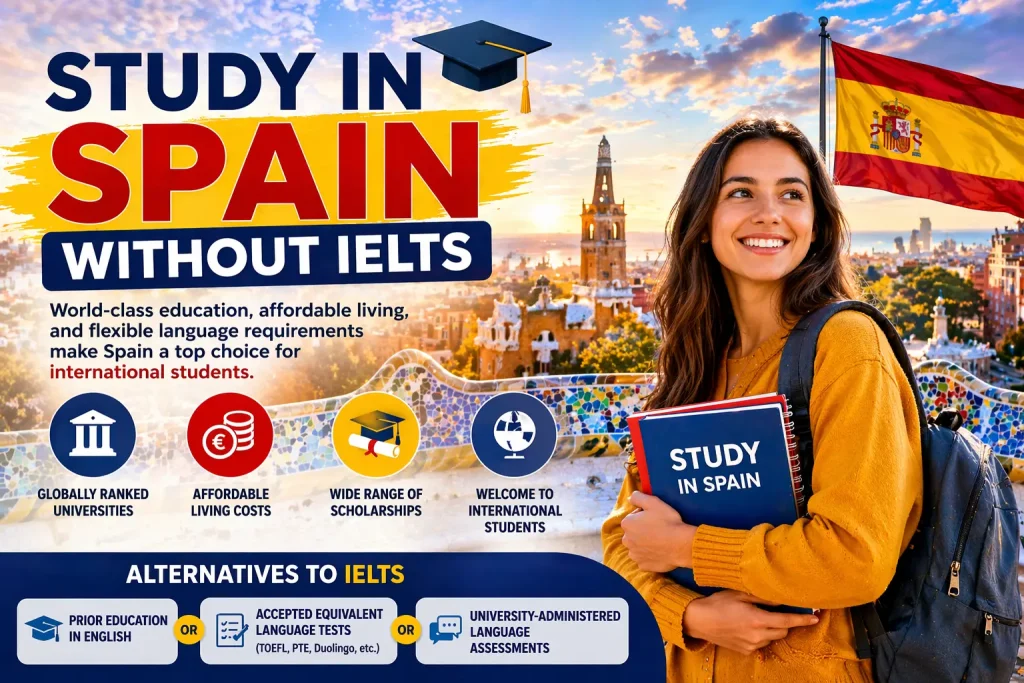
This article—“Scholarships in Spain Without IELTS (Starting April Deadlines)”—highlights major government, EU, and university scholarship pathways for international students at undergraduate, master’s, and doctoral levels, with an emphasis on options that may not require IELTS as a strict condition. It also explains how “without IELTS” usually works in practice, what alternative documents universities accept, and where to find official application links to avoid scams.
Note on deadlines: Scholarship windows change by year and by program. Many Spain-related scholarship calls commonly run from spring to summer (often April–July), while others open earlier. Always confirm dates on the official pages linked below.
1) Studying in Spain Without IELTS: What It Typically Means
When scholarship listings say “without IELTS,” it rarely means “no English proof at all.” More commonly, it means IELTS is not the only acceptable option. Many Spanish universities and scholarship programs accept one or more of the following:
- Proof of previous education taught in English (sometimes called an English Medium Instruction (EMI) letter or MOI letter).
- Other English tests (depending on the institution): TOEFL iBT, Cambridge English exams, Duolingo English Test (in some cases), etc.
- University language placement tests or internal assessments.
- For Spanish-taught programs: proof of Spanish such as DELE or SIELE, or completion of preparatory Spanish courses.
Because Spain offers degrees in Spanish, English, and bilingual formats, your language pathway depends on the program’s teaching language. Many scholarships are tied to admission requirements, so confirm the language proof accepted by your target university/program.
Click: DAAD Scholarship 2026 in Germany
Click: Postdoctoral Scholarships at the University of Zurich (UZH), Switzerland
2) Spanish Government Scholarship (MAEC-AECID) — Fully Funded (Often All Levels)
One of the most significant opportunities associated with Spain is the MAEC-AECID scholarships (from Spain’s Ministry of Foreign Affairs / AECID). These scholarships are widely recognized and can support international students and researchers depending on the call and profile.
Why it’s important
- Often described as fully funded or highly comprehensive (depending on the specific call).
- Supports international academic cooperation and global talent.
- Calls may include options connected to master’s, research, institutional cooperation, or specialized training.
IELTS note
Requirements depend on the specific call and host institution. Some tracks may prioritize Spanish proficiency or accept alternative English proof when the academic activity is conducted in English.
Official link (apply/info)
- AECID Scholarships (official MAEC-AECID portal):
https://www.aecid.gob.es/
(Navigate to Convocatorias / Becas y lectorados or scholarship calls.) - MAEC (Ministry of Foreign Affairs) official site:
https://www.exteriores.gob.es/
Because calls can be highly specific, always read the official PDF call document and annexes on AECID’s website before applying.
3) Erasmus Mundus Joint Masters (EMJM) — Fully Funded Master’s (Spain Included in Many Consortia)
If you want a prestigious, fully funded European experience, Erasmus Mundus Joint Masters (EMJM) is one of the strongest routes. Many EMJM programs include a mobility track that places students in Spain for one semester or more, or includes a Spanish university as a core consortium member.
What it offers
- Typically full scholarship (tuition + stipend + insurance + travel support; structure varies by program).
- Study at multiple European universities; Spain is often part of the mobility pathway.
- Strong international cohort and career network.
IELTS note
EMJM programs set their own language policies. Some accept alternatives to IELTS (TOEFL, Cambridge, MOI letter, etc.). You must check the individual program page.
Official links (catalog & program search)
- European Commission – Erasmus Mundus Joint Masters (official):
https://erasmus-plus.ec.europa.eu/programme-guide/part-b/three-key-actions/key-action-2/erasmus-mundus-joint-masters - EU Funding & Tenders Portal (official EU portal):
https://ec.europa.eu/info/funding-tenders/opportunities/portal/screen/home
You apply directly on the official consortium website of the EMJM program you choose (linked from the EU pages/catalog).
4) UIC Barcelona Scholarships — Partial Funding (Often up to ~40% depending on program)
UIC Barcelona (Universitat Internacional de Catalunya) is known for offering scholarships and tuition support schemes for international students across selected programs. Scholarship levels can vary and may include merit-based reductions.
What it offers
- Frequently partial tuition reductions (some scholarship routes can be significant, such as up to ~40% depending on the program/scholarship scheme).
- A private university environment with international-facing programs.
IELTS note
Whether IELTS is required depends on the program language and admissions rules. Many universities accept alternative proofs or different tests.
Official link (scholarships/financial aid)
- UIC Barcelona – Scholarships & Financial Aid (official):
https://www.uic.es/en
(Use the site menu/search for Scholarships, Financial Aid, or your specific degree page.)
Because UIC’s scholarships can be program-specific, confirm the exact conditions on the degree page and the scholarship call page.
5) University of Granada (UGR) Scholarships — Fully/Partially Funded Options
The University of Granada (Universidad de Granada, UGR) is among Spain’s most well-known public universities, with a strong international community and a range of scholarship opportunities and mobility programs.
What it offers
- Scholarship options can include partial tuition support, mobility grants, and funded opportunities depending on the call (university-based, regional, national, or EU-linked).
- Strong research ecosystem and doctoral opportunities.
IELTS note
UGR’s language requirements depend on the program (Spanish/English). For English-taught programs, alternatives to IELTS may be acceptable; for Spanish-taught programs, Spanish proficiency may be required.
Official link
- University of Granada (UGR) official site:
https://www.ugr.es/
(Check International, Students, Scholarships/Grants, and specific faculty pages.)
6) University of Valencia Scholarships — Funded Support for Bachelor’s & Master’s (Varies by Call)
The University of Valencia (Universitat de València) is another major public university with scholarships that may support international students depending on the specific program/call and the applicant’s status.
What it offers
- Various grants, scholarships, and aid schemes (some linked to academic merit, mobility, or institutional partnerships).
- Opportunities at both undergraduate and master’s levels, subject to eligibility.
IELTS note
As with other institutions, the need for IELTS depends on the teaching language and admissions requirements. Alternatives may be possible.
Official link
- University of Valencia official site:
https://www.uv.es/
(Navigate to student services, scholarships/grants, or international sections.)
7) European University of the Atlantic (Universidad Europea del Atlántico) — Scholarships Up to 100% Tuition (Program-Dependent)
The European University of the Atlantic (UNEATLANTICO) is known for offering scholarship schemes that, in some cases, can cover a large portion of tuition—sometimes advertised as up to 100% depending on program, applicant profile, and scholarship type.
What it offers
- Potential high-percentage tuition scholarships (including up to full tuition coverage in specific cases).
- International student recruitment and program availability in selected fields.
IELTS note
Language requirements depend on the degree’s language and admissions rules. Applicants may be able to use alternatives to IELTS if accepted by the university.
Official link
- UNEATLANTICO official site:
https://www.uneatlantico.es/
(Look for Becas / Scholarships or admissions funding pages.)
8) Additional Scholarship Routes in Spain (Ministries, Regions, Universities, and Mobility)
Beyond the headline programs above, Spain’s scholarship ecosystem includes a broad range of options. Many international students find funding through combinations of:
- University-specific scholarships (merit-based, need-based, alumni, departmental awards)
- Regional government scholarships (autonomous communities sometimes support education and research)
- Research and doctoral contracts (PhD funding often comes via projects, research groups, or national/regional R&D schemes)
- Mobility programs (Erasmus+ exchanges, bilateral agreements, summer schools)
Where to verify legitimate opportunities
Use official sources first:
- Your target university’s official website (scholarships, international office, admissions).
- The Spanish government/ministries and EU portals.
A useful official starting point for studying in Spain and locating recognized institutions is:
- Study in Spain (official government portal):
https://www.educacionfpydeportes.gob.es/
(Navigate to higher education/international sections as relevant.)
Typical Deadline Window: April to July (Why This Matters)
Many Spain-related scholarship calls and university funding rounds often appear from spring through mid-summer, frequently aligning with planning for the next academic year. A staggered schedule (often April–July) benefits applicants because it allows:
- Time to gather transcripts, translations, and legalizations
- Time to request recommendation letters
- Flexibility to apply to multiple universities and scholarships
- A chance to improve language proof through alternatives (e.g., Duolingo/TOEFL/Cambridge, or obtain an MOI letter)
However, some major scholarships (including many Erasmus Mundus programs) can close earlier, sometimes in December–February. So the best strategy is to build a shortlist early and track each program’s timeline.
How to Build a Strong “No IELTS” Scholarship Application (Practical Checklist)
Even when IELTS is not required, competitive scholarships in Spain still demand a strong application. Plan to prepare:
- Academic documents: transcripts, degree certificates, grading scale notes (if available)
- CV (Europe-friendly format): often Europass-style works well
- Motivation letter: tailored to the program and Spain-based academic goals
- Two recommendation letters: academic referees are usually preferred
- Language proof alternative: MOI letter / TOEFL / Cambridge / university test results
- Passport copy and identity documents
- Portfolio (for architecture/design/arts) or research proposal (for PhD) when required
- Document translations: some universities require Spanish sworn translations; others accept English—verify early
Official Links Summary (Safe Starting Points)
- MAEC-AECID Scholarships (official AECID portal): https://www.aecid.gob.es/
- Spain Ministry of Foreign Affairs (MAEC official): https://www.exteriores.gob.es/
- Erasmus Mundus Joint Masters (European Commission): https://erasmus-plus.ec.europa.eu/programme-guide/part-b/three-key-actions/key-action-2/erasmus-mundus-joint-masters
- EU Funding & Tenders Portal: https://ec.europa.eu/info/funding-tenders/opportunities/portal/screen/home
- UIC Barcelona (official): https://www.uic.es/en
- University of Granada (official): https://www.ugr.es/
- University of Valencia (official): https://www.uv.es/
- UNEATLANTICO (official): https://www.uneatlantico.es/
- Study in Spain / Education Ministry portal (official): https://www.educacionfpydeportes.gob.es/
FAQs (8)
1) Can I get a scholarship in Spain without IELTS?
Yes, in many cases. “Without IELTS” usually means you can submit alternative English proof (MOI letter, TOEFL, Cambridge, or an internal test) or apply to Spanish-taught programs with Spanish proof instead.
2) Which fully funded scholarships are most notable for Spain?
Two major options are MAEC-AECID (Spanish government-related calls) and Erasmus Mundus Joint Masters (many include Spain as a host country in the consortium). Always confirm the funding scope in the official call.
3) Are Erasmus Mundus programs available in Spain?
Many Erasmus Mundus Joint Master’s programs include Spanish universities or mobility semesters in Spain. Use the official Erasmus Mundus catalog page to find programs and then apply via the consortium’s official website.
4) Do Spanish universities accept MOI (Medium of Instruction) letters instead of IELTS?
Some do, but policies vary by university and program. Always check the degree’s official admissions page. If accepted, the MOI letter usually must state that your previous degree was taught entirely in English.
5) Are scholarships available for undergraduate students in Spain?
Yes. While many high-profile international scholarships are at master’s level, undergraduate scholarships exist through university funding, tuition reductions, and specific institutional programs (eligibility varies).
6) What are the typical deadlines for Spain scholarships?
Many opportunities open in spring and may close between April and July, but some (especially international master’s scholarships) can close earlier. Check each scholarship’s official timeline.
7) Can I apply to multiple scholarships at once?
Usually yes, as long as each program allows it. Many students apply to multiple universities and scholarship schemes simultaneously to increase their chances.
8) How do I avoid fake scholarship links?
Use official sources only: EU pages for Erasmus Mundus, Spain’s government portals (AECID/ministries), and the official websites of universities (UGR, UV, UIC Barcelona, UNEATLANTICO). If a site asks for payment to “secure” a scholarship, treat it as a red flag.
Spain is increasingly feasible for international students without IELTS—especially when you target the right programs and prepare credible alternative language evidence. Start from the official links above, shortlist scholarships that match your academic level (bachelor’s, master’s, or PhD), and track deadlines carefully—particularly those opening from April onward.