A Comprehensive Guide to PhD Positions at Max Planck Institutes in Germany
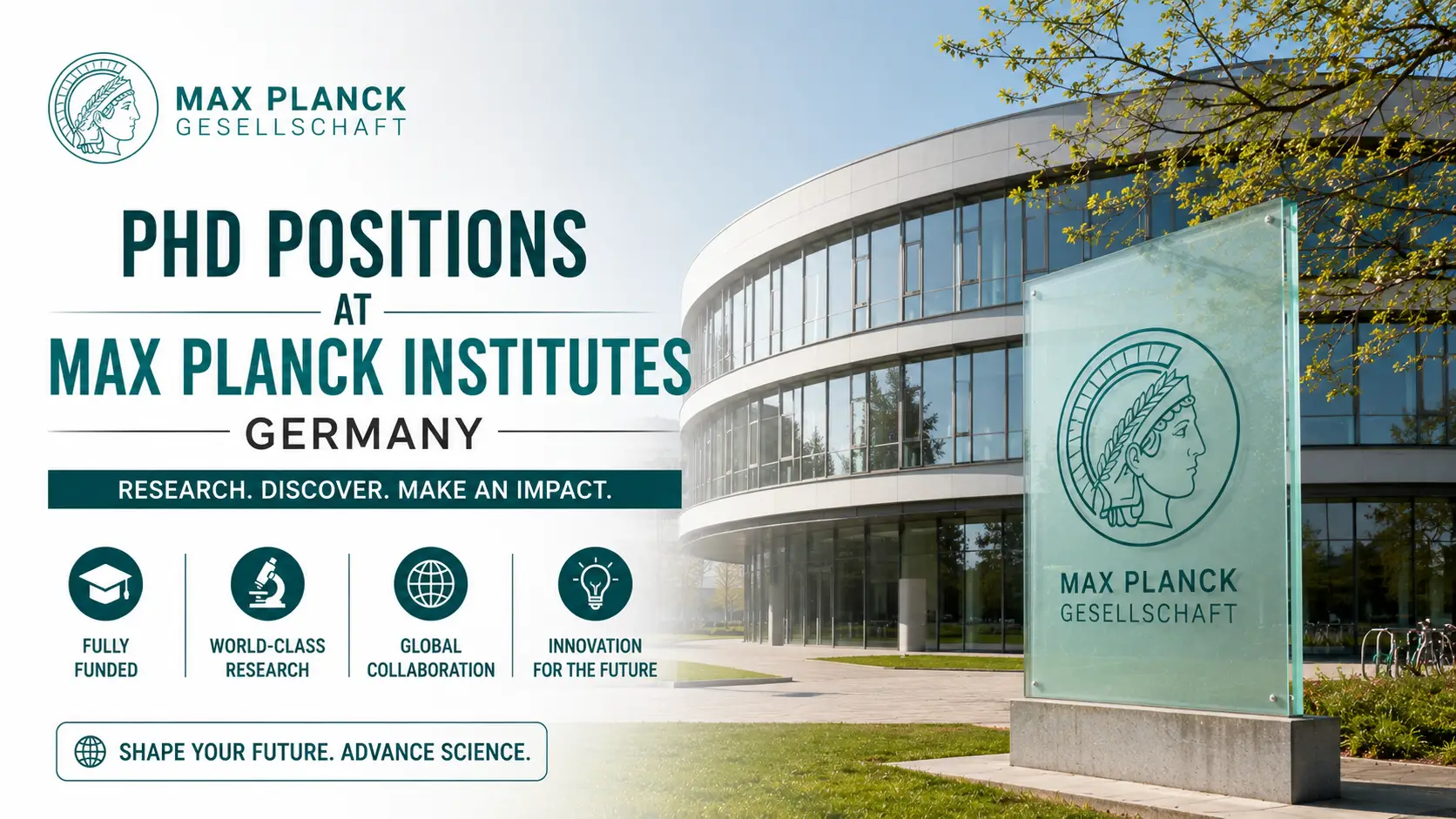
For researchers aspiring to reach the pinnacle of scientific inquiry, few institutions command as much respect and recognition as the Max Planck Society (Max-Planck-Gesellschaft). Founded in 1948 and rooted in the legacy of the Kaiser Wilhelm Society, the Max Planck Society is one of the world’s leading organizations for basic research. With over 80 institutes and facilities across Germany, it covers a vast spectrum of disciplines including the natural sciences, life sciences, social sciences, and humanities. For doctoral candidates, securing a PhD position at a Max Planck Institute represents not just an academic achievement, but a career-defining opportunity to work alongside Nobel laureates and field leaders in state-of-the-art environments.
Germany’s approach to doctoral education is distinct from many other countries. Rather than being classified solely as students, PhD candidates at Max Planck Institutes are often treated as early-career researchers and employees. This model provides financial stability, social security, and professional status from the outset of the research journey. However, navigating the landscape of over 80 independent institutes can be daunting for international applicants. Each institute operates with a degree of autonomy, and recruitment processes vary. This article provides an exhaustive guide to pursuing PhD positions at Max Planck Institutes. It covers the structural organization, funding models, the prestigious International Max Planck Research Schools (IMPRS), eligibility criteria, and the step-by-step application process. Whether you are interested in quantum physics, molecular biology, or legal history, this guide will equip you with the knowledge to secure a position within this elite network.
Check: PhD Scholarships at the University of Southern Denmark: Complete Guide for International Students
The Max Planck Society: An Overview of Research Excellence
The Max Planck Society (MPG) is dedicated to fundamental research that serves the public good. Unlike universities, which have broad teaching obligations, Max Planck Institutes focus almost exclusively on research. This allows PhD candidates to dedicate the majority of their time to their projects without the heavy teaching loads often found in university departments. The society is organized into three sections: the Section for Natural Sciences, the Section for Life Sciences, and the Section for Human Sciences.
Diversity of Institutes
The breadth of research is immense. Some of the most renowned institutes include:
- Max Planck Institute for Physics (Werner Heisenberg Institute): Focuses on elementary particle physics and astrophysics.
- Max Planck Institute for Chemistry: Dedicated to understanding chemical processes in the atmosphere and biosphere.
- Max Planck Institute for Human Development: Researches human development and education in Berlin.
- Max Planck Institute for Intelligent Systems: Located in Stuttgart and Tübingen, focusing on robotics and machine learning.
- Max Planck Institute for Molecular Genetics: A hub for genome research in Berlin.
This diversity means that regardless of your specialization, there is likely an institute aligned with your interests. The collaborative nature of the society also encourages interdisciplinary projects, allowing researchers to work across institute boundaries. The infrastructure provided is world-class, featuring advanced laboratories, supercomputing facilities, and extensive libraries. For a PhD candidate, this environment removes logistical barriers to research, allowing full focus on scientific discovery.
PhD Models: Employment vs. Structured Programs
Understanding the contractual nature of a PhD at Max Planck is crucial. There are generally two pathways to undertaking a doctorate within the society: direct employment at an institute or enrollment in an International Max Planck Research School (IMPRS).
Direct Employment (Wissenschaftlicher Mitarbeiter)
The most common model is direct employment. PhD candidates are hired as scientific staff members under a fixed-term contract. This is governed by the collective agreement for the public service (TV-L). In this model, you are an employee of the Max Planck Society. You receive a monthly salary, pay into the pension system, and have full health insurance coverage. Your primary duty is research, though you may have minor teaching obligations if the institute is partnered with a university. This model offers the highest level of financial security and is highly competitive. Positions are advertised individually as vacancies arise based on grant funding.
International Max Planck Research Schools (IMPRS)
The IMPRS are structured doctoral programs established jointly by Max Planck Institutes and German universities. These schools offer a more organized curriculum compared to individual employment. They are designed to attract top international talent and provide a cohort-based experience. IMPRS programs typically include coursework, rotations in different labs during the first year, and intensive mentoring. While some IMPRS candidates are employed on contracts similar to direct hires, others may receive stipends depending on the funding source. The IMPRS model is particularly beneficial for students who value a structured learning environment and peer support network. There are over 60 IMPRS programs across Germany, covering fields from astronomy to psychology.
Financial Benefits and the TV-L Contract
One of the most attractive aspects of pursuing a PhD at a Max Planck Institute is the remuneration. For employed candidates, the salary is determined by the TV-L (Tarifvertrag für den öffentlichen Dienst der Länder) pay scale.
Salary Structure
Most PhD positions are advertised at pay grade E13. The percentage of the full position varies depending on funding availability.
- 100% Position: Rare for PhD students, usually reserved for postdocs.
- 75% Position: Common in engineering and experimental sciences where lab presence is required.
- 65% Position: The standard for many theoretical and life science PhD positions.
As of recent years, a 65% TV-L E13 contract yields a gross monthly salary of approximately €2,400 to €2,600, depending on the federal state’s specific tax rates and social contributions. A 75% position can exceed €3,000 gross per month. This income is sufficient to live comfortably in most German cities, including expensive hubs like Munich or Heidelberg.
Social Security and Benefits
As an employee, you are covered by the German social security system. This includes:
- Health Insurance: Mandatory public health insurance is deducted from your salary, providing comprehensive medical coverage.
- Pension: Contributions are made to the state pension fund, building your retirement security.
- Unemployment Insurance: You are insured against unemployment, though this is less relevant for fixed-term research contracts.
- Paid Leave: Employees are entitled to 30 days of paid annual leave, plus public holidays. This encourages a healthy work-life balance.
- Relocation Support: Some institutes offer relocation allowances or assistance with finding housing for international candidates.
This employment status distinguishes Max Planck PhD positions from many scholarship-based programs elsewhere, where students may lack pension contributions or paid vacation.
The IMPRS Structure and Curriculum
For those joining an International Max Planck Research School, the experience is highly structured. The IMPRS system was created to professionalize doctoral training in Germany.
Curriculum and Coursework
IMPRS programs typically last three to four years. The first year often involves rotating through different research groups to find the best fit for your thesis project. During this time, candidates attend mandatory courses in research methodology, scientific writing, and ethics. These courses earn ECTS credits, which are required for the formal enrollment at the partnering university.
Mentoring and Support
Each PhD candidate is assigned a thesis committee consisting of the primary supervisor and two other faculty members. This committee meets annually to review progress and provide guidance. This system prevents the isolation that can sometimes occur in doctoral studies. Additionally, IMPRS programs offer soft skills training, such as presentation skills, project management, and career planning.
International Environment
IMPRS programs are explicitly international. English is the working language for most programs, even if the institute is located in a German-speaking region. The cohort usually consists of students from dozens of different countries, fostering a multicultural research environment. This network becomes invaluable for future collaborations and career opportunities.
Eligibility Criteria and Requirements
Competition for positions at Max Planck Institutes is intense. Applicants from around the globe vie for limited spots. Meeting the eligibility criteria is the first hurdle.
Academic Qualifications
The primary requirement is a Master’s degree (or equivalent) in a field relevant to the research project. In some cases, exceptional Bachelor’s graduates may be considered, but this is rare. Your academic transcripts must demonstrate strong performance. Typically, a grade point average in the top 10-15% of your class is expected. For international degrees, the selection committee will assess the equivalence of your qualification to the German Master’s standard.
Language Proficiency
While the research language is predominantly English, requirements vary.
- English: Mandatory for almost all positions. If your previous degree was not taught in English, you may need to provide TOEFL or IELTS scores.
- German: Generally not required for research positions, especially within IMPRS. However, basic German skills are highly beneficial for daily life and integration. Some institutes in the Human Sciences may require German depending on the research topic.
Research Experience
Prior research experience is heavily weighted. Publications in peer-reviewed journals, even as a co-author, significantly strengthen an application. Experience with specific laboratory techniques, computational methods, or fieldwork relevant to the institute’s focus is often a prerequisite. The selection committee looks for evidence of independence, critical thinking, and resilience.
Step-by-Step Application Guide
Unlike universities with central admission portals, Max Planck Institutes operate independently. There is no single “apply here” button for the entire society. You must target specific institutes or IMPRS programs.
Step 1: Identify Opportunities
Regularly monitor the official Max Planck career website. Vacancies are posted as they become available. You can filter by discipline, location, and type of position.
Official Career Link: https://www.mpg.de/career
IMPRS Portal: https://imprs.mpg.de
Step 2: Prepare Your Documents
A standard application package includes:
- Cover Letter: Tailored to the specific institute and project. Explain why you want to work there and how your skills match.
- Curriculum Vitae (CV): Use a clear, academic format. Include publications, conferences, and technical skills.
- Transcripts: Certified copies of your degree certificates and grade transcripts.
- Research Proposal: Some institutes require a brief outline of your research interests, especially for IMPRS.
- References: Contact details for two or three academic referees.
Step 3: Submission
Submit your application via the link provided in the vacancy announcement. Some institutes use online forms, while others accept email applications. Ensure all files are in PDF format. Pay close attention to deadlines; IMPRS programs often have specific annual intake cycles (e.g., applications open in September for an October start), while direct employment positions may close as soon as a suitable candidate is found.
Step 4: Interview and Selection
Shortlisted candidates are invited for interviews. These are often conducted via video conference for international applicants. You may be asked to give a presentation on your past research. For IMPRS, there may be a selection workshop where candidates interact with faculty and current students.
Step 5: Contract and Visa
Upon success, you will receive a contract offer. For non-EU citizens, the institute’s international office will assist with the visa process. You will typically apply for a Researcher Visa or an EU Blue Card, depending on the salary level.
Life as a PhD Candidate in Germany
Living in Germany as a researcher offers a high quality of life, but it comes with administrative complexities.
Cost of Living and Housing
Germany’s cost of vary significantly by city. Munich and Hamburg are expensive, while Leipzig and Göttingen are more affordable. Rent is the largest expense. Finding accommodation can be challenging in university cities. Max Planck Institutes often provide assistance or lists of housing resources. It is advisable to start looking for housing as soon as you receive a contract.
Visa and Residence Permits
Non-EU citizens need a residence permit. The “Researcher Visa” is designed for PhD candidates. It allows you to work and travel within the Schengen Area. After completing your PhD, you may be eligible for an 18-month Job Seeker Visa to find employment in Germany. The EU Blue Card is an option for highly skilled workers, offering a pathway to permanent settlement.
Work-Life Balance
German culture values leisure time. It is common to finish work at 5:00 PM and enjoy weekends fully. This balance is protected by labor laws. PhD candidates are encouraged to take their full vacation allowance. This environment supports mental health and sustainable productivity over the three-year doctoral period.
Integration
While English works in the lab, learning German helps with bureaucracy and social life. Many institutes offer language courses. Joining local clubs or university sports groups is a great way to meet people outside the academic bubble.
Career Prospects After the PhD
A PhD from a Max Planck Institute is a gold standard on a CV. The reputation of the society opens doors globally.
Academic Careers
Many graduates pursue postdoctoral positions at other top institutions worldwide. The networking opportunities within the Max Planck Society facilitate collaborations that can lead to faculty positions. The teaching experience gained through university partnerships is valuable for academic job markets.
Industry and R&D
German industry highly values Max Planck graduates, particularly in engineering, chemistry, and IT. Companies like Siemens, Bosch, and Bayer actively recruit from these institutes. The problem-solving skills and technical expertise developed during the PhD are transferable to R&D roles.
Entrepreneurship
The Max Planck Society supports innovation. There are programs to help researchers commercialize their findings. Some PhD graduates go on to found startups based on their research, particularly in biotechnology and software.
Strategic Tips for a Successful Application
To stand out in the competitive pool of applicants, consider these strategies:
- Research the Institute: Do not send generic applications. Read the recent publications of the department you are applying to. Mention specific projects in your cover letter.
- Network: If possible, attend conferences where Max Planck directors are speaking. A personal connection can lead to information about unadvertised positions.
- Highlight Technical Skills: Be specific about your methodologies. If the project requires Python programming or CRISPR technology, explicitly state your proficiency level.
- Prepare for the Interview: Practice presenting your research to a non-specialist audience. Communication skills are key.
- Be Patient: The hiring process can be slow due to administrative procedures. Follow up politely if you haven’t heard back after the deadline.
Frequently Asked Questions
Q: Can I apply without a Master’s degree?
A: Generally, no. A Master’s is the standard entry requirement. Exceptional Bachelor’s graduates may be considered for IMPRS programs that include a Master’s component, but this is rare.
Q: Is the salary taxable?
A: Yes, income tax is deducted from your salary. However, the net income is still sufficient for a comfortable lifestyle.
Q: Can I bring my family?
A: Yes. As a researcher with a residence permit, you can apply for family reunification. Your spouse may also be permitted to work in Germany.
Q: Do I need to know German to apply?
A: For most natural science positions, no. English is sufficient. For humanities, check the specific job description.
Q: How long does the visa process take?
A: It varies by country, typically ranging from 4 to 12 weeks. Start early.
Conclusion
Pursuing a PhD at a Max Planck Institute is an opportunity to engage in world-leading research within a supportive and financially secure environment. The combination of cutting-edge infrastructure, the employment-based funding model, and the structured training of the IMPRS programs makes Germany a top destination for doctoral candidates. The society’s commitment to basic research ensures that you will be working on questions that push the boundaries of human knowledge.
While the application process requires diligence and preparation, the rewards are substantial. From the professional stability of a TV-L contract to the vibrant international community of the IMPRS, the experience equips you with the skills and reputation needed for a successful career. Whether you aim for academia, industry, or entrepreneurship, a Max Planck PhD provides a solid foundation.
If you are ready to advance your research career in one of the world’s most innovative scientific environments, we encourage you to explore the current vacancies. Prepare your application meticulously, highlight your research potential, and consider the unique quality of life that awaits in Germany.
Start your application today by visiting the official Max Planck career portals:
Max Planck Society Career Page:
https://www.mpg.de/career
International Max Planck Research Schools (IMPRS):
https://imprs.mpg.de
Job Market and Vacancies:
https://www.mpg.de/career/job-market
Embark on your journey of discovery at a Max Planck Institute, where excellence is the standard, and your research can shape the future of science.