A Comprehensive Guide to PhD Positions at the University of Bern
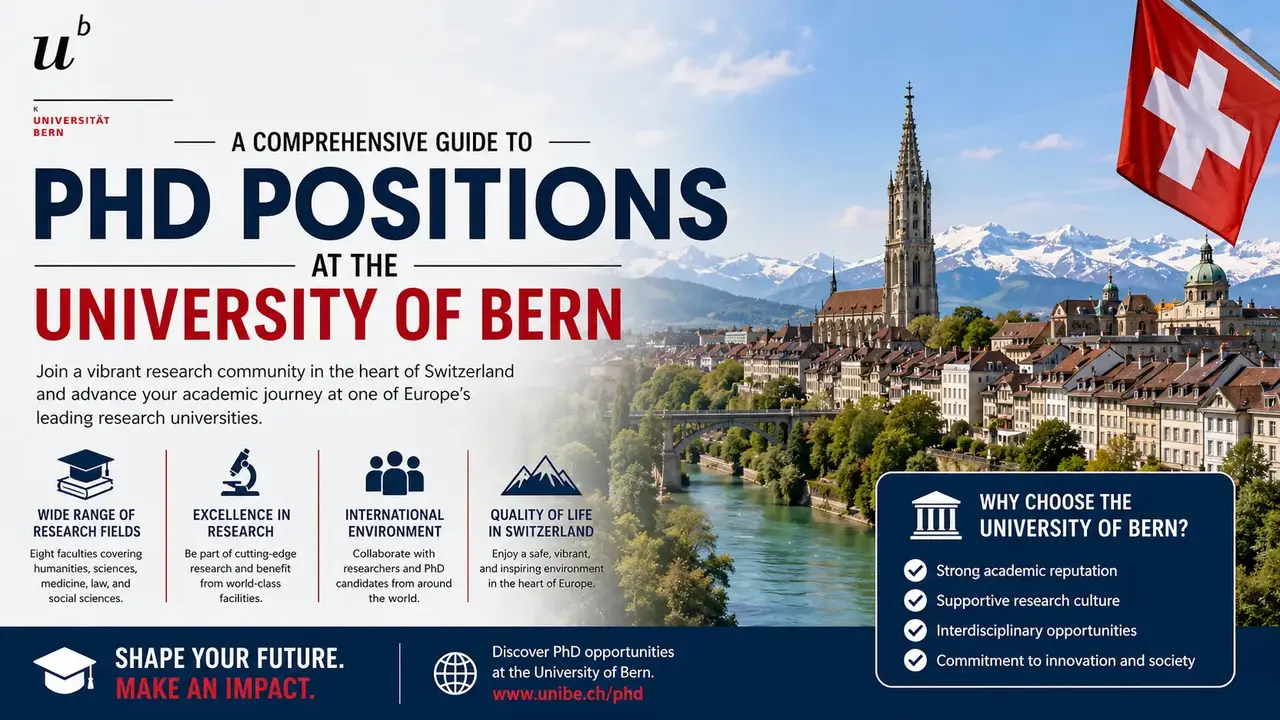
The University of Bern stands as one of Switzerland’s most respected research institutions, combining a rich academic tradition with a strong commitment to innovation and international collaboration. Founded in 1834, the university has grown into a comprehensive research university with eight faculties, offering exceptional opportunities for doctoral candidates across the humanities, sciences, medicine, law, and social sciences. For those seeking a PhD, the University of Bern provides a unique environment where rigorous academic training meets the high standards of Swiss research culture.
Switzerland is renowned for its world-class research infrastructure, competitive salaries, and excellent work-life balance. Unlike many countries where doctoral students are treated primarily as learners, PhD candidates at the University of Bern are employed as researchers. This employment model offers financial stability, social security benefits, and professional recognition from the very beginning of the doctoral journey. The university regularly advertises PhD positions through its official career portal, allowing candidates to apply for funded projects that align with their research interests.
This article provides a detailed overview of PhD opportunities at the University of Bern. It covers the employment structure, salary and benefits, the application process, and what life looks like for a doctoral researcher in the Swiss capital. Whether you are interested in biomedical research, climate science, or European law, understanding the landscape of doctoral education at Bern will help you make an informed decision about your academic future.
Check: Hokkaido University, Japan 2027: Fully Funded Master’s and PhD Opportunity
Check: A Comprehensive Guide to PhD Positions at Max Planck Institutes in Germany
The Swiss PhD Employment Model
One of the most attractive features of pursuing a doctorate in Switzerland is the employment-based system. At the University of Bern, PhD candidates are typically hired as scientific assistants or doctoral researchers under fixed-term contracts. This means you are not a student paying tuition but an employee of the university with all associated rights and responsibilities.
Salary and Benefits
PhD salaries at the University of Bern are among the most competitive in Europe. According to Swiss national salary scales for academic staff, doctoral researchers usually earn between CHF 50,000 and CHF 70,000 per year, depending on their experience, the funding source, and the specific department. This salary is sufficient to live comfortably in Bern, a city known for its high quality of life but relatively moderate living costs compared to Zurich or Geneva.
In addition to the base salary, employees receive:
- 13th-month salary payment (a standard Swiss benefit)
- Generous pension contributions
- Paid vacation (typically 5–6 weeks per year)
- Parental leave and sick leave benefits
- Health insurance support
Many positions also include a dedicated research budget for attending conferences, purchasing equipment, or conducting fieldwork. This financial security allows doctoral candidates to focus entirely on their research without the need for additional part-time work.
Duration and Structure
A standard PhD at the University of Bern lasts between three and four years. The program is research-focused, with limited mandatory coursework compared to many North American or UK systems. Candidates work closely with their supervisor while developing independent research skills. The university emphasizes publication in peer-reviewed journals and encourages participation in international conferences, preparing graduates for both academic and non-academic careers.
Finding PhD Vacancies at the University of Bern
The University of Bern does not operate a centralized annual admission cycle for PhD programs. Instead, positions are advertised individually as funding becomes available through research grants, departmental budgets, or external sources. This means that opportunities arise throughout the year, and candidates should regularly monitor the university’s official job portal.
Official Vacancies Portal:
https://karriere.unibe.ch/job_vacancies/index_eng.html
This page lists all current academic and administrative positions, including PhD roles across all faculties. Positions are typically posted in English, German, or French, reflecting the multilingual nature of the university. Candidates can filter by faculty, department, or keyword to find relevant opportunities in their field.
In addition to the central portal, many faculties and research groups maintain their own websites where they announce upcoming positions. It is also common for professors to recruit PhD students through their professional networks or at academic conferences. Proactive candidates often reach out directly to potential supervisors whose research aligns with their interests, even if no position is currently advertised.
Eligibility and Application Requirements
Admission to a PhD position at the University of Bern requires a strong academic background, typically a Master’s degree or equivalent qualification in a relevant field. While specific requirements vary by department, most positions expect candidates to demonstrate:
- Excellent academic performance in previous studies
- Research experience, preferably through a Master’s thesis or publications
- A clear and compelling research proposal aligned with the advertised project
- Proficiency in English (and sometimes German or French, depending on the project)
The application process usually involves submitting a CV, academic transcripts, a motivation letter, and references through the university’s online recruitment system. Shortlisted candidates are typically invited for an interview, which may be conducted online or in person. Some positions also require a presentation of the candidate’s previous research or a proposed research plan.
Because positions are tied to specific research projects, the fit between the candidate’s expertise and the project description is crucial. Successful applicants often show not only academic excellence but also genuine enthusiasm for the particular research question being addressed.
Life as a PhD Researcher in Bern
Bern, the capital of Switzerland, offers an exceptional environment for doctoral study. The city is known for its well-preserved medieval old town, efficient public transportation, and proximity to the Alps. With a population of around 140,000, Bern maintains a manageable size while offering all the amenities of a modern European capital.
The cost of living in Bern is high by international standards, but the PhD salary is designed to cover these expenses comfortably. Many doctoral researchers live in shared apartments or university-affiliated housing during their first year. The university provides support for international students through its Welcome Center, which assists with visa processes, housing, and integration into Swiss society.
Switzerland’s multicultural environment makes it easy for international researchers to feel at home. English is widely spoken in academic settings, though learning German or French enhances daily life and social integration. The university offers language courses, and the city provides numerous cultural and recreational activities, from hiking and skiing to world-class museums and festivals.
Career Prospects
A PhD from the University of Bern is highly regarded both within Switzerland and internationally. Graduates pursue careers in academia, industry, government, and international organizations. The university’s strong connections with research institutions across Europe and its location in the heart of Switzerland provide excellent networking opportunities.
Many doctoral candidates at Bern participate in collaborative projects with industry partners or international research consortia. This exposure often leads to postdoctoral positions, research roles in the private sector, or careers in science policy and administration. The skills developed during the PhD—critical thinking, project management, and specialized expertise—are highly transferable across sectors.
Frequently Asked Questions
1. Are PhD positions at the University of Bern fully funded?
Most advertised PhD positions at the University of Bern are fully funded through employment contracts. These positions include a salary, social security benefits, and often a research budget. However, candidates should always check the specific job advertisement, as funding details can vary depending on the source of the grant.
2. Do I need to speak German or French to apply for a PhD?
While many research groups operate primarily in English, language requirements depend on the specific position and department. Scientific and medical faculties often conduct research in English, whereas humanities and law positions may require German or French. Checking the job description and contacting the supervisor directly is recommended.
3. How long does it take to complete a PhD at the University of Bern?
A standard PhD program at the University of Bern lasts between three and four years. The exact duration depends on the research project, funding availability, and individual progress. Extensions are sometimes possible but require approval from the faculty.
4. Can international students apply for these positions?
Yes, the University of Bern actively welcomes international applicants. Switzerland’s research environment is highly international, and many PhD positions are filled by candidates from outside Switzerland. International students receive the same salary and benefits as Swiss nationals.
5. Is there a tuition fee for PhD students?
Because PhD candidates are employed by the university, they do not pay traditional tuition fees. However, there may be small semester fees (typically a few hundred Swiss francs) that cover administrative costs and access to university services. These fees are minimal compared to the salary received.
6. When is the best time to apply for PhD positions?
PhD positions at the University of Bern are advertised throughout the year as funding becomes available. There is no single application deadline for all positions. Candidates should regularly check the official vacancies portal and apply as soon as they find a suitable opening, as competition can be high and positions may close quickly.
Conclusion
The University of Bern offers outstanding opportunities for doctoral research in a supportive, well-funded, and internationally oriented environment. The employment-based PhD model provides financial security and professional recognition, while the university’s strong research reputation ensures that graduates are well-positioned for successful careers. With regular vacancies posted on the official career portal, motivated researchers from around the world can find positions that match their interests and expertise.
For those considering a PhD, the University of Bern represents an excellent choice. The combination of competitive salaries, world-class research facilities, and the high quality of life in Switzerland creates an ideal setting for advanced academic work. Prospective candidates are encouraged to explore current openings and take the first step toward joining this vibrant research community.
Official Links:
- Current PhD Vacancies: https://karriere.unibe.ch/job_vacancies/index_eng.html
- University of Bern Doctoral Studies: https://www.unibe.ch/studies/programs/doctoral_studies/index_eng.html
- University of Bern International Office: https://www.unibe.ch/university/international/index_eng.html
Embark on your doctoral journey at the University of Bern, where research excellence meets exceptional living standards.